Can Japan Help ASEAN Unlock Myanmar’s Political Deadlock?
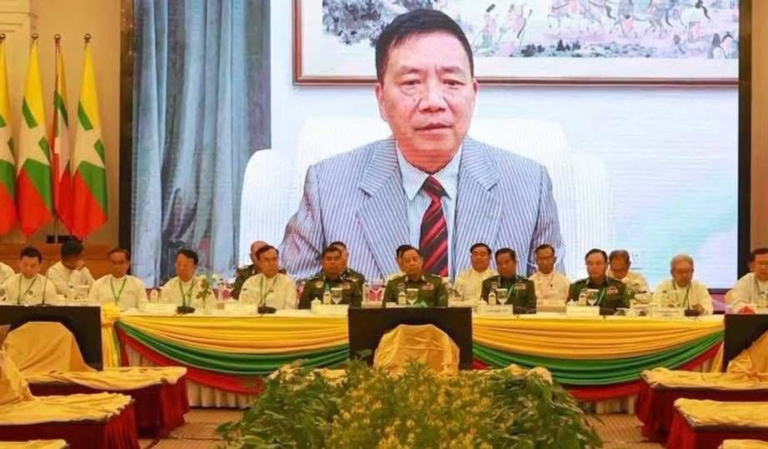
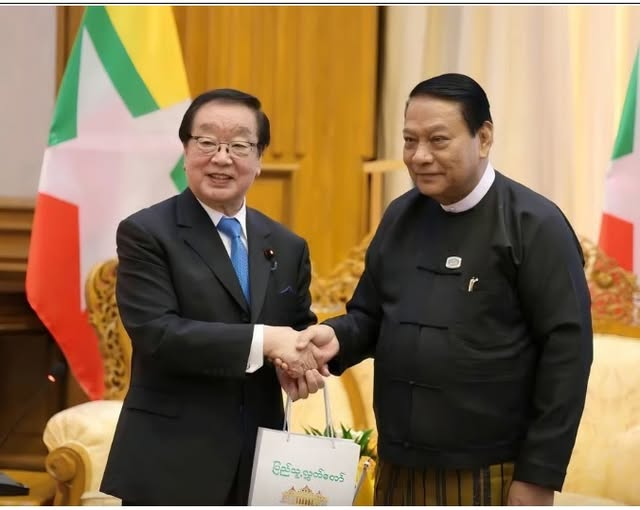
Japanese parliamentarian Hiromichi Watanabe (left) meets U Khin Yi, speaker of Myanmar’s House of Representatives and the leader of the Union Solidarity and Development Party, in Naypyidaw last month. Photo: Handout
While ASEAN remains the primary vehicle for resolving Myanmar’s crisis, Japan’s decades of quiet diplomacy, mediation experience, development assistance, and relatively high credibility among regional stakeholders may make it a valuable behind-the-scenes partner in any future peace process.
The article is also interesting because it highlights three important realities:
- ASEAN alone has struggled to move the peace process forward.
- China’s influence in Myanmar mediation has grown significantly, especially since Operation 1027.
- Japan is positioning itself as a neutral facilitator rather than a power broker, offering support without seeking to dominate the process.
As ASEAN continues searching for a workable path toward peace in Myanmar, a growing number of analysts believe Japan could play an important supporting role through what has become known as its “silent diplomacy.”
Unlike major powers that often pursue high-profile interventions, Japan has traditionally engaged behind the scenes, emphasizing dialogue, mediation, humanitarian assistance, and long-term relationship building. This approach has deep roots in Southeast Asia, dating back to Japan’s involvement in facilitating peace efforts in Cambodia and later in the Philippines’ Mindanao peace process.
Since Myanmar’s 2021 military takeover, Tokyo has maintained communication channels with multiple stakeholders while avoiding the confrontational posture adopted by some Western countries. Japanese peace advocate Yohei Sasakawa has played a particularly visible role, helping to broker informal ceasefires between the Myanmar military and the Arakan Army (AA) in both 2020 and 2022.
However, the subsequent collapse of those ceasefires has exposed the limitations of mediation efforts in Myanmar’s increasingly complex conflict environment. The military reportedly became more skeptical of ceasefire arrangements after the AA resumed military operations and expanded its territorial control. At the same time, some ethnic armed organizations have grown wary of externally mediated agreements following experiences with other international peace initiatives.
Despite those setbacks, Japan remains one of the few external actors viewed with a relatively high level of trust across Southeast Asia. Unlike China, which has emerged as the most influential foreign mediator in Myanmar but often favors bilateral arrangements, Japan is generally perceived as less coercive and more focused on development, humanitarian assistance, and confidence-building measures.
Analysts argue that this makes Japan a potentially valuable partner for ASEAN’s peace efforts. Rather than leading negotiations, Tokyo could provide technical expertise, mediation support, humanitarian resources, and diplomatic channels while allowing ASEAN to retain ownership of the process.
Japan also possesses considerable soft-power leverage through decades of development assistance and its continued economic presence in Myanmar, where hundreds of Japanese companies still operate. Such influence could complement ASEAN’s ongoing attempts to develop benchmarks and pathways for political dialogue and conflict reduction.
The broader strategic context is equally important. As China’s role in regional conflict mediation continues to expand, ASEAN may see benefits in engaging Japan as a balancing and supportive partner. Tokyo’s experience in conflict resolution, combined with its preference for quiet engagement, could offer ASEAN an additional tool as it seeks to revive a peace process that has thus far produced limited results.
Ultimately, supporters of this approach believe Japan’s greatest strength lies not in taking charge, but in helping ASEAN succeed. In a conflict as fragmented and distrustful as Myanmar’s, discreet diplomacy and sustained engagement may prove more valuable than highly publicized initiatives.
MMNN Perspective: While no external actor can resolve Myanmar’s crisis on its own, Japan’s reputation for patient, low-profile diplomacy may provide ASEAN with a credible partner at a time when trust among stakeholders remains scarce and the prospects for a comprehensive peace settlement remain uncertain.
MMNN Closing Observation
Myanmar’s conflict has grown too complex for any single actor to resolve. ASEAN continues to insist on regional leadership, China remains a powerful stakeholder, and Western influence has diminished. Against this backdrop, Japan’s low-profile but persistent engagement may provide ASEAN with an additional diplomatic channel. Whether such “silent diplomacy” can translate into meaningful progress, however, will ultimately depend on the willingness of Myanmar’s competing actors to pursue dialogue over continued armed confrontation.