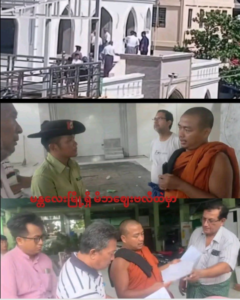
When online hate goes viral, responsible media must show the real Myanmar beyond the noise
We are witnessing a dangerous escalation of inflammatory rhetoric surrounding religion and identity in Myanmar.
As the country remains locked in a devastating political and armed conflict, social-media networks can become fertile ground for rumours, threats, hate speech, fabricated claims and provocative propaganda. Posts designed to provoke anger can travel far faster than careful reporting or fact-checking.
Some online networks and anonymous accounts repeatedly portray Muslims and other minorities as foreigners, migrants or threats to the nation. Such narratives can deepen fear and suspicion and can potentially turn existing tensions into communal hostility.
But there is another danger.
If responsible media simply repeats the loudest and most provocative voices, even in an attempt to report them, journalism can unintentionally help those voices become louder.
The viral Myanmar is not necessarily the real Myanmar.
There is another Myanmar—quieter, less spectacular and therefore less likely to become a social-media sensation.
It is the Myanmar of neighbours helping neighbours, children playing together, families attending one another’s celebrations, patients caring little about the religion or ethnicity of the doctor treating them, and ordinary citizens sharing workplaces, markets, schools and streets.
That Myanmar rarely goes viral.
But it is real.
The Myanmar between the headlines
If we sit long enough at a neighbourhood teashop, walk through a housing quarter during a pagoda festival, a merit-giving ceremony, Eid or Chinese New Year—or observe ordinary life during the Spring Revolution—we can encounter a very different Myanmar.
We see neighbours helping neighbours without first asking for identity cards.
Young people play football across ethnic and religious boundaries.
People buy food from one another, work together, study together, marry into one another’s families and attend one another’s celebrations.
Ordinary people often practise a quiet, everyday pluralism without giving it a grand name.
This is not a perfect Myanmar. There are discrimination, prejudice, violence and genuine grievances that must be reported.
But this everyday coexistence is also part of the country.
It is the middle ground where millions of people actually live.
And it is precisely this middle ground that can disappear from public attention when every argument, insult and provocation is turned into a viral event.
The loudest voice is not necessarily the largest voice
Digital media has changed the economics of attention.
Outrage is immediate. A provocative statement can generate thousands of reactions before the original claim has even been verified.
A rumour can become a screenshot.
A screenshot can become a headline.
A headline can become another post.
And before anyone establishes what actually happened, the original allegation may already have become “truth” in the minds of thousands of people.
This is particularly dangerous when race, religion or ethnicity is involved.
A single individual’s action can quickly be presented as evidence against an entire community.
One criminal becomes “the Muslims”.
One extremist becomes “the Buddhists”.
One political supporter becomes “the ethnic group”.
One inflammatory monk, politician, activist or social-media personality becomes an excuse to condemn millions of ordinary people who had nothing to do with the incident.
That is not scrutiny. It is collective blame.
Responsible journalism must do better.
Freedom of the press—and responsibility
Former UN Secretary-General Kofi Annan repeatedly defended freedom of expression while also stressing the responsibilities that accompany it.
During the 2006 controversy over cartoons depicting the Prophet Muhammad, Annan said that freedom of speech and freedom of the press were not a licence to act without responsibility and judgment.
In a 2005 World Press Freedom Day message, he described journalists as working on the front lines of history and emphasised their responsibility to seek and tell the truth.
The principle is especially relevant today.
Freedom of expression protects the right to speak. It does not remove the responsibility to verify.
A journalist should be able to report a difficult truth without becoming part of the conflict.
Conflict is news.
But conflict should not become the only news.
Report the difficult truth—but do not make it the whole story
A responsible newsroom does not need to hide wrongdoing, discrimination, extremism, corruption or violence.
If a government abuses power, report it.
If a religious institution commits wrongdoing, investigate it.
If a political organisation spreads hatred, scrutinise it.
If an individual commits a crime, report the facts.
But distinguish the individual from the community.
Challenge the institution. Establish the facts. Question the conduct. Do not make an entire community answer for it.
The Australian Press Council specifically advises that references to race, ethnicity and nationality should be relevant to the story and in the public interest, and warns against allowing the negative traits of individuals to be represented as applying to entire communities.
This principle is particularly important for Myanmar, where ethnicity and religion have repeatedly been used as political and social dividing lines.
Before putting race or religion into a headline, a newsroom should ask:
Why does it belong there?
Is it relevant?
Is it verified?
Is it necessary for understanding what happened?
Or will it simply make the story more provocative?
Fairness does not mean false equivalence
Responsible journalism also does not mean mechanically giving every claim equal weight.
If one allegation is unsupported while credible evidence points elsewhere, simply presenting both claims as equally established does not necessarily make a report more balanced.
Ofcom’s broadcasting standards similarly explain that “due impartiality” does not require every argument or every side to receive exactly equal treatment. Appropriate weight depends on the subject, evidence, context and significance.
This is an important distinction for Myanmar.
Fairness is not false equivalence.
Fact-checking is not bias.
Correcting misinformation is not censorship.
And refusing to amplify an unverified accusation is not the same as suppressing legitimate criticism.
Social media has changed the information battlefield
The 2026 Reuters Institute Digital News Report illustrates how dramatically the information environment has changed.
Globally, 27% of respondents said they had received news from news-focused creators or influencers, while overall trust in news fell to 37%, the lowest level recorded by the report since its measurement began in 2015. The report also found growing concern about misinformation and increasing reliance on social and video platforms for news.
This matters enormously for Myanmar.
A professional newsroom may spend hours checking a story.
An anonymous account can create a rumour in seconds.
A journalist may carefully qualify an allegation.
A social-media troll may remove every qualification and replace it with a simple accusation.
The rumour may receive more attention than the correction.
That is why credibility becomes more valuable, not less, in the age of viral information.
The new challenge: AI, fabricated material and instant misinformation
The problem is becoming even more complicated.
Artificial intelligence can now produce increasingly convincing photographs, audio and video. It can also generate large quantities of text, including material designed to look like news reporting.
The Society of Professional Journalists is currently considering revisions to its Code of Ethics, with proposed changes addressing verification, artificial intelligence, misinformation and disinformation, source transparency and responsibility for work produced with technological tools. The proposal is still under review and is not yet the final Code.
For Myanmar media, this should be taken seriously.
A photograph is no longer automatically proof.
A video is no longer automatically proof.
A screenshot is no longer automatically proof.
A viral post is certainly not automatically proof.
Verification must come before amplification.
Multiracial and multicultural newsrooms can do better
There is another practical lesson.
A newsroom serving a multiracial and multicultural society benefits from having people who understand different languages, histories, religions and cultural sensitivities.
One journalist may notice something another has missed.
A colleague may recognise that a translation has subtly changed the meaning.
Another may ask whether a headline could make an individual’s conduct appear to represent an entire community.
Someone else may know that an apparently new allegation is actually an old rumour circulating under a new photograph.
That is diversity doing editorial work.
It is not merely about having different people sitting in the same office.
It is about creating an environment where people can challenge one another before publication—without hostility and without turning disagreement into division.
For Myanmar, independent and free media outside the control of any military authority have an especially important responsibility to practise this kind of journalism.
There are two Myanmars on our screens
One Myanmar shouts.
Another Myanmar helps.
One Myanmar insults.
Another Myanmar quietly lives together.
One Myanmar trends.
The other usually does not.
One Myanmar produces angry comments, shares and clicks.
The other produces something less spectacular:
trust.
We should not romanticise ordinary life or pretend that Myanmar’s serious conflicts do not exist.
They do.
But neither should we allow the most divisive voices to become the default description of the entire country.
The Myanmar of ordinary people is larger than the Myanmar of viral posts.
Responsible media can help reveal—not manufacture—unity
Myanmar does not need journalism to manufacture artificial national harmony.
Nor should journalists conceal injustice in the name of harmony.
What Myanmar needs is journalism that allows people to see the country honestly.
Report the conflict.
Expose wrongdoing.
Investigate hate speech.
Challenge propaganda.
Fact-check viral claims.
Give victims a voice.
Question those in power.
But also report the ordinary cooperation that continues despite everything.
Show the Buddhist neighbour helping a Muslim neighbour.
Show the Muslim family participating peacefully in the wider community.
Show Kachin, Karen, Shan, Chin, Rakhine, Mon, Bamar and other communities working together where that is what actually happens.
Show people of different faiths sharing public life.
These stories are not distractions from the national crisis.
They are evidence about the society that still exists beneath the crisis.
The duty of responsible media
The responsibility of journalism is therefore not simply to ask:
“What will go viral?”
It should also ask:
“What is true?”
“What is relevant?”
“What is missing?”
“Who may be harmed by careless generalisation?”
And perhaps most importantly:
“Are we reporting the conflict—or helping the conflict spread?”
The answer should determine how we report.
The world does not need Myanmar’s journalists to make the country look better than it is.
It needs them to make the country visible in its entirety.
That means reporting the argument without becoming part of the argument.
Scrutiny without stereotyping.
Fairness without false equivalence.
Freedom without irresponsibility.
Verification before virality.
And compassion without abandoning truth.
Above all, it means remembering that Myanmar exists beyond its loudest headlines.
The Myanmar our headlines rarely show may be the Myanmar we most need to see.
MMNN — Myanmar Muslim News Network
Edited with AI assistance for clarity, verification and responsible journalism.