The advocacy for refugees by Tuanku Muhriz ibni Almarhum Tuanku Munawir, the Yang di-Pertuan Besar of Negeri Sembilan, and his second son, Tunku Zain Al-’Abidin, represents a compassionate and system-level push for human rights in Malaysia. Their efforts focus heavily on policy reform, public education, and socioeconomic integration.
The Father: Tuanku Muhriz’s Royal Appeal for Policy Reform
At the Human Rights Day Forum, Tuanku Muhriz used his platform to directly call out the systemic barriers facing marginalized children.
- Breaking the Generational Cycle: His Royal Highness emphasized that denying formal education to refugee or stateless children creates a “generational cycle of poverty and destitution” that ultimately burdens society.
- Fostering Independence: He argued that giving these children access to structured, formal education allows them to eventually fend for themselves and contribute to the host nation, breaking free from a reliance on government or external assistance.
- Systemic Changes Over Temporary Gaps: While praising Civil Society Organizations (CSOs) and Non-Governmental Organizations (NGOs) for stepping up to fill the educational vacuum, Tuanku Muhriz explicitly called on federal authorities to review state policies and build holistic, long-term partnerships with these groups to ensure “No One is Left Behind”.
The Son: Tunku Zain Al-’Abidin’s Institutional Advocacy
His son, Tunku Zain Al-’Abidin, tackles the issue through public policy, academic platforms, and non-profit involvement.
- The IDEAS Platform: As the founding president of the Institute for Democracy and Economic Affairs (IDEAS), Tunku Zain helps steer research that regularly addresses the geopolitical and socio-economic realities of refugees and statelessness in Southeast Asia. Under his guidance, platforms like the annual Liberalism Conference frequently feature deep-dive policy breakouts defending human dignity and freedom of movement, regardless of a person’s citizenship status.
- Direct Grassroots Work: Beyond writing columns and driving institutional policy, Tunku Zain is deeply involved in grassroots alternative education. As a trustee for organisations like Yayasan Chow Kit—which operates homeschooling and literacy programs for vulnerable children, including a significant population of Rohingya youth—he actively works to secure basic literacy and mathematical training where formal schooling fails.
- Spreading Global Solidarity: Tunku Zain regularly collaborates with international entities like the UNHCR Malaysia to champion public empathy. His public messaging reminds host communities that “no one chooses to become a refugee,” urging compassionate responsibility over fear-mongering.
Together, the royal father-and-son duo leverages their unique status to transform the conversation around refugees in Malaysia from one of “security anxiety” to an urgent matter of economic foresight and human dignity.
READ MORE AND REFERENCES:
1/ Tuanku Muhriz: Review policy that denies refugee children education
By Bernama
December 12, 2022
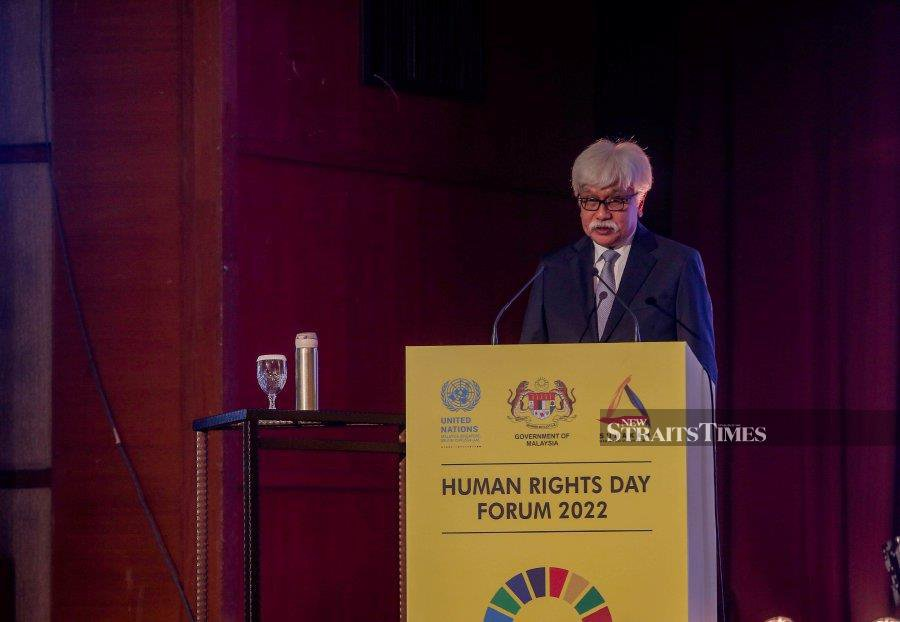
Yang di-Pertuan Besar Negri Sembilan Tuanku Muhriz Tuanku Munawir has urged the government to review policies that deny refugee or stateless children access to formal education. – NSTP/HAZREEN MOHAMAD
Get breaking news fast — follow us on WhatsApp and Telegram.
KUALA LUMPUR: Yang di-Pertuan Besar Negri Sembilan Tuanku Muhriz Tuanku Munawir has urged the government to review policies that deny refugee or stateless children access to formal education.
In a royal address at a Human Rights Day forum here today, he called for the review of policies to break the cycle of generational poverty among refugees and stateless people, saying the review will be a significant step to benefit the country.
“Government policy has denied children who are refugees or stateless access to formal education. This policy results in a generational cycle of poverty and destitution which imposes a burden on society.
“If these children are given access to education, they can eventually be able to fend for themselves and be independent of governmental assistance.”
Tuanku Muhriz said some civil society and non-governmental organisations have taken up the call to help these groups and within their means have managed to create some success stories.
He said one example is Yayasan Chow Kit, a non-profit organisation that operates a 24-hour crisis and drop-in centre providing meals, therapy, case management and educational programmes for at-risk children who live around Chow Kit in Kuala Lumpur.
“To date, the yayasan has (helped) over 100 successful youths who are able to pursue tertiary education or become owners of business enterprises. This success is due to some relaxation of the government policy.”
He said since 2017, the Education Ministry has registered 15 refugee learning centres as private education institutions.
“But much more needs to be done, as according to the UNHCR (United Nations High Commission for Refugees), there are some 40,000 refugee and asylum seeker children registered in Malaysia.”
On poverty, particularly the hardcore poor and the homeless, Tuanku Muhriz said the government has taken many initiatives on this, but more needs to be done.
He said many civil society organisations have stepped up to provide care for them, but holistic and long-term solutions are needed, and he hoped government agencies will work together with these organisations to address poverty and homelessness.
He called on the government to work more closely with civil society and non-governmental organisations to review policies.
“With these steps, the country can get closer to ensuring that no one is left behind.”
The Human Rights Day theme this year is “Strengthening and Enhancing Human Rights Towards Leaving No One Behind”.
On health, Tuanku Muhriz thanked frontliners for putting themselves at risk in the discharge of their duties.
“I urge the relevant authorities to constantly review the accessibility by marginalised groups to healthcare facilities.”
He said over the years, the government has done a lot to help marginalised people, while civil society and non-governmental organisations have carried out their own initiatives to fill in the gaps.
Public service
Tunku Zain began his career in public service holding positions at the Houses of Parliament and various think tanks in London before relocating to Washington, D.C., to work as a public sector consultant for the World Bank.[5] In 2006, while still in London, he co-founded the Malaysian Think Tank with his friends Wan Saiful Wan Jan and Wan Mohd Firdaus Wan Mohd Fuaad. The organisation was created to promote classical liberal ideas in Malaysia and eventually evolved into the IDEAS after being relocated to Kuala Lumpur in 2009.[2]
Following his return to Malaysia in 2008, Tunku Zain was employed by the United Nations Development Programme in Kuala Lumpur.[5] That same year, he also began writing opinion columns that have appeared in five national newspapers. His current column, #abidinideas, is featured in The Star, Sin Chew, and Borneo Post. His essays have been compiled into three books, one of which was nominated for a Popular Readers’ Choice Award. He also authored a commemorative coffee table book for the installation of the 11th Yang di-Pertuan Besar of Negeri Sembilan.[1]
In 2009, the organisation was renamed IDEAS and relocated to Malaysia, where it received a positive response for its inaugural event on press freedom, which helped spark wider public interest in policy debates. As the organisation grew, it expanded its initiatives guided by the Merdeka values and the principles of Malaysia’s first prime minister, Tunku Abdul Rahman. Under Tunku Zain’s leadership, IDEAS has contributed significantly to parliamentary development and education reform.[2] Alongside his work with IDEAS, Tunku Zain has maintained a strong presence in public discourse, consistently writing the column Abiding Times in The Sun since March 2008. He also served as a research fellow at the Lee Kuan Yew School of Public Policy, National University of Singapore, from March 2009 to August 2010.[5]
Tunku Zain played a leading role in the restoration of the state anthem, Berkatlah Yang DiPertuan Besar Negeri Sembilan, which was revamped in October 2010. A passionate music enthusiast, he collaborated with music teacher Chong Yew Boon and composer Johari Salleh to create a more vibrant and standardised version of the anthem. After extensive research and experimentation with various musical interpretations, he developed multiple arrangements suitable for different settings, including orchestral, school choir, and military band performances. His goal was to preserve the anthem’s original melody and lyrics while inspiring greater respect and pride, particularly among the younger generation.[6] Beyond this, he has been a key figure in the development of ICAN College since 2012 and,[5] in May 2017, was appointed the first royal patron of the percussion ensemble Hands Percussion.[7]
Tunku Zain was appointed pro-chancellor of UCSI University in 2021, a role in which he made notable contributions to the development of its Bangladesh branch campus and helped expand the university’s international research collaborations through various overseas initiatives.[8] In April that same year, he and his brother, Tunku Ali Redhauddin, collaborated with The 10 Ringgit Project to support B40 families in Negeri Sembilan, raising funds through Yayasan Munarah to provide essential aid. As chairman of General Assembly Malaysia, Tunku Zain also spearheaded the MySTEP Programme 2021, which aimed to equip unemployed Malaysians with digital skills to enhance their employability during the COVID-19 lockdown.[9] Since 2023, he has served as advisor to the UCSI Group.[8] In early 2025, he was appointed patron of UCSI Hospital, and on 14 May that year, he was officially installed as the university’s second chancellor.[10]
3/ Tuanku Muhriz returns home amid dispute over removal as Negeri Sembilan ruler
Yesterday
Nur Alif HazmiShare
The Yang Dipertuan Besar was greeted by his family and some 200 supporters upon his arrival at KLIA this evening.

The Yang Dipertuan Besar of Negeri Sembilan, Tuanku Muhriz Tuanku Munawir told reporters he was going ‘to the palace’ after returning to the country this evening.SEPANG:
Tuanku Muhriz Tuanku Munawir returned to Malaysia tonight amid a dispute over the validity of his removal as the Negeri Sembilan ruler.
Tuanku Muhriz was greeted by about 200 supporters when he walked out of KLIA’s VIP lounge after flying in from Dubai around 10.40pm. They were heard shouting “daulat Tuanku” and “tangkap penderhaka” (arrest the traitors).
Also on hand to welcome Tuanku Muhriz was the Tunku Ampuan Besar of Negri Sembilan, Tuanku Aishah Rohani Tengku Besar Mahmud, and their son, Tunku Besar Seri Menanti, Tunku Ali Redhauddin Tuanku Muhriz, who had arrived at the airport much earlier and greeted supporters.
Asked where he was headed next, Tuanku Muhriz said: “To the palace. Where else?”
Asked if he had returned to the country to resolve the dispute, he said: “Yes, insya-Allah, insya-Allah. Thank you all.”
The Negeri Sembilan executive council (exco), in a statement yesterday, said Tuanku Muhriz’s removal in April was legitimate and that Tuanku Nadzaruddin Tuanku Ja’afar was the new ruler of Negeri Sembilan.
Earlier today, menteri besar Ismail Lasim endorsed the statement, adding that the decision had been made unanimously when the exco convened on Tuesday.
He also said the state secretary had been asked to proceed with gazetting the proclamation on Tuanku Muhriz’s removal “according to the relevant regulations”.
However, the Negeri Sembilan Dewan Keadilan dan Undang (DKU) separately said the exco’s decision had no legal effect, that Tuanku Muhriz remains the Yang Dipertuan Besar, and that it holds the ultimate authority to decide on the appointment or removal of the state ruler.
This evening, the Attorney-General’s Chambers agreed with the DKU on the matter, adding that exco members had no jurisdiction, authority or power under the Negeri Sembilan constitution to make such an announcement.
The AGC added that neither the menteri besar nor the state exco members had the power to unilaterally vacate the ruler’s position.