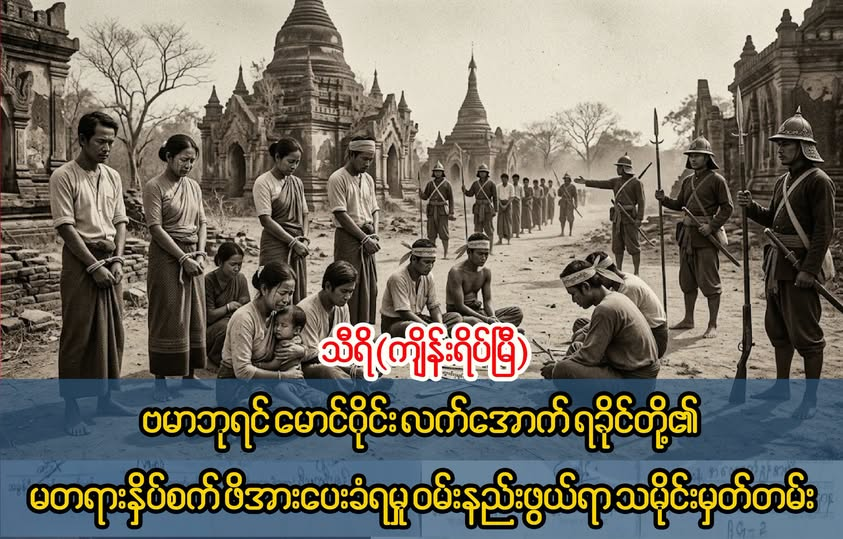
U Aung Tin’s Preface: The Rakhine people were also enslaved. In 1784, after all sovereignty of the Rakhine was seized by the Bamar King Maung Waing (King Bodawpaya), the entire Rakhine population was branded as “slaves.”
Thiri (Kyain Yeik Myae): In the era of kings, if you win, you become the master; if you lose, you become the slave. When you win, you take others’ wives and children. When you lose, your own wife and children are taken. These are the worldly vicissitudes—one day a royal pinnacle, the next day firewood. We must study past events to take lessons so we do not repeat mistakes in the future. It is not for the purpose of hating.
Arakan Post A Sorrowful Historical Record of the Rakhine People’s Oppression and Coercion under the Bamar King Maung Waing (King Bodawpaya)
Thiri (Kyain Yeik Myae) In 1784, after the Bamar King Maung Waing (King Bodawpaya) seized all sovereignty of the Rakhine, the entire Rakhine population was branded as “slaves.” The entirety of Arakan was governed according to the Bamar King’s will. From that time onward, Bamar language, Bamar culture, and Bamar customs—including forced intermarriages—became widespread everywhere.
The Rakhine and Bamar had maintained equal royal status and power parity in military and political terms for a very long time. Because King Bodawpaya deeply feared that the Rakhine might regain strength and rebel one day, he ruthlessly eradicated anyone he perceived as a potential threat or thorn in his side.
Arakan was endowed with eight royal attributes (Anga). Believing that they might mount a counter-offensive in the future, King Bodawpaya acted to destroy and erase the royal palace, royal umbrella, clock tower, royal drum, city gate pillars, breastworks, the seven city attributes, and the Nine Gems (Navaratna) to prevent any possibility of resistance. In 1788, these attributes completely vanished from Mrauk-U.
Following that, the remaining royal descendants in Arakan, senior monks observing Vinaya, court priests (Purohita Brahmins), universal monarch (Cakkavatti) Brahmins, astrologers, traditional physicians, royal bodyguards, and monks were forcibly deported to Amarapura.
Furthermore, villagers who remained in every settlement were forced to wear palm/palmyra leaves on their heads inscribed with the words “Slave of the Sun-Rising King” in order to systematically crush the morale of the Rakhine people. Rakhine people in areas surrounding Mrauk-U, including children, were slaughtered.
Thirty major monasteries, 3,700 minor monasteries in the capital city of Mrauk-U, as well as all ordination halls (Sima), monasteries, and pagodas across the country vanished.
Approximately 200,000 Rakhine civilians—men, women, and children—were killed. The king, royal queens, princes, princesses, commanders, generals, large and small cannons, various scholars and artisans, horses, elephants, and over 30,000 prisoners of war were taken away as forced laborers.
Some died along the journey due to killings by Bamar troops, while others were killed by tiger attacks.
This is not written to incite ethnic hatred. History written solely by victors or the powerful is meaningless. Under Bamar rule, the Rakhine people suffered injustice, inequality, and a lack of progress for Arakan. History was a real event.
Remarks & Historical Context
- Historical Event (1784–1785): The Burmese conquest of Arakan (Mrauk-U Kingdom) was led by Crown Prince Thado Minsaw under the orders of King Bodawpaya (Badon Min, r. 1782–1819) of the Konbaung Dynasty.
- The Mahamuni Buddha Image: A central outcome of this conquest—though omitted in this specific excerpt—was the removal of the sacred Mahamuni Buddha statue from Mrauk-U to Amarapura, where it remains today in Mandalay.
- Casualty & Exile Figures: While traditional local chronicles (Yazawin) and modern nationalist accounts often cite figures like 200,000 deaths and tens of thousands deported as forced labor, contemporary historian estimates regarding casualties vary depending on historical sources. However, mass deportations of artisans, royal court members, and monks to central Myanmar are well-documented facts of Konbaung imperial expansion.
- Refugee Crisis & Subsequent Conflict: The harsh Konbaung administration led to large-scale migrations of Rakhine refugees into British-administered Bengal (Chittagong region), sparking border tensions between Konbaung Burma and the British East India Company, which eventually contributed to the First Anglo-Burmese War (1824–1826).
References
- Harvey, G. E. (1925). History of Burma: From the Earliest Times to 10 March 1824 The Beginning of the English Conquest. London: Longmans, Green and Co.
- Charney, Michael W. (2009). A History of Modern Burma. Cambridge University Press.
- Leider, Jacques P. (2004). Le Royaume d’Arakan, Birmanie: Son histoire politique entre le XVe et le XVIIe siècle. EFEO.
- Myint-U, Thant (2001). The Making of Modern Burma. Cambridge University Press.