Kachin and Other Christian Refugees in Malaysia Should Appeal to the Philippines and UNHCR for University Scholarships
If the Philippines Can Open University Pathways for Rohingya Refugees, Could Similar Opportunities Be Extended to Kachin and Other Christian Refugees in Malaysia?

A Possible New Pathway for Myanmar Refugee Youth
Thousands of young people from Myanmar have been displaced by decades of armed conflict, political persecution and instability. Many are now living in neighbouring countries, including Malaysia, where refugee and asylum-seeking families struggle to provide their children with opportunities for higher education.

Among them are Kachin and other Christian refugees and displaced young people who may have completed secondary education but are unable to continue to university because of financial, legal and immigration barriers.
Could the Philippines offer them another possible pathway?
The answer may be worth exploring.
The Philippines Has Already Created a Model
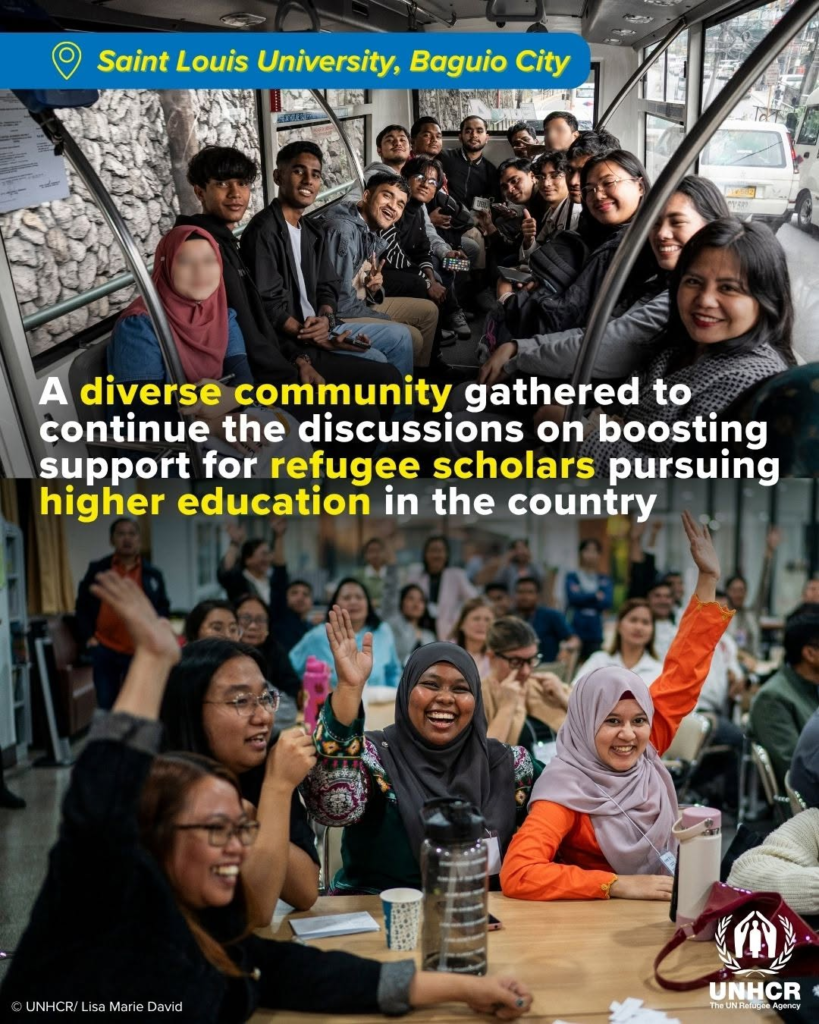
The Philippines has established an innovative Complementary Pathways (CPath) programme in cooperation with the United Nations High Commissioner for Refugees (UNHCR) and the Philippine Department of Justice.
The programme provides selected refugees with a safe and regulated pathway to enter the Philippines through education. It is designed not merely as a scholarship programme, but as a broader humanitarian pathway providing protection, legal status and access to higher education while helping refugees develop skills and become self-reliant.
The first Rohingya students arrived in 2022. Philippine universities subsequently joined the programme and offered scholarships.
One particularly encouraging example is San Beda University, which committed to accommodate two Rohingya refugee scholars through the scholarship programme of the San Beda University Alumni Foundation.
Other Philippine universities have also joined the programme, including Columban College, De La Salle Araneta University, St. Louis University, Tarlac State University and the University of St. La Salle.
By January 2026, the Philippines had opened its doors to 25 Rohingya refugees, who were studying various university courses through seven partner institutions.
This is therefore not simply an isolated scholarship for two individuals. It has developed into a recognised complementary pathway involving the Philippine Government, UNHCR, universities, civil society and other partners.
Could the Same Humanitarian Principle Help Other Myanmar Refugees?
This raises a reasonable question.
If the Philippines has demonstrated that refugee youth can be admitted to Philippine universities through a structured partnership involving government, UNHCR and educational institutions, could a similar pathway be explored for Kachin and other Christian refugee youth currently living in Malaysia?
This should not be presented as a demand that the Philippines must accept every refugee.
Rather, MMNN proposes that the relevant authorities and organisations explore the possibility of extending complementary education pathways to other vulnerable Myanmar refugee communities on a selective, transparent and needs-based basis.

Potential beneficiaries could include qualified young refugees who:
- have completed secondary education;
- have the academic ability to pursue university studies;
- cannot realistically access higher education in their present circumstances;
- are recognised or documented by UNHCR or the relevant authorities;
- have no safe and practical opportunity to continue their education in Myanmar; and
- are willing to comply with Philippine immigration and educational requirements.
Why Malaysia Could Be a Starting Point
Malaysia hosts a large refugee population from Myanmar, including communities that have been displaced by different conflicts.
Some refugee families have lived in Malaysia for many years. Their children have grown up here, learned languages, completed whatever education was available to them and developed aspirations for professional careers.
Yet for many, university remains extremely difficult to access.
A scholarship pathway to a third country could therefore transform a young refugee from a dependent recipient of humanitarian assistance into a future professional capable of contributing to his or her own community.
A young refugee who becomes a doctor, engineer, teacher, lawyer, scientist, entrepreneur or other professional can eventually become an asset—not only to the refugee community, but potentially to Myanmar and the wider region.

Education Can Be More Than Charity
The Philippine CPath model is particularly interesting because it recognises that education can serve several purposes simultaneously.
It can provide:
Protection — by giving vulnerable young people a safe and regulated pathway.
Education — by allowing them to obtain recognised university qualifications.
Self-reliance — by giving refugees skills with which they can eventually support themselves.
Human-resource development — by preventing an entire generation of talented young people from being lost because of displacement.
Durable solutions — because education can create a bridge toward a more sustainable future.
UNHCR itself describes complementary pathways as a means of expanding opportunities for refugees beyond traditional humanitarian assistance.
A Proposal for UNHCR, the Philippines and Malaysian Stakeholders
MMNN therefore respectfully proposes that:
1. UNHCR Malaysia and UNHCR Philippines explore whether the Philippine CPath experience could be expanded to selected Myanmar refugee youth in Malaysia.
2. The Philippine Government consider whether qualified Kachin and other Christian refugee students could participate in future education-based complementary pathways.
3. Philippine universities that already participate in the CPath programme could consider reserving a small number of scholarship places for other exceptionally vulnerable Myanmar refugee youth.
4. Malaysian refugee communities should identify academically qualified candidates and prepare proper educational records, references and applications rather than simply requesting assistance without documentation.
5. Donors, churches, foundations and civil-society organisations could help finance tuition, accommodation, travel, living expenses and other costs.
6. The programme should remain transparent and needs-based. Selection should depend on vulnerability, academic merit, financial circumstances and the ability of the student to benefit from higher education—not on political affiliation, ethnicity or religious preference.
A Model of Solidarity, Not Competition
This proposal should never be interpreted as competition between Rohingya, Kachin, Chin, Karen, Shan, Rakhine, Bamar or any other displaced communities.
The suffering of one community does not diminish the suffering of another.
The generosity shown to Rohingya refugees by Philippine universities can instead become a model that inspires more opportunities for other displaced people from Myanmar.
The objective should be to create more doors—not to close existing ones.
The Philippines Has Already Shown That It Can Be Done
The most important lesson from the Philippine experience is perhaps this:
A refugee does not necessarily have to remain permanently dependent on humanitarian aid.
With education, protection and opportunity, a refugee can become a professional, an entrepreneur, a teacher, a scientist or a community leader.
The Philippines has already demonstrated that government, UNHCR, universities and civil society can work together to create such a pathway.
Why should this experience not be explored for other deserving young refugees from Myanmar?
An Appeal
MMNN therefore respectfully appeals to:
The Government of the Philippines, UNHCR, Philippine universities, Malaysian authorities, refugee organisations, churches, humanitarian organisations and philanthropic foundations:
Please consider whether the successful Philippine Complementary Pathways model for Rohingya refugees could be carefully expanded to include qualified Kachin and other Christian refugee youth from Myanmar currently living in Malaysia.
Perhaps only a handful of students could be selected initially.
But even five, ten or twenty university scholarships could change the lives of those students—and eventually the lives of hundreds or thousands of people whom they may serve.
Education does not merely rescue an individual from poverty and displacement. It can rescue an entire generation from becoming a lost generation.
And perhaps, one day, these educated young Myanmar refugees may return—not as refugees seeking help, but as doctors, engineers, teachers, entrepreneurs and professionals helping to rebuild a peaceful Myanmar.
From refugee to scholar.
From scholar to professional.
From professional to nation-builder.
That is the kind of humanitarian investment that can create a future beyond displacement.
Read also:
The Philippine government, in partnership with the UNHCR Philippines and academic institutions, runs the Complementary Pathways (CPath) program. Under successive rollouts of this initiative, batches of Rohingya refugee students—including a major group arriving in mid-2025—have received higher education scholarships to study at participating Philippine universities. [1]
Program Details
- Framework: Complementary Pathways (CPath) [1]
- Partners: Philippine Government (Department of Justice, Department of Foreign Affairs), UNHCR, and private/academic donors. [1, 2, 3]
- Partner Universities: Institutions like De La Salle University – Dasmariñas, San Beda University, University of St. La Salle, and Columban College. [1, 2]
- Goal: Provide safe legal entry, tertiary education, and long-term self-reliance for displaced Rohingya youth from countries like Malaysia and refugee camps in Bangladesh. [1]
1/ Creating Pathways of Hope for Rohingya Refugees BY KOON PENG OOI, PROJECTS MANAGER AND IRIS TAYAG, UNHCR

 Together we are proving that education opens doors for all!

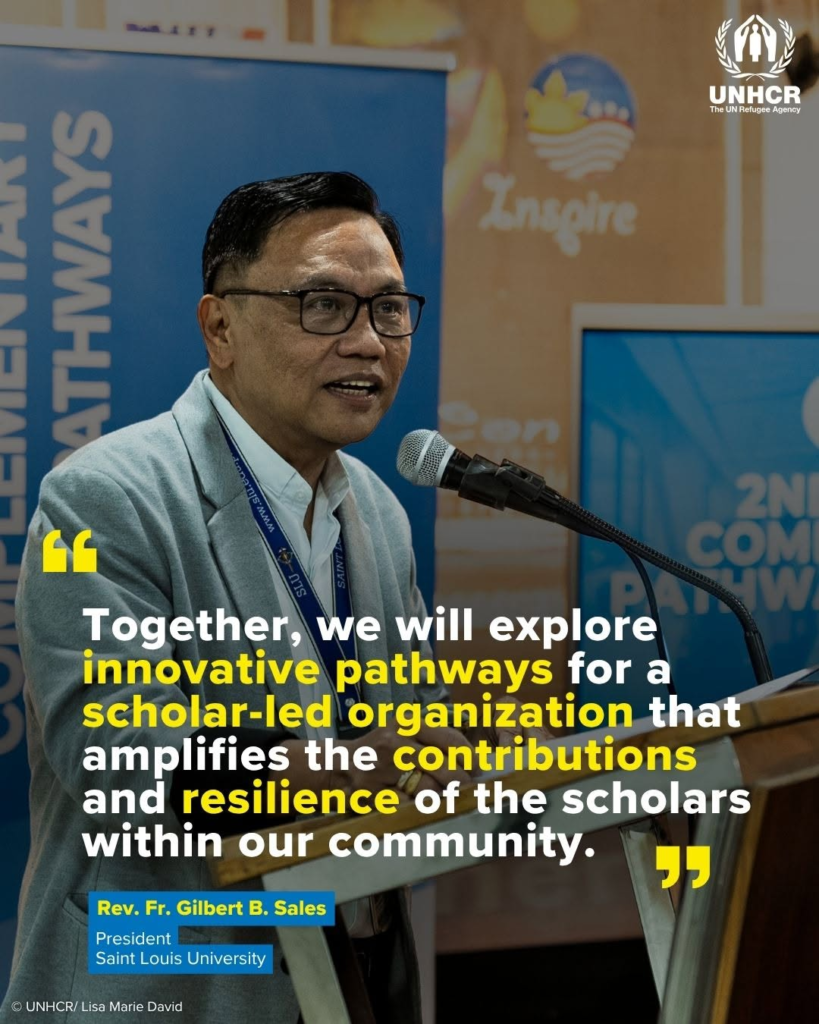
The strong collaboration of partners for the Philippines’ Complementary Pathways (CPath) programme continues with the 2nd annual gathering hosted by Saint Louis University.
This annual get-together unites scholars, schools, government partners, and other stakeholders in the collective goal of empowering young Rohingya refugees through education. 
With 15 scholars studying in 6 partner schools, the journey to a brighter future is well underway!