Based on an original analysis by Ko Ko Gyi — translated, edited, and updated to June 2026
I. The Lone Ruler Behind the Curtain
Senior General Than Shwe ruled Myanmar’s armed forces and the nation singlehandedly for nearly two decades — from 23 April 1992 to 30 March 2011. For nineteen years, he was the unchallenged master of the Tatmadaw and the state, a figure whose patience, cunning, and ruthlessness exceeded anything his predecessors had managed.
He rose not through battlefield glory but through the military’s psychological warfare and propaganda apparatus. When the ailing General Saw Maung stepped aside in April 1992, Than Shwe assumed control of the State Law and Order Restoration Council (SLORC) — having, in effect, engineered the palace coup that removed his own superior. He had done the same to Ne Win before that. He understood, from personal experience, exactly what ambitious subordinates were capable of.
That awareness shaped everything that followed.
II. Neutralising the Number Two
The first order of business for any strongman is his deputy. General Maung Aye was Than Shwe’s number two, and a potentially formidable rival. Rather than confront him directly, Than Shwe chose a subtler approach: he promoted and elevated a series of lower-ranking generals — call them 2A, 2B, 2C, 2D, 2E — granting each of them near-equal rank and authority, and positioning them to counterbalance one another. No single officer could accumulate enough institutional weight to stage a coup. Collective loyalty replaced individual dependence.
The most dangerous figure among Than Shwe’s subordinates was not Maung Aye, however. It was General Khin Nyunt — the head of military intelligence, Prime Minister, and Secretary-1 of the ruling State Peace and Development Council (SPDC, formerly SLORC). Khin Nyunt was brilliant, well-connected internationally, and possessed of a power base in military intelligence that operated almost as a state within a state. In October 2004, Than Shwe moved against him: Khin Nyunt was dismissed, placed under house arrest, and eventually given a suspended sentence. His entire military intelligence apparatus was dissolved.
When the 2007 Saffron Revolution brought mass international pressure down on Myanmar’s junta, Than Shwe recognised that his continued visibility as supreme leader had become a liability. He made a decisive calculation: to disappear from the spotlight while retaining the real strings of power — to become, in effect, an invisible puppet master operating from behind the curtain. But first, he had to learn from the fates of those he had himself destroyed.
III. Avoiding the Fate of Ne Win and Saw Maung
Than Shwe was acutely aware of what happened to Myanmar’s military leaders when they outlived their usefulness. He himself had betrayed both Ne Win and Saw Maung through palace coups, and then kept both men under house arrest until they died. He had no intention of suffering the same fate.
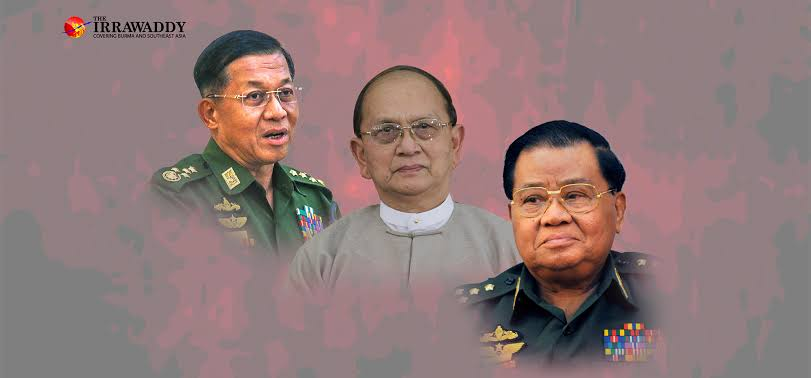
His exit strategy was therefore planned with characteristic care. He did not simply retire — he engineered a collective departure. He ensured that his number two, General Maung Aye, resigned alongside him, eliminating any residual challenger from within the existing command structure. He then distributed power across a carefully selected group of figures who were each given near-equal standing: President U Thein Sein, Parliament Speaker U Shwe Mann, Commander-in-Chief Senior General Min Aung Hlaing, USDP Chairman U Htay Oo, and ministers U Aung Thaung and U Aung Min. The design was explicit: no single figure would be powerful enough to move against the others — or against Than Shwe himself.
The result was a managed transition — the 2008 Constitution, the 2010 election, the nominally civilian government from 2011 — in which Than Shwe remained the unseen force. He had written the rules of the game, and he was not leaving the board.
IV. The Good Cop / Bad Cop Game — and When It Failed
For a time, the strategy worked brilliantly. Than Shwe’s arrangement produced what political analysts recognise as the classic “good cop / bad cop” or “soft gang / hard gang” performance: reformists like Thein Sein and Aung Min handled international engagement and democratic optics, while hardliners managed internal repression. Myanmar’s image on the world stage softened considerably between 2011 and 2015. Western governments eased sanctions. Investment flowed. Aung San Suu Kyi was released and participated in the April 2012 by-elections.
Then came the problem. The NLD won those by-elections in a landslide — 43 of 44 contested seats. It became apparent that if the 2015 General Election proceeded at the current pace of reform, the USDP would be routed and the NLD would form the government. Than Shwe’s carefully constructed political architecture — designed to keep real power within a military-aligned orbit — was at risk of being bypassed entirely through the ballot box.
V. The Manufactured Crisis: 969, Ma Ba Tha, and the Anti-Muslim Riots
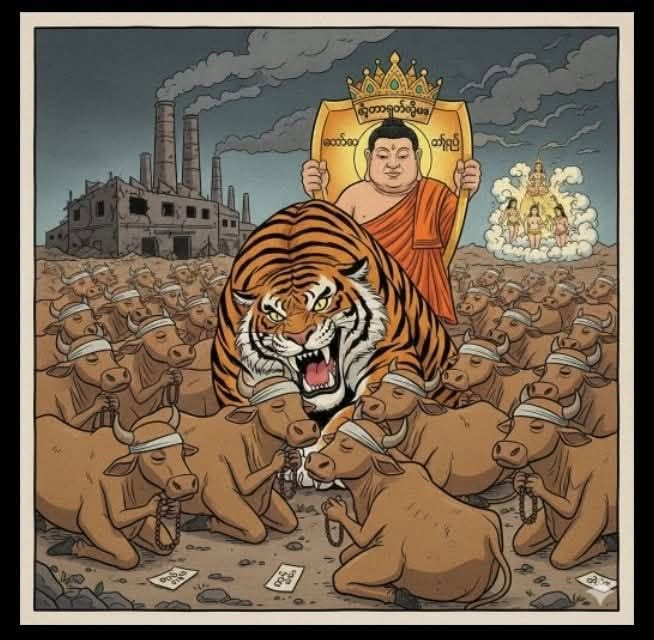
Faced with this threat, Than Shwe activated his right-hand man, U Aung Thaung, and the network of organised thugs known as the Swan Arr Shin (“Masters of Force”). The plan was to manufacture social chaos sufficient to destabilise the reform process and discredit the NLD’s political momentum.
The instrument chosen was anti-Muslim violence. Using a combination of Swan Arr Shin operatives and monks who had been cultivated by military intelligence — what Ko Ko Gyi’s original analysis calls “ex-MI monks” — the 969 Buddhist nationalist movement was created and spread across the country. It subsequently evolved into Ma Ba Tha (the Association for the Protection of Race and Religion), which became the organisational vehicle for sustained anti-Muslim agitation.
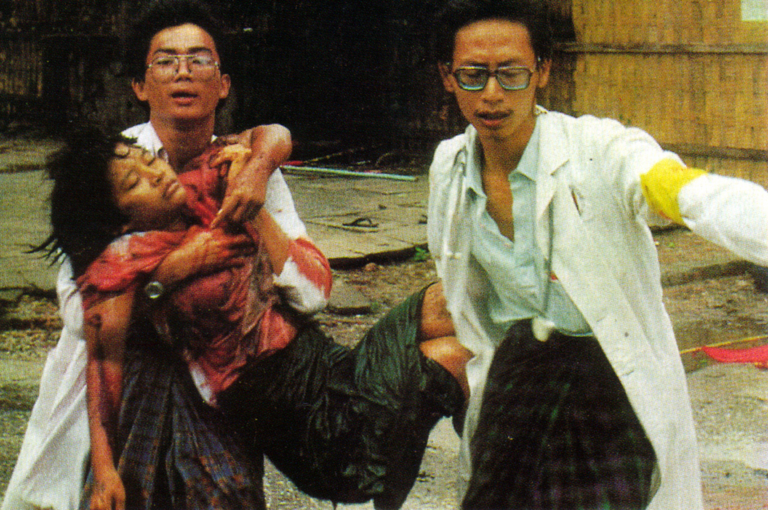
The results were devastating. The Taunggoke massacre, the Meiktila massacre of March 2013, and waves of anti-Muslim violence across multiple townships followed. The Rohingya of northern Rakhine State bore the worst of it — subjected to mass displacement, destruction of villages, and what the UN and international courts have since characterised as crimes against humanity and acts of genocide.
Ko Ko Gyi’s analysis is explicit: this was not spontaneous communal violence. It was a manufactured crisis, planned at the top of the military hierarchy, designed to destabilise the political environment and prevent a genuine democratic transition from taking hold.
The broader anti-Muslim campaign was stalled in Mandalay, where the awareness and solidarity of Buddhist monks, civil society, and citizens of both faiths prevented the violence from fully taking root — a rare example of grassroots resistance checking the military’s provocateurs.
VI. The Protégé Who Copied the Playbook
Min Aung Hlaing was appointed Commander-in-Chief of Defence Services in 2011 — one of Than Shwe’s carefully calibrated appointments. He was selected in part precisely because he was not a combat general with an independent power base, but an officer with administrative and political experience who could be managed.
He proved harder to manage than expected.
On 1 February 2021, just as Myanmar’s democratically elected parliament was scheduled to convene following the NLD’s second landslide victory, Min Aung Hlaing launched a coup, arresting State Counsellor Aung San Suu Kyi, President Win Myint, and dozens of elected officials. He appointed himself Chairman of the newly formed State Administration Council (SAC) and, within months, Prime Minister as well.
In the years that followed, he reproduced Than Shwe’s toolkit with striking fidelity:
- He imprisoned potentially rival officers — Lieutenant General Moe Myint Tun, whose influence had grown after the coup, and Lieutenant General Soe Htut — just as Than Shwe had imprisoned Khin Nyunt.¹
- In February 2025, he initiated a sweeping military and cabinet reshuffle designed to position a chosen successor: Lieutenant General Kyaw Swar Lin, sixteen military intakes his junior, was promoted to Chief of the General Staff. Senior officers who might challenge the preferred succession were moved into administrative posts with no real military authority — precisely Than Shwe’s method for neutralising powerful regional commanders.²
- He escalated his accumulation of titles. By July 2024, with nominal Acting President Myint Swe incapacitated by a neurological disorder, Min Aung Hlaing had presidential authority transferred to himself, assuming the title Pro Tem President. The shadow National Unity Government’s spokesman responded sharply: “He is behaving like a monarch, treating the country as if it were his family’s sole business enterprise.”³ When Myint Swe died on 7 August 2025, Min Aung Hlaing became Acting President.
- By April 2026, the process reached its logical conclusion. Through a widely disputed election using the military-backed USDP, Min Aung Hlaing was elected President of Myanmar by a junta-installed parliament on 3 April 2026 and sworn in on 10 April — stepping down as Commander-in-Chief and appointing loyalist General Ye Win Oo in his place.⁴ His cabinet of 30 ministers, approved on 9 April, was dominated by retired military officers and holdovers from the previous administration.⁵ The United Nations and most Western governments dismissed the election as a sham.
VII. Turning on the Old Master — and the Rumours About Than Shwe
Here the story takes an unexpected turn.
In October 2024, Min Aung Hlaing’s government arrested Dr. Nay Soe Maung — Than Shwe’s own son-in-law, married to his daughter Kyi Kyi Shwe — in Pyigyidagun Township, Mandalay, ostensibly for social media posts that “incited unrest.” In January 2025, Nay Soe Maung was sentenced to three years in prison.⁶ Than Shwe’s grandson, Nay Shwe Thway Aung, posted a veiled public rebuke on Facebook: “Doing such things makes the people suffer… Let’s think carefully.”
The message behind the arrest was unmistakable. Min Aung Hlaing was signalling that the old man’s family name offered no protection. The reversal from the days when Than Shwe’s circle was untouchable could not be more complete.
My original post flagged the rumours that have circulated in political circles: that Than Shwe himself is now under a form of house arrest — unable to move or communicate freely. These claims remain unverified and Than Shwe has made no public appearance. But they carry a particular historical irony. Than Shwe famously kept both Ne Win and Saw Maung under house arrest until they died, having engineered their removal. He then spent years carefully avoiding the same fate — designing his exit to ensure he would remain the hidden hand, not the caged bird.
If the rumours are accurate, his own protégé has turned the instrument against him.
VIII. The Prisoner Min Aung Hlaing Cannot Release
Daw Aung San Suu Kyi — universally known as DASSK — has been in detention since the morning of the coup on 1 February 2021. She was held in solitary confinement in a specially built facility in Naypyidaw, subjected to a series of politically motivated trials that produced sentences totalling 27 years, subsequently reduced to 22.5 years in the April 2026 Thingyan amnesties.⁷ On 30 April 2026, the military government commuted the remainder of her sentence to house arrest — where she is now expected to serve an estimated 18 years and 9 months. She is 80 years old.
Her legal team has been unable to meet her in person since December 2022. Her son, Kim Aris, stated in December 2025 that no one in the family had received direct communication from her since 2023.⁸ Reports of declining health — low blood pressure, dizziness, heart problems — could not be independently verified.
Min Aung Hlaing has consistently refused to release her or reach any political accommodation with her. The contrast with Than Shwe is instructive. In November 2010, having arranged an election designed to guarantee continued military influence regardless of the outcome, Than Shwe released Suu Kyi — calculating that her freedom would serve his managed-transition narrative and reduce international pressure at precisely the moment he needed it. It was a tactical concession that cost him little and bought him much.
Min Aung Hlaing either cannot or will not make that calculation. He has no comparable exit strategy, no managed transition to offer. Releasing Suu Kyi would be read internationally and domestically as a sign of weakness he cannot afford, while keeping her imprisoned deepens the legitimacy crisis at the centre of his rule. She is, in this sense, both his most visible prisoner and one of his most intractable political problems.
IX. My Suggestion: A Way Out Through the Back Door?
My original analysis floats an intriguing possibility: that Min Aung Hlaing might attempt to use Than Shwe as a scapegoat — offloading blame for the worst atrocities onto his predecessor, presenting himself to international courts as a cooperative witness or reformed actor, and using the peace negotiation process as a vehicle for seeking his own exit and protection.
The logic is not entirely fanciful. Min Aung Hlaing understands his legal exposure. The chain of responsibility for the 2017 Rohingya atrocities runs through institutions Than Shwe designed and officers Than Shwe appointed. A sufficiently cynical actor might attempt to redirect international attention toward the hidden architect while positioning himself as willing to cooperate.
Whether this is a realistic option is another matter. The ICC’s case against him is specifically focused on his own command responsibility. The Argentine arrest warrants name him directly. Prosecutors are not looking for a scapegoat — they have their suspect. The window for that kind of manoeuvre may already have closed.
X. Two Generals, Two Legal Fates
Than Shwe has never faced formal criminal indictment before any international tribunal. The ICJ case brought by Gambia against Myanmar — alleging violations of the Genocide Convention over the Rohingya atrocities — is a state-responsibility proceeding that does not charge individuals. No ICC prosecutor has sought a warrant for him, partly because he left formal power before the 2017 clearance operations that form the evidentiary core of the current investigation. He remains legally untouched, though morally implicated in the institutional architecture that made the atrocities possible.
Min Aung Hlaing faces some of the most serious pending international legal proceedings currently open against any individual:
- On 27 November 2024, ICC Prosecutor Karim Khan filed an application for an arrest warrant for Min Aung Hlaing for crimes against humanity — specifically the deportation and persecution of the Rohingya between August and December 2017. The application remains pending before Pre-Trial Chamber I.⁹
- On 14 February 2025, a federal court in Argentina, invoking the principle of universal jurisdiction, issued arrest warrants against Min Aung Hlaing and 24 other Myanmar military officials for genocide and crimes against humanity — the first such warrants issued against Myanmar military figures in a universal jurisdiction case.¹⁰
- The ICJ case, in which merits hearings opened in January 2026, is a state-level genocide proceeding. While it does not target individuals, a ruling against Myanmar would carry enormous weight as an authoritative international determination.¹¹
- Amnesty International, Human Rights Watch, the UN Special Rapporteur on Myanmar, and numerous other bodies have called for accountability processes covering not only the 2017 Rohingya atrocities but also the ongoing war crimes committed since the 2021 coup.¹²
The practical effect of the ICC and Argentine warrants should not be overstated: Min Aung Hlaing cannot be arrested while he remains within Myanmar, and Myanmar is not a member of the Rome Statute. But if the ICC Pre-Trial Chamber formally issues the warrant, he would be obligated to be arrested and surrendered to The Hague should he enter any of the 123 member states. His world is already geopolitically narrow. It would narrow further.
Both men are free. But they are not equally free.
XI. The Balance Sheet: Power, Isolation, and Decline
Than Shwe, at the peak of his power, commanded the undivided loyalty of a functioning military, a state at relative peace, and an international community willing — however reluctantly — to engage with his managed-transition process. He exited on his own terms, at a time of his own choosing, and has lived in retirement ever since.
Min Aung Hlaing commands a military that has suffered significant territorial losses to a multi-front resistance, a country engulfed in civil war, an economy collapsing under international sanctions, a currency in freefall, and a population whose hatred of the coup is deep and durable. ASEAN has upheld its exclusion of him from summits. His main international partners — Russia and China — have at times signalled frustration. His political isolation is more profound than anything Than Shwe faced at a comparable point.
He has reproduced Than Shwe’s moves — the purges, the reshuffles, the engineered transition to a nominally civilian presidency, the appointment of loyal successors to military command, even the Good Cop / Bad Cop performance for international audiences. But he is running that playbook in conditions his predecessor never faced: an armed resistance with genuine military capability, an international legal system actively closing in, and a moral and political reckoning that Than Shwe, for all his crimes, never had to confront while still in power.
The hidden hand, once so deft, is no longer quite so hidden — and no longer quite so free.
References
- Institute for Strategy and Policy – Myanmar (ISP-Myanmar), “Myanmar’s Min Aung Hlaing Sets the Groundwork for a Possible Political Exit,” April 2025. https://ispmyanmar.com/myanmars-min-aung-hlaing-sets-the-groundwork-for-a-possible-political-exit/
- Ibid.
- Radio Free Asia Burmese / Global Security, “Junta Chief Min Aung Hlaing Becomes Myanmar’s Acting President,” 22 July 2024. https://www.rfa.org/english/news/myanmar/junta-chief-min-aung-hlaing-acting-president-07222024165919.html
- Wikipedia, “President of Myanmar” and “Min Aung Hlaing,” updated April 2026. https://en.wikipedia.org/wiki/President_of_Myanmar
- The Irrawaddy, “Min Aung Hlaing Names Cabinet Dominated by Military Figures,” April 2026. https://www.irrawaddy.com/news/politics/min-aung-hlaing-names-cabinet-dominated-by-military-figures.html; Reuters via US News, “Myanmar’s Min Aung Hlaing Appoints New Cabinet, Military Still Dominates,” 9 April 2026.
- Wikipedia, “Than Shwe” (citing October 2024 arrest of Nay Soe Maung); Wikipedia, “2025 in Myanmar” (January 2025 sentencing of Nay Soe Maung to three years). https://en.wikipedia.org/wiki/Than_Shwe
- Al Jazeera, “Myanmar’s Former Leader Aung San Suu Kyi Moved from Prison to House Arrest,” 30 April 2026. https://www.aljazeera.com/news/2026/4/30/myanmars-former-leader-aung-san-suu-kyi-moved-from-prison-to-house-arrest
- NPR, “Myanmar Junta Says Suu Kyi Moved to House Arrest, Doubts Linger,” 30 April 2026. https://www.npr.org/2026/04/30/g-s1-119543/myanmar-junta-says-suu-kyi-moved-to-house-arrest-doubts-linger
- International Criminal Court, “Statement of ICC Prosecutor Karim A.A. Khan KC: Application for an Arrest Warrant in the Situation in Bangladesh/Myanmar,” 27 November 2024. https://www.icc-cpi.int/news/statement-icc-prosecutor-karim-aa-khan-kc-application-arrest-warrant-situation-bangladesh
- Winona Xu, “A Glimpse of Hope for the Rohingya: Argentinian Arrest Warrant for Min Aung Hlaing in the First Universal Jurisdiction Case,” Verfassungsblog, 27 February 2025. https://verfassungsblog.de/argentinian-arrest-warrant-for-hlaing/
- Human Rights Watch, “Myanmar: Critical Hearings in Rohingya Genocide Case,” 8 January 2026. https://www.hrw.org/news/2026/01/08/myanmar-critical-hearings-in-rohingya-genocide-case
- Amnesty International, “Myanmar: ICC Arrest Warrant Request for Military Leader Must Be Decisive Step in Breaking Cycle of Impunity,” 28 November 2024. https://www.amnesty.org/en/latest/news/2024/11/myanmar-icc-arrest-warrant-request-for-military-leader-must-be-decisive-step-in-breaking-cycle-of-impunity/
Original Burmese-language analysis by Ko Ko Gyi. Translated, edited, and updated as of June 2026.