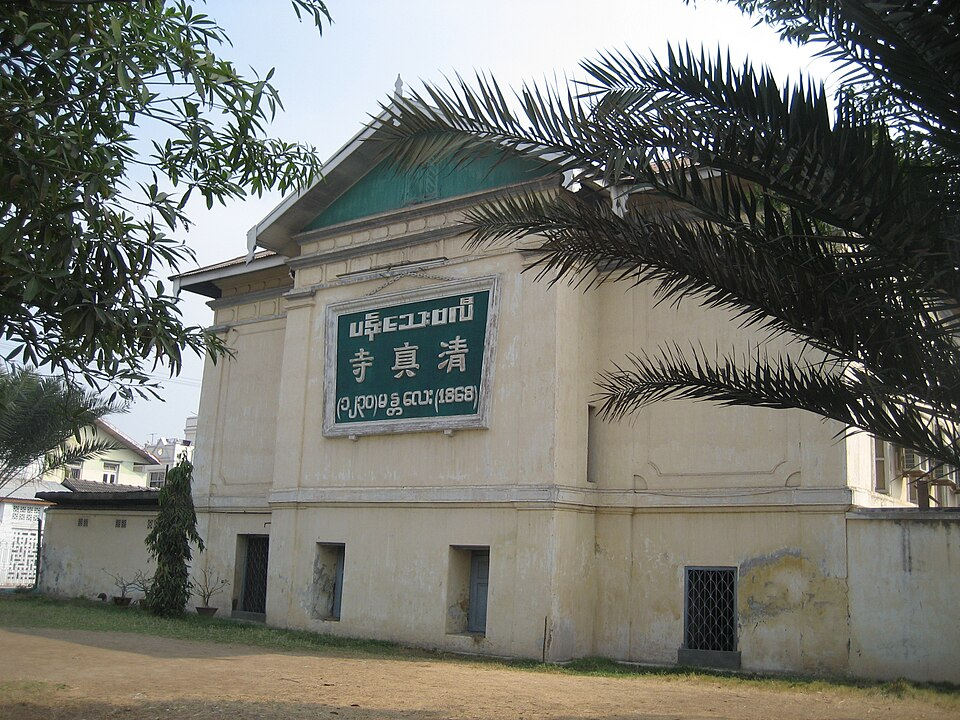
Photo By Wagaung at English Wikipedia, CC BY-SA 3.0, https://commons.wikimedia.org/w/index.php?curid=34984620
I wrote about Panthays or Myanmar Chinese Muslims in Wikipedia. Part of that article is taken and revised from The Emergence Of The Panthay Community At Mandalay, by Professor U Maung Maung Lay. He lectured in History and was an Associate Professor in International Relations at Mandalay University. He retired in 1997. The writer is a great-grandson of Yunnan Chinese Colonel Mah Too-tu who had supervised the construction of the Panthay Mosque at Mandalay. He had personally given me permission to freely use this research paper in any place so that all the people could understand and know the history of Panthays.
The Emergence Of The Panthay Community At Mandalay, by Professor U Maung Maung Lay, was the original research paper’s photocopy I got from him. I found that research paper edited and published in the “Essays given to Than Tun on his 75th birthday” in the book, “Studies in Myanmar History” volume 1, published by Innwa Publishing House (in 1999) . No 136/6, 36 street. Kyauktada T/S. Yangon, Myanmar. This is the first of the three felicitation Volumes by the Colleages and students of Than Tun, retired Professor of History, University of Mandalay, given on his 75th birthday. First published February 1999. Than Tun Diamond Jubilee Publication Committee. 158 (A) Yogi Kyaung Road. Hlaing XI, Yangon, Myanmar.
Professor U Maung Maung Lay’s The Emergence of the Panthay Community at Mandalay is a foundational historical work detailing how Chinese Muslims (the Panthays) fled the Yunnan rebellion in the 19th century and established a lasting, culturally distinct community in upper Myanmar. [1, 2]
Key Historical Highlights
- King Mindon’s Patronage: Fleeing the late-19th-century warfare in China’s Yunnan province, these Muslim refugees were welcomed into the royal capital by King Mindon. The King granted them land and even employed some Panthays at the royal court as jade assessors. [1, 2, 3]
- The Mandalay Panthay Mosque: Completed in 1868 with the backing of Sultan Suleiman of Yunnan and the Burmese court, this mosque (the second oldest in the city) remains the cultural and architectural centerpiece of the community. It is uniquely characterized by its striking Chinese-style architectural motifs and minarets. [1, 2, 3, 4]
- Integration and Culture: Historically residing alongside non-Muslim Chinese near 80th Street, the Panthays managed to maintain strong relations with their Buddhist neighbors, successfully preserving their unique Chinese-Islamic heritage. [1, 2]
Where to Find the Text
Professor U Maung Maung Lay’s work is a primary source for understanding this cross-border migration. You can access a deeper exploration of this topic through these sources: [1]
- Academic Compilations: The research is notably featured in Studies in Myanmar History (available via University Press Library) and the Essays Given to Than Tun publication.
- General Overview: For a quick, encyclopedic breakdown of the Panthay diaspora and their impact in Myanmar, you can consult the Wikipedia Panthays Article.
Read also: Panthays