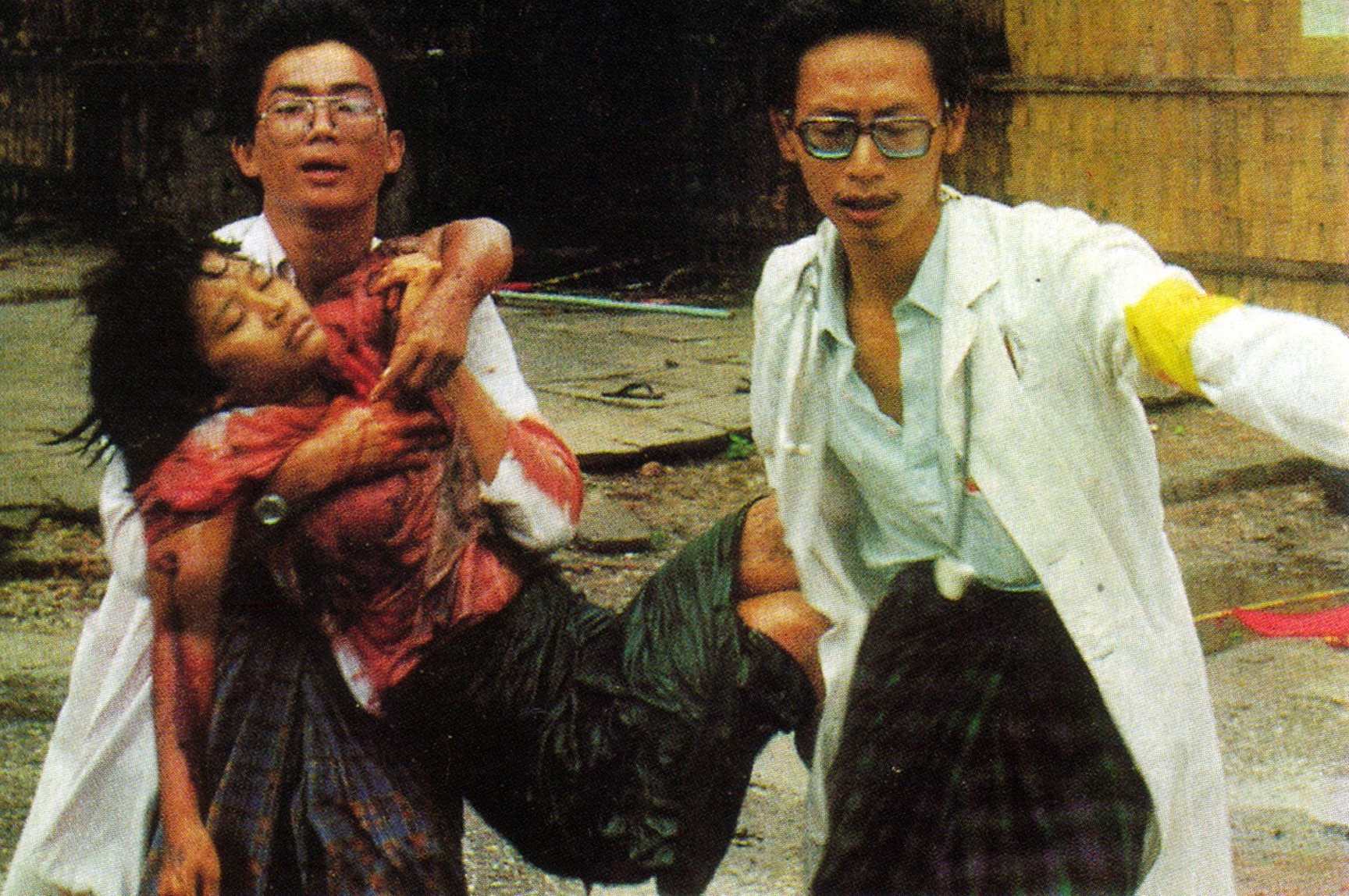
The photograph of two doctors carrying Win Maw Oo ran in Newsweek’s Asian edition of 3 October 1988. The photographer was Steve Lehman.
Thirty years ago today (continued from this morning)
“Hello.”
“Yes, Colonel, the General wants to speak with you. Please hold for a moment.”
“Yes.”
I became curious: who could these two be? I pressed the headset firmly against my left ear so no background noise would get in, and kept listening. About ten seconds later…
“Hello.”
“Hello… yes.”
“Ko Saw Lwin… this is Phone Myint.”
“Yes, General.”
My heart skipped. Lord Buddha… I’ve ended up tapping the phone of some really big men. I had no idea what I was about to hear, and if anyone found out, I’d be sent straight to Insein Pauk Taw. Thoughts chained on like that. But I immediately dropped the idea of pulling out the “tap.” I grabbed an old newspaper lying nearby and got ready to write down what they said. Just then I saw a friend of mine, a groom-to-be, walking past, and signalled with gestures for him to fetch a pen. Within seconds he was back with one. It takes a while to write this now, but at the time all of this was thought and done in a split second while listening.
From the evening radio announcements, I already knew General Phone Myint was a member of the State Law and Order Restoration Council. I didn’t know who Colonel Saw Lwin was. Only later, as I kept listening, did I learn he was Deputy Commander of Division 22. What follows is what I noted down of their conversation. Thirty years have passed, and the speakers themselves may not remember what they said. But even if I can’t claim every grammatical particle, the words, the breathing, the tone of voice are still lodged in my ears, so I remember them well.
“You already know, Ko Saw Lwin, that our Tatmadaw has taken responsibility.”
“Yes, General.”
“Well… I’m the one in charge of Home Affairs.”
“Yes, General.”
General Phone Myint did not call himself a minister. He said “in charge,” in a proud, boastful voice. Colonel Saw Lwin just kept saying “Yes, General.” They weren’t chatting as equals. This was one man giving orders and another receiving them.
“Ko Saw Lwin, deal with these groups of demonstrators decisively.”
“Yes, General.”
“I, the one in charge of Home Affairs, take full responsibility. All right?”
“Yes, General.”
“I don’t mean just hitting legs, arms or heads. I don’t want that. Even if corpses pile up in the streets, no problem. I take full responsibility.”
“Yes, General.”
“Don’t wait to deal with them only when you meet them face to face in the street. Go and clear the places where they are. Ambush them if necessary.”
“Yes, General.”
“If needed, use the heavy weapons. The 81s, the 82s, hand grenades, you can use them all. Even if corpses pile up in the streets, I take full responsibility.”
“Yes, General.”
I don’t know whether it was to make sure of his words and orders, but General Phone Myint repeated himself twice over. My hands, taking notes, were shaking. Colonel Saw Lwin said:
“Just now, someone came and fired two shots at us with a small one, General.”
“A small one” means a small weapon, a revolver or pistol. General Phone Myint replied:
“Don’t bother about the likes of these. We’ve fought until even the BCP was toppled. That’s exactly why I’m telling you: there’s no need to hold back. Even if corpses lie on top of each other in the streets, I take full responsibility.”
“Yes, General.”
“I’ll be at this military region office all night and all day. If needed, call. Hey, read out the phone numbers!”
I don’t know the ranks of the telephone operators beside General Phone Myint. The person who had called Colonel Saw Lwin earlier was also a communications officer of the region office, whether a sergeant-major or a warrant officer I can’t say. He recited four-digit phone numbers beginning with 8, and I heard his voice through the very phone line General Phone Myint was speaking on. As it turned out, those were my friend’s exchange numbers.
“OK. Use those numbers if you need to reach us. Don’t use radio at all. Use only the telephone. Only the telephone.”
“Yes, General.”
He evidently thought that in those days military walkie-talkie radios were easy to intercept, while automatic telephones were more secure. Then they said goodbye and hung up.
I was left dazed, holding the newspaper covered in pen notes, not knowing what to do. Soon two friends came over. I read them my notes. Then I said:
“So what do we do? These men will really shoot.”
“Phone Daw Aung San Suu Kyi’s house and report it. I have their number.”
This came from my friend who worked at the telephone exchange and was a union member. It wasn’t actually Daw Aung San Suu Kyi’s personal number. My friend was the union’s information officer, so he seems to have had contact with the “tricolour” team that held office at her house, and he asked me to report to that team, since news could then reach the various strike camps through them.
“Fine, then you go ahead and talk. Here’s what I wrote down…”
“No, you do it. You listened in with your own ears, you can give the fuller account.”
“All right, I’ll speak. You place the call.”
My friend placed the call, got through, and passed me the phone. From the voice, the listener on the other end was a young man of our age. I told him everything I had heard and written down. I urged him to send word quickly to the strike camps and to warn people not to go out onto the streets to demonstrate tomorrow morning. We already knew from experience that these men would carry out orders as given, and we did not want the public to suffer casualties. The listener said, “Yes, we’ll take care of it,” and hung up.
Uneasy, wondering whether they would believe me and whether they could warn the strike camps in time, we friends went to bed. The General Hospital strike camp was still there that night. All night I heard distant gunfire, dozed off, woke with a start, and so the morning of 19 September arrived.
Our prayers were not answered. On the morning of the 19th, the coup-making army shot and killed many people, including the young 8th-grade schoolgirl Ma Win Maw Oo. The body-collecting teams from the General Hospital, with their house surgeons and doctors, would know better than we do how many. The photo of the two doctors carrying Win Maw Oo, taken from the ambulance by the foreign journalist who was with them, is now world-famous and stands as an emblem of the junta’s cruelty, isn’t it?
(To be continued tomorrow)
Translator’s notes: “General” renders Bogyoke, used loosely for senior officers. “Colonel” renders Bo Hmu Gyi. “Exchange” is the telephone exchange, and my reading of “tap” is a wiretap connection. I couldn’t identify “Insein Pauk Taw” or the “tricolour team.”
Fact-check
Two corrections to the framing
- The date. “8888” means 8 August 1988, when troops fired on protesters. The 18 September events are the SLORC coup, which ended the uprising. On 18 September a 4:00 pm radio announcement declared the military had assumed all power and announced a 19-member SLORC.
- “Home Minister.” The speaker says he is “in charge of Home Affairs,” and that fits. SLORC Order 1/1988 lists Major General Bhone Myint (Phone Myint) as one of the 19 members. A VOA Burmese piece says he was Quartermaster General at the time of the coup and later Minister of Home and Religious Affairs. A list announced by Radio Rangoon two days later gave him Home and Religious Affairs plus Information and Culture. So he was not yet a publicly announced minister on the 18th, which is consistent with the post’s careful wording. What checks out
- 22nd LID in the streets. Amnesty International reported that troops of the 22nd, 33rd and 44th Light Infantry Divisions took up positions in the streets at the time of the coup. Soldiers of the 22nd LID were also reported to have fired on the crowd at Sule Pagoda on 8 August.
- The September 19 crackdown. Journalist Bertil Lintner described the shooting of protesters on 19 September as carried out “with military precision,” unlike the more random killing in August. The SLORC officially claimed only 15 demonstrators died after the coup. The US State Department estimates about 3,000 people were killed in the crackdown that followed
- Win Maw Oo. She was a 16-year-old student, shot on 19 September 1988, and died at 5:35 pm after being treated in intensive care. The photograph of two doctors carrying her ran in Newsweek’s Asian edition of 3 October 1988. The photographer was Steve Lehman. Her funeral rites were held in 2016, honouring her wish that they wait until democracy came. The post’s “foreign journalist” detail is correctWhat I couldn’t verify, or that differs from other sources
- The call itself. I found no recording, second witness or contemporaneous record. It is plausible against what followed, but treat the quoted words as the author’s recollection.
- Colonel Saw Lwin as Deputy Commander of the 22nd LID. I found no source for this. Don’t confuse him with Dr. Saw Lwin, the house surgeon in the famous photo, since it’s a common name.
- “8th-grade” schoolgirl. Wikipedia says she attended Basic Education High School (4) in Kyimyindaing. Other sources call her a 16-year-old high school student. I found none that say Grade 8.
- “Killed that morning.” She was shot on the 19th but died that evening.
- Source discrepancies on the photo. The Irrawaddy’s photo caption gives 18 September, while its article text and other sources say 19 September. The Irrawaddy calls Win Zaw a medical student, while the Korea Herald calls him a doctor at Yangon’s main hospital, working with an older colleague, Saw Lwin.
References
- Irrawaddy, “The Heroic Medics of the 8888 Uprising”: https://www.irrawaddy.com/from-the-archive/heroic-medics-8888-uprising.html
- Irrawaddy, “Analysis: Myanmar Still Living with Legacy of 1988 Military Coup”: https://www.irrawaddy.com/stories-that-shaped-us/analysis-myanmar-still-living-legacy-1988-military-coup.html
- Irrawaddy, “Why the Past Can’t Be Put to Rest”: https://www.irrawaddy.com/news/why-the-past-cant-be-put-to-rest.html
- Wikipedia, Win Maw Oo: https://en.wikipedia.org/wiki/Win_Maw_Oo
- Wikipedia, Tatmadaw Government (1988–2011), for the Order 1/1988 member list: https://en.wikipedia.org/wiki/Tatmadaw_Government_(1988%E2%80%932011)
- Deseret News/AP, “New Burma Leaders,” 20 Sept 1988: https://www.deseret.com/1988/9/20/18778559/new-burma-leaders/
- VOA Burmese, on SLORC members’ 1988 posts: https://burmese.voanews.com/a/article-09-19-10-soldiers-talk026-103225084/1245613.html
- Amnesty International, “Burma: The 18 September 1988 Military Takeover and its Aftermath”: https://www.burmalibrary.org/docs3/18_Sept_1988-ocr.pdf
- ARTICLE 19, “State of Fear: Censorship in Burma”: https://www.burmalibrary.org/docs3/State-of-Fear-minus.pdf
- Sciences Po, “The repression of the August 8-12 1988 uprising”: https://www.sciencespo.fr/mass-violence-war-massacre-resistance/en/document/repression-august-8-12-1988-8-8-88-uprising-burmamyanmar.html
- Korea Herald, “25 years after unrest, Myanmar begins to cope”: https://www.koreaherald.com/article/17879
- Bangkok Post/AP, “Democracy fulfills last wish of Myanmar teen”: https://www.bangkokpost.com/opinion/opinion/990349/democracy-fulfills-last-wish-of-myanmar-teen
- US State Department, Background Note: Burma: https://2009-2017.state.gov/outofdate/bgn/burma/106321.htm
#လွန်ခဲ့တဲ့အနှစ်(၃၀)က ဒီနေ့
(မနက်က အဆက်)
“ဟဲလို”
“ဟုတ်ကဲ့ ဗိုလ်မှူးကြီးနဲ့ ဗိုလ်ချုပ်က စကားပြောချင်လို့ ခင်ဗျ။ ခဏ ကိုင်ထားပေးပါ”
“ဟုတ်ကဲ့”
နားထောင်နေတဲ့ ကျနော် စိတ်ဝင်စားသွားမိတယ်။ ဘယ်သူတွေပါလိမ့်ပေါ့။ ဘေးအသံဗလံ မဝင်အောင် နားကြပ်ကို ဘယ်ဘက်နားပေါ် လက်နဲ့ သေသေချာချာဖိထားရင်း ဆက် နားစွင့်နေမိပါတယ်။ ၁၀ စက္ကန့်လောက်အကြာမှာ …
“ဟဲလို”
“ဟဲလို… ဟုတ်ကဲ့”
“ကိုစောလွင်… ကျနော် ဘုန်းမြင့်ပါ”
“ဟုတ်ကဲ့ ဗိုလ်ချုပ်”
ကျနော့ ရင်ထဲ ထိပ်ကနဲ ဖြစ်သွားပါတယ်။ မြတ်စွာဘုရား… ငါတော့ တကယ့် အကောင်ကြီးကြီးတွေ ဖုန်း ခိုးနားထောင်မိရက်သား ဖြစ်နေပြီ၊ ဘာတွေကြားရမလဲ မသိဘူး၊ သိသွားလို့ကတော့ အင်းစိန် ပေါက်တောဝ ကို တန်းနေမှာပဲ စသဖြင့် အတွေးတွေ ဇယ်ဆက်သလို တွေးနေမိပါတယ်။
ဒါပေမယ့် “တက်ပင်” ကို ဖြုတ်ချပစ်လိုက်ဖို့ စိတ်ကူးကို ချက်ချင်းထုတ်ပစ်လိုက်ပါတယ်။ ပြီးတော့ ကိုယ့်အနီးအနားမှာ တွေ့တဲ့ သတင်းစာအဟောင်းတစောင်ကို ဆွဲယူပြီး သူတို့ ပြောတာတွေ လိုက်မှတ်ဖို့ အသင့်ပြင်လိုက်ပါတယ်။ အဲဒီအချိန်မှာ ဘေးနားက ဖြတ်သွားတဲ့ သတို့သားလောင်း သူငယ်ချင်းကို တွေ့လို့ ဘောပင်တချောင်း သွားရှာပြီး ယူလာဖို့ လက်ဟန်ခြေဟန်နဲ့ ပြလိုက်ရပါတယ်။ သူငယ်ချင်းက စက္ကန့်အနည်းငယ်အတွင်းမှာပဲ ဘောပင်တချောင်းနဲ့အတူ ပြန်ရောက်လာပါတယ်။ အခုရေးပြနေချိန်မှာသာ ကြာနေပေမယ့် အဲဒီအချိန်ကတော့ နားထောင်နေရင်း စက္ကန့်ပိုင်းအတွင်း တွေးမိ လုပ်မိကိုင်မိတာတွေပါ။ ညနေ ရေဒီယို ကြေငြာချက်တွေ အရ ဗိုလ်ချုပ်ဘုန်းမြင့်ဟာ နိုင်ငံတော် ငြိမ်ဝပ်ပိပြားမှု တည်ဆောက်ရေးအဖွဲ့ အဖွဲ့ဝင်တယောက်ဆိုတာ ကျနော် သိပြီးနေပါပြီ။ ဗိုလ်မှူးကြီးစောလွင် ဆိုတာ ဘယ်သူမှန်း မသိပါဘူး။ နောက်ပိုင်းကျမှ နားထောင်ရင်းနှဲ့ တပ်မ (၂၂) ဒု တပ်မမှူး ဆိုတာ သိလာရပါတယ်။ အောက်မှာ ဆက်ရေးမယ့်အရာတွေဟာ သူတို့နှစ်ယောက် ပြောဆိုတာတွေကို ကျွန်တော် လိုက်မှတ်ထားခဲ့တာတွေပါ။ အနှစ် ၃၀ ကြာခဲ့ပြီ ဖြစ်ပေမယ့်၊ ပြောခဲ့တဲ့သူတွေတောင် သူတို့ ဘာပြောခဲ့သလဲ မှတ်မိချင်မှ မှတ်မိမှာ ဖြစ်ပေမယ့် ကျနော်ကတော့ “၏ သည် မ ၍” မဟုတ်တောင် စကားလုံးတွေ လေယူလေသိမ်းတွေ အသံနေအသံထားတွေကို ခုထိ နားထဲစွဲနေတုန်းမို့ ကောင်းကောင်းမှတ်မိနေပါတယ်။
“ကျနော်တို့ တပ်က တာဝန်ယူလိုက်တာ ကိုစောလွင် သိပြီးရောပေါ့”
“ဟုတ်ကဲ့ ဗိုလ်ချုပ်”
“အေးဗျာ…ကျနော်က ပြည်ထဲရေးဌာန တာဝန်ခံ ဗျ”
“ဟုတ်ကဲ့ ဗိုလ်ချုပ်”
ဗိုလ်ချုပ်ဘုန်းမြင့်က သူ့ကိုယ်သူ ဝန်ကြီး လို့ မပြောပါ။ တာဝန်ခံ လို့ သုံးနှုန်းပါတယ်။ ဂုဏ်ယူဝင့်ကြွားတဲ့ အသံနဲ့ပါ။ ဗိုလ်မှူးကြီးစောလွင်ကတော့ “ဟုတ်ကဲ့ ဗိုလ်ချုပ်” ချည်းသာ ပြောနေပါတယ်။ တကယ်တော့ သူတို့နှစ်ဦးက အလ္လာပသလ္လာပ ပြောနေကြတာမှ မဟုတ်တာ၊ အမိန့်ပေးသူနဲ့ အမိန့်နာခံသူတွေ ပြောနေကြတာ မဟုတ်လား။
“ကိုစောလွင် ဒီဆန္ဒပြတဲ့ လူ အုပ်စုတွေကို ပြတ်ပြတ်သားသား နှိမ်နင်းပါ”
“ဟုတ်ကဲ့ ဗိုလ်ချုပ်”
“ကျနော် ပြည်ထဲရေးဌာန တာဝန်ခံ အကုန်တာဝန်ယူတယ်…နော်”
“ဟုတ်ကဲ့ ဗိုလ်ချုပ်”
“ခြေတွ လက်တွေ ခေါင်းတွေ ထိတာလောက် မဟုတ်ဘူး၊ မလိုချင်ဘူး။ လမ်းပေါ်မှာ အလောင်းတွေ ပုံနေပလေ့စေ၊ ကိစ္စမရှိဘူး…ကျနော် အကုန်တာဝန်ယူတယ်”
“ဟုတ်ကဲ့ ဗိုလ်ချုပ်”
“လမ်းပေါ်မှာ ရင်ဆိုင်တွေ့မှ ရှင်းမနေနဲ့…သူတို့ရှိတဲ့နေရာကို သွားရှင်း…လိုအပ်ရင် ambush လုပ်”
“ဟုတ်ကဲ့ ဗိုလ်ချုပ်”
“လိုအပ်ရင် လက်နက်ကြီးတွေသုံးဗျာ၊ 81, 82, လက်ပစ်ဗုံး အကုန်သုံးနိုင်တယ်..လမ်းပေါ်မှာ အလောင်းတွေ ပုံနေပလေ့စေ… ကျနော် အကုန် တာဝန်ယူတယ်”
“ဟုတ်ကဲ့ ဗိုလ်ချုပ်”
ဗိုလ်ချုပ်ဘုန်းမြင့်ဟာ သူ့စကား သူ့အမိန့်ကို သေချာအောင်လား မသိပါဘူး၊ နှစ်ခါ နှစ်ခါ ထပ်ပြောတယ်ခင်ဗျ။ လိုက်မှတ်နေတဲ့ ကျနော့ လက်တွေ တုန် နေပါတယ်။ ဗိုလ်မှူးကြီးစောလွင် က ပြောလိုက်ပါတယ်။
“အခုနလေးတင် ကျနော်တို့ကို အငယ် နဲ့ နှစ်ချက် လာပစ် သွားတယ် ဗိုလ်ချုပ်”
အငယ် ဆိုတာ လက်နက်ငယ် “ခြောက်လုံးပြူး သို့မဟုတ် ပစ္စတို” ကို ပြောတာပါ။
ဗိုလ်ချုပ်ဘုန်းမြင့်က ပြန်ပြောပါတယ်။
“ဒီကောင်တွေလောက်များ ဂရုစိုက်မနေပါနဲ့ဗျာ။ ကျနော်တို့တတွေ ဗကပကိုတောင် ပြုတ်အောင် တိုက်လာခဲ့တာပဲ။ ကျနော် အဲဒါကြောင့် ပြောတာ၊ ဘာမှ ညှာနေစရာ မလိုဘူး။ လမ်းပေါ်မှာ အလောင်းချင်း ထပ်နေပလေ့စေ… ကျနော် အကုန်တာဝန်ယူတယ်”
“ဟုတ်ကဲ့ ဗိုလ်ချုပ်”
“ကျနော် ဒီစစ်ဒေသ ရုံးမှာ တညလုံး တနေ့လုံး ရှိမယ် လိုအပ်ရင် ဖုန်းဆက်ပါ၊ ဟေ့…ဖုန်းနံပါတ်တွေ ပြောစမ်း”
ဗိုလ်ချုပ်ဘုန်းမြင့်ဘေးမှာ တယ်လီဖုန်း အော်ပရေတာ လုပ်နေသူတွေဟာ ဘယ်ရာထူးတွေနဲ့ လူတွေလဲတော့ ကျနော် မသိပါဘူး။ စောစောက ဗိုလ်မှူးကြီး စောလွင်ကို ဖုန်းခေါ်တဲ့သူဟာလည်း စစ်ဒေသရုံးရဲ့ ဆက်သွယ်ရေးတာဝန်ခံတယောက်ပါပဲ။ တပ်ကြပ်ကြီးလား၊ အရာခံဗိုလ်လား အသေအချာ မသိပါဘူး။ သူက နံပါတ် ၈ နဲ့ စတဲ့ ဖုန်းနံပါတ် ၄ လုံး ရွတ်ပြပါတယ်။ သူရွတ်ပြတဲ့အသံကို ဗိုလ်ချုပ်ဘုန်းမြင့် ပြောနေတဲ့ ဖုန်းကတဆင့် ကျနော် ကြားနေရပါတယ်။ လက်စသပ်တော့ ကျနော့သူငယ်ချင်း အိပ်ချိန်း ဖုန်းတွေကိုး။
“အိုကေ…အဲဒီဖုန်းနံပါတ်တွေကို လိုအပ်ရင် ဆက်သွယ်ပါ။ ရေဒီယို လုံးဝမသုံးပါနဲ့၊ တယ်လီဖုန်းနဲ့ပဲ ဆက်သွယ်ပါ…တယ်လီဖုန်းပဲသုံးပါ”
“ဟုတ်ကဲ့ ဗိုလ်ချုပ်”
သူ့စိတ်ထဲမှာ အဲဒီအချိန်က စစ်သုံးဝေါ်ကီတော်ကီ ရေဒီယိုတွေက ကြားဖြတ် ဖမ်းယူနားထောင်လို့ လွယ်ပြီး အော်တို တယ်လီဖုန်း တွေက ပိုစိတ်ချလုံခြုံတယ်လို့ ယူဆဟန်တူပါတယ်။
အဲဒီနောက် နှုတ်ဆက်ပြီး ဖုန်းတွေ ချသွားကြပါတယ်။
ကျနော်ကတော့ သူတို့ပြောတာတွေ ဘောပင်နဲ့ လိုက်မှတ်ထားတဲ့ သတင်းစာကို ကိုင်ပြီး ဘာလုပ်ရမှန်းမသိဘဲ ငေါင်ကြောင်ကြောင် ဖြစ်နေမိပါတယ်။ ခဏနေတော့ သူငယ်ချင်း နှစ်ယောက် ကျနော့်အနား ရောက်လာပါတယ်။ သူတို့ကို ကျနော် မှတ်ထားတဲ့ စာတွေ ဖတ်ပြလိုက်ပါတယ်။ ပြီးတော့မှ ကျနော်က…
“အဲဒီတော့ တို့ ဘယ်လိုလုပ်ကြမလဲ၊ ဒီကောင်တွေက တကယ်ပစ်မယ့်ကောင်တွေ”
“ဒေါ်အောင်ဆန်းစုကြည် အိမ်ကို ဖုန်းဆက်ပြီး သတင်းပို့ကွာ၊ ငါ့မှာ သူတို့ ဖုန်းနံပါတ် ရှိတယ်”
ကျနော့သူငယ်ချင်း အိပ်ချိန်းသမဂ္ဂဝန်ထမ်း က ပြောပါတယ်။ တကယ်က ဒေါ်အောင်ဆန်းစုကြည်ရဲ့ ကိုယ်ပိုင် ဖုန်းနံပါတ် မဟုတ်ပါဘူး။ သူငယ်ချင်းက သမဂ္ဂ ပြန်ကြားရေးတာဝန်ခံ ဆိုတော့ ဒေါ်စု အိမ်မှာ ရုံးထိုင်နေတဲ့ သုံးရောင်ခြယ်အဖွဲ့နဲ့ အဆက်အသွယ်ရှိပုံရပါတယ်။ အဲဒီအဖွဲ့ဆီကို အကြောင်းကြား သတင်းပို့ ခိုင်းတာပါ။ အဲဒီအဖွဲ့ကမှတဆင့် သပိတ်စခန်းအသီသီးကို သတင်းရောက်သွားနိုင်တာကိုး။
“အေး…ဒါဆိုလဲ မင်း ဆက်ပြီး ပြောလိုက်လေ။ ဒီမှာ ငါ မှတ်ထားတာတွေ…”
“ဟာ…မင်းပဲ ပြောပါ၊ မင်းက မင်းနားနဲ့ ဆတ်ဆတ် နားထောင်လာတဲ့ကောင်ပဲဟာ၊ ပိုပြည့်ပြည့်စုံစုံ ပြောနိုင်တာပေါ့ဟ”
“အေးပါ…ဒါဆိုလဲ ငါပြောပါ့မယ်။ မင်း အဲဒီကို ဖုန်းခေါ်ပေး”
သူငယ်ချင်းက ဖုန်းခေါ်ပေးပြီး အဆက်အသွယ်ရတော့ ကျနော့ကို ဖုန်း ထိုးပေးပါတယ်။ တဖက်က နားထောင်သူက အသံနေအသံထားအရတော့ ကျနော်တို့အရွယ် လူငယ်တယောက်ပါပဲ။ ကျနော်က ကျနော်ကြားသမျှ စာရွက်ပေါ် မှတ်ထားသမျှ အကုန် သူ့ကို ပြောပြလိုက်ပါတယ်။ ပြီးတော့ သပိတ်စခန်းတွေဆီ အမြန်သတင်းပို့ဖို့၊ မနက်ဖြန်မနက်မှာ လမ်းတွေပေါ် ဆန္ဒပြ မထွက်ကြအောင် သတိပေးဖို့။ ဒီလူတွေဟာ အမိန့်ရရင် အမိန့်အတိုင်း လုပ်မယ့်သူတွေဆိုတာ ကျနော်တို့ သိခဲ့ တွေ့ကြုံခဲ့ပြီး ဖြစ်တာကြောင့် ပြည်သူလူထု ကို ထိခိုက်သေဆုံးမှု တွေ ကျနော်တို့ အနေနဲ့ မဖြစ်စေလိုကြောင်း စသဖြင့် ပြောချလိုက်ပါတယ်။ တဖက်က နားထောင်နေသူကလည်း “ဟုတ်ကဲ့ ကျနော်တို့ ဆောင်ရွက်ပေးပါ့မယ်” လို့ ပြောပြီး ဖုန်းချလိုက်ပါတယ်။
သူတို့ အနေနဲ့ ကျနော်ပြောတာတွေ ယုံပါ့မလား၊ သပိတ်စခန်းတွေကို အချိန်မီ အကြောင်းကြားနိုင်ပါ့မလား စိတ်တထင့်ထင့်နဲ့ ကျနော်တို့ သူငယ်ချင်းတွေ အိပ်ရာဝင်ခဲ့ကြပါတယ်။ ဆေးရုံကြီး သပိတ်စခန်းဟာ အဲဒီညအထိ ရှိနေသေးပါတယ်။ အဲဒီတညလုံး အဝေးက သေနတ်သံ ဖြိုးဖြိုးဖြောက်ဖြောက် ကြားလိုက်၊ အိပ်ပျော်သွားလိုက်၊ လန့် နိုးလိုက်နဲ့ နောက်နေ့ မနက် စက်တင်ဘာ (၁၉)ရက်နေ့ ကို ရောက်သွားပါတယ်။
ကျနော်တို့ ဆုတောင်းမပြည့်ခဲ့ပါဘူး။ အဲဒီနေ့ (၁၉) ရက်နေ့ မနက်မှာ အာဏာသိမ်းစစ်တပ်က ပစ်ခတ်သတ်ဖြတ်လို့ ၈တန်းကျောင်းသူလေး မဝင်းမော်ဦး အပါအဝင် လူပေါင်းများစွာ ကျဆုံးခဲ့ကြရပါတယ်။ ဆေးရုံကြီးက အလုပ်သင်ဆရာဝန်နဲ့ ဆရာဝန်တွေ ပါတဲ့ အလောင်းကောက်အဖွဲ့က ဘယ်နှယောက်လဲဆိုတာ ကျနော်တို့ထက် ပို သိမှာပါ။ မဝင်းမော်ဦးကို ပွေ့ချီလာတဲ့ ဆရာဝန် နှစ်ဦးကို အတူပါလာတဲ့ နိုင်ငံခြားသားသတင်းထောက်က ambulance ပေါ်ကနေ ဓာတ်ပုံ ရိုက်ယူခဲ့တဲ့ဓာတ်ပုံဟာ ဒီကနေ့မှာ ကမ္ဘာကျော်ဓာတ်ပုံ တပုံဖြစ်နေပြီဖြစ်ပြီး စစ်အစိုးရရဲ့ ရက်စက်ယုတ်မာမှု ပြရုပ်တခုလည်း ဖြစ်နေပြီ မဟုတ်ပါလားခင်ဗျာ။
(နောက်နေ့ ဆက်ရေးပါဦးမည်)