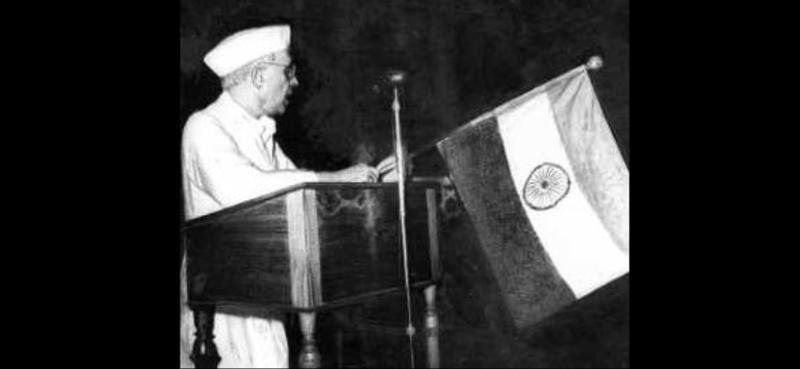
Jawaharlal Nehru’s Midnight Pledge (1947) On the eve of independence, Nehru’s “Tryst with Destiny” speech captured the soul of a nation stepping into freedom. His words — “At the stroke of the midnight hour, when the world sleeps, India will awake to life and freedom” — framed independence not as an end, but as the beginning of responsibility. He called for service to the millions who suffer, for the eradication of poverty, ignorance, and inequality, and for the building of a democratic, progressive India. Nehru’s vision was inclusive: all religions, all communities, united as children of India. He pledged cooperation with the world for peace and democracy, while paying homage to Gandhi, the “torchbearer of freedom,” and countless unnamed volunteers. It was a moment of solemn hope, a promise that India would discover herself anew.
Sidharth Bhatia’s Reflection (2022) Seventy-five years later, journalist Sidharth Bhatia observed a striking irony: Nehru, the architect of that midnight pledge, was conspicuously absent from official commemorations of independence. His image and legacy, he argued, were being airbrushed from public memory by the Modi government. The Enforcement Directorate’s actions against the Gandhi family, the sealing of the National Herald offices, and the heavy police presence around opposition leaders symbolized a deliberate sidelining of Nehru’s lineage. Meanwhile, patriotic fervour was channelled into flag-waving campaigns and digital displays, while the RSS — historically aloof from the freedom struggle — now embraced the tricolour it once rejected. Bhatia suggested that the anniversary had become less about Nehru’s vision of justice and equality, and more about projecting the current leadership’s achievements. Yet, he concluded, Nehru’s “Tryst with Destiny” will continue to resonate far beyond the shelf life of government slogans.
Commentary Flow
Together, these two speeches — one from Nehru himself, and one reflecting on his erasure — reveal the contested terrain of memory in Indian politics. Independence was once framed as a collective pledge to justice and equality; today, its commemoration is refracted through partisan optics. The enduring question remains: will India continue to “wipe every tear from every eye,” as Nehru aspired, or will the midnight promise be overshadowed by selective remembrance?
********************************************
MMNN Feature: India’s Tryst With Destiny – From Nehru’s Midnight Pledge to Modi’s Amrit Mahotsav
Introduction
On the night of August 14, 1947, Jawaharlal Nehru stood before the Constituent Assembly and delivered words that would echo across generations: “At the stroke of the midnight hour, when the world sleeps, India will awake to life and freedom.” His Tryst with Destiny speech was not merely a declaration of independence, but a solemn pledge — a vision of justice, equality, and service to the millions who suffered. Seventy-five years later, journalist Sidharth Bhatia reflects on how that vision has been refracted, contested, and in some ways erased from the official memory of India’s independence celebrations under the current government.
Nehru’s Midnight Vision
Nehru’s speech was both poetic and political. He reminded India that freedom was not an end in itself, but the beginning of responsibility. “Freedom and power bring responsibility,” he declared, urging leaders to dedicate themselves to ending poverty, ignorance, and inequality. He invoked Gandhi as the “torchbearer of freedom,” honoured unnamed volunteers who sacrificed without reward, and called for unity across religions and communities.
The speech was infused with hope but tempered by realism. Nehru acknowledged the “pains of labour” that accompanied independence — partition, displacement, and sorrow — yet insisted that India must build “the noble mansion of free India where all her children may dwell.” His vision was expansive: India’s destiny was tied to the destiny of the world, with peace and prosperity indivisible in an interconnected age.
The 75th Anniversary: Erasure and Optics
Fast forward to 2022, as India marked 75 years of independence under the banner of Azadi ka Amrit Mahotsav. Bhatia observed that Nehru, the architect of that midnight pledge, was conspicuously absent from official commemorations. His image was missing from government campaigns, his photo at the National Herald offices appeared behind chains, and his descendants faced investigations and police action.
Instead, the celebrations were dominated by flag-waving campaigns, digital display pictures, and patriotic songs centred on themes favoured by the current leadership — yoga, cleanliness drives, and monumental statues. The irony was stark: the Rashtriya Swayamsevak Sangh (RSS), which had historically rejected the tricolour, now urged citizens to wave it enthusiastically. Nehru’s inclusive vision of diversity was sidelined in favour of a narrower projection of nationalism.
Continuity and Contestation
The juxtaposition of Nehru’s speech and Bhatia’s commentary reveals a deeper tension in Indian politics: the struggle over memory. Independence anniversaries are not just about celebration; they are about defining whose vision of India is remembered and whose is forgotten.
Nehru’s pledge was to “wipe every tear from every eye,” a moral ambition that transcended politics. Today, the optics of commemoration often serve partisan ends, with opposition leaders portrayed as inconvenient and Nehru himself airbrushed from history. Yet, as Bhatia notes, the resonance of Tryst with Destiny cannot be erased. Its words continue to inspire, reminding Indians of a promise larger than any government slogan.
Conclusion
India’s midnight tryst was a moment of collective awakening, a pledge to justice and equality. Seventy-five years later, the commemoration of that moment has become a contested space, reflecting the politics of erasure and projection. But Nehru’s words endure: “The service of India means the service of the millions who suffer.”
The challenge for India today is whether it will continue to honour that pledge — building a nation of equal rights and opportunities — or whether the midnight promise will be overshadowed by selective remembrance. History, as Nehru said, begins anew with each generation. The question is whether India will remain true to its tryst with destiny.