User Commentary (Thant Zin):
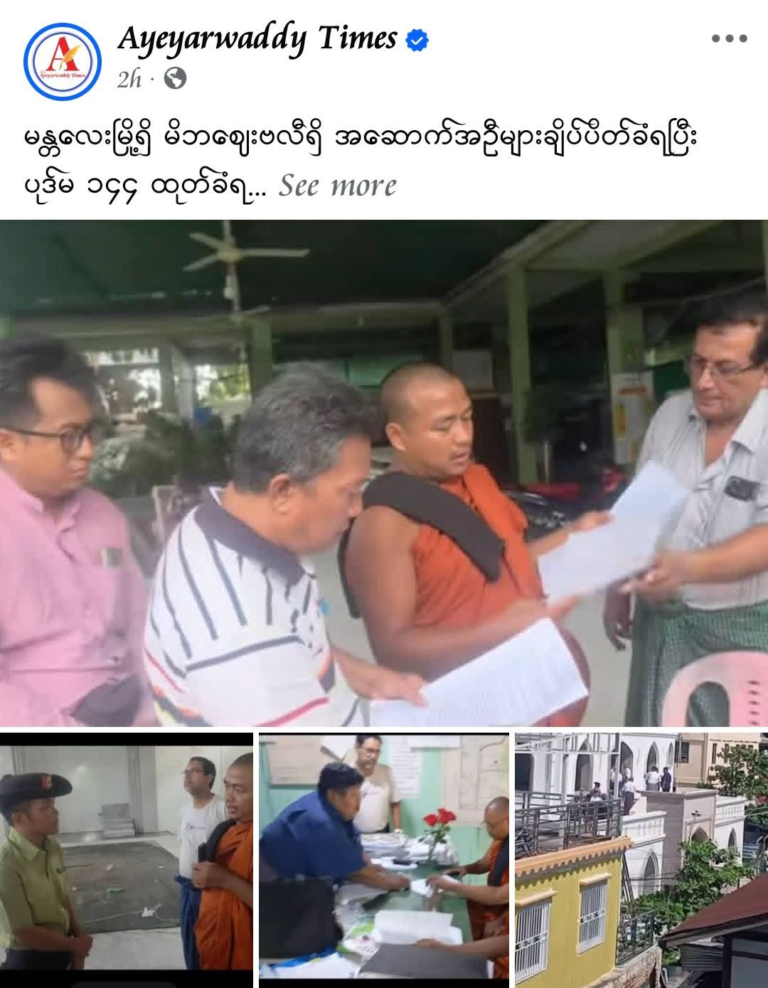
“If you practice Buddhism, even if your roots are uncertain and it’s unknown who your parents are, you will be granted citizenship. However, if you belong to another religion, successive governments have practiced—and continue to practice—a policy of fabricating accusations of ‘mixed blood’ to block citizenship through various means. This is proof of that.”
News Article (Xinhua):
NAY PYI TAW, August 25 (Xinhua) — Union Minister U Thein Swe of the Ministry of Labour, Immigration and Population announced in Pyithu Hluttaw today that National Verification Cards (Citizenship Scrutiny Cards) will be issued to native ethnic orphans residing and studying at monastic charity schools across Myanmar.
Responding to an inquiry by Daw May Win Myint, Pyithu Hluttaw representative for Mayangone Township, Yangon Region, the Minister stated: “Even if parental information cannot be verified, as long as it is confirmed that the individual belongs to a recognized national ethnic group or was born to two national ethnic parents, the Township Citizenship Scrutiny and Oversight Committee will decide and issue Citizenship Scrutiny Cards under relaxed procedural guidelines to grant them birthright citizenship.”
The Union Minister explained that a five-member Township Oversight Committee—comprising representatives from the Township Immigration Department, Township Police Force, Township Health Department, Township Planning Department, and the respective Ward/Village Tract Administrator—has been instructed to inspect and facilitate the issuance of citizenship cards for orphans in monastic charity schools.
According to the Minister’s directives:
- If the child’s father is unknown, the head of the monastic school (or a male teacher if the head of the school is female) will be listed as the adoptive father in the application, followed by “(Adoptive Father)”. However, the final Citizenship Scrutiny Card will state only the name of the father without adding “Adoptive Father”.
- If the mother’s name is unknown, it will simply be marked as “Unknown.”
- If ethnicity can be verified, the actual ethnicity will be recorded; if it cannot be determined, the ethnicity decided upon by the guardian and the five-member committee will be listed.
Fact-Check & Verification
- Origin of Report: The news report accurately reflects an official response delivered by Union Minister U Thein Swe in the Pyithu Hluttaw (Lower House) on August 25 during the NLD-led government administration.
- Legal Context (Myanmar 1982 Citizenship Law): Under Myanmar’s 1982 Citizenship Law, full birthright citizenship is legally reserved primarily for recognized “indigenous national ethnic groups” (such as Kachin, Kayah, Karen, Chin, Bamar, Mon, Rakhine, Shan, etc.).
- Religious vs. Ethnic Distinction: While the text specifically mentions “monastic charity schools” (ပရဟိတ ဘုန်းတော်ကြီးကျောင်းများ)—which are predominantly Buddhist institutions—the legal standard articulated by the Minister relies on ethnic classification (“တိုင်းရင်းသား”) rather than formal religious status. However, because monastic schools house the vast majority of state-supported orphans in Myanmar, applying relaxed procedures exclusively through these Buddhist-run institutions systematically favors children raised within Buddhist environments over non-Buddhist religious minorities who lack access to similar state-recognized monastic verification pathways.
- Critique of Discrimination: The user commentary highlights an ongoing structural issue in Myanmar’s citizenship administration. Human rights organizations and legal experts have documented that non-Buddhist minorities (particularly Muslims and non-recognized ethnic groups) routinely face systemic barriers, mandatory lineage verification, and accusations of being non-native (“mixed blood”), whereas orphans processed through state-sanctioned monastic networks receive streamlined documentation under administrative exceptions.
References
- Legislative Record: Pyithu Hluttaw Meeting Proceedings (Ministry of Labour, Immigration and Population response by Union Minister U Thein Swe).
- Legal Framework: Myanmar Citizenship Law (1982), Pyithu Hluttaw Law No. 4 of 1982, regulating full citizenship by ethnicity and bloodline.
- International Human Rights Context: NUS Centre for Asian Legal Studies Report on Freedom of Religion and Citizenship in Myanmar.