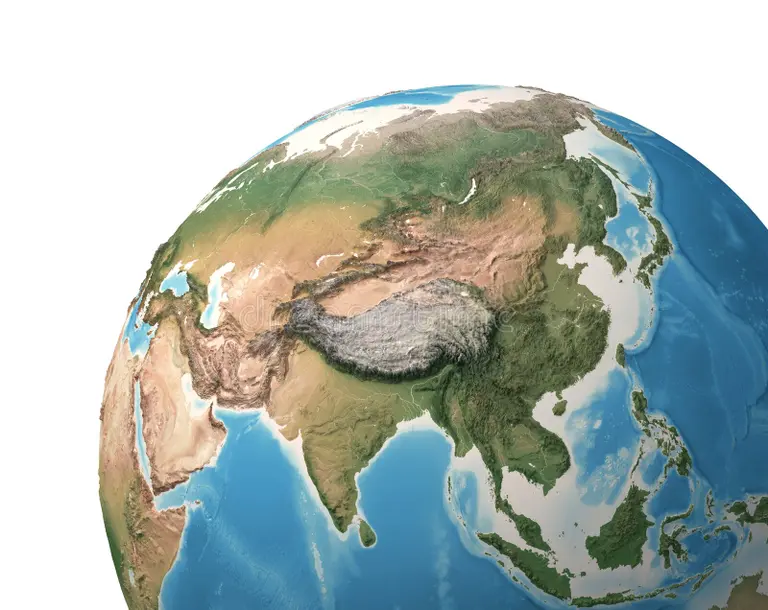
Planet Earth globe – Asia, Russia, China, India, Himalaya. High resolution satellite view of Planet Earth,focused on Asia,Russia,China,India,Himalaya – 3D illustration,elements of this image furnished by NASA. ID 275671231. © Titoonz | Dreamstime.com
Following the Rivers
The earliest people who entered ancient Burma did not carry maps.
They knew nothing of political borders or future kingdoms.
They simply followed nature’s guidance.
Like travellers everywhere, they searched for what every family has always needed: fresh water, fertile land, food, and safety.
Their greatest guide was not a king.
It was a river.
The Ayeyarwady and its tributaries became natural pathways into the heart of the country. Rivers provided fish to catch, fertile soil for cultivation, water for drinking, and convenient routes for travel. Forests supplied timber, wild fruits, medicinal plants, and game. Together, they created an environment in which scattered families could gradually grow into settled communities.
The story of Burma therefore began not in palaces but beside rivers.
Every civilization on Earth has depended upon water. The Nile nurtured ancient Egypt. The Tigris and Euphrates sustained Mesopotamia. The Indus gave rise to one of the world’s earliest urban civilizations, while the Yellow River helped shape ancient China.
Burma’s great river was the Ayeyarwady.
It became the quiet architect of history.
Generation after generation, people settled along its banks. They cleared forests, planted crops, learned from one another, and slowly transformed the landscape. They probably spoke different languages and came from different directions, yet the river united them in ways they themselves could never have imagined.
Long before anyone called this land Burma, the Ayeyarwady was already weaving together the lives of countless families.
Empires would later rise and fall.
Dynasties would come and go.
But the river endured.
In many ways, the history of Burma is also the history of the Ayeyarwady.
In the next chapter, we shall explore how archaeology, language, and modern science are helping us identify some of the earliest peoples who settled along these life-giving waterways.
Continue to read:
7/The Making of Myanmar: A History of Migrations, Civilizations and Peoples. Part Seven
8/The Making of Myanmar: A History of Migrations, Civilizations and Peoples. Part Eight