Why Did So Many Peoples Come to Burma?
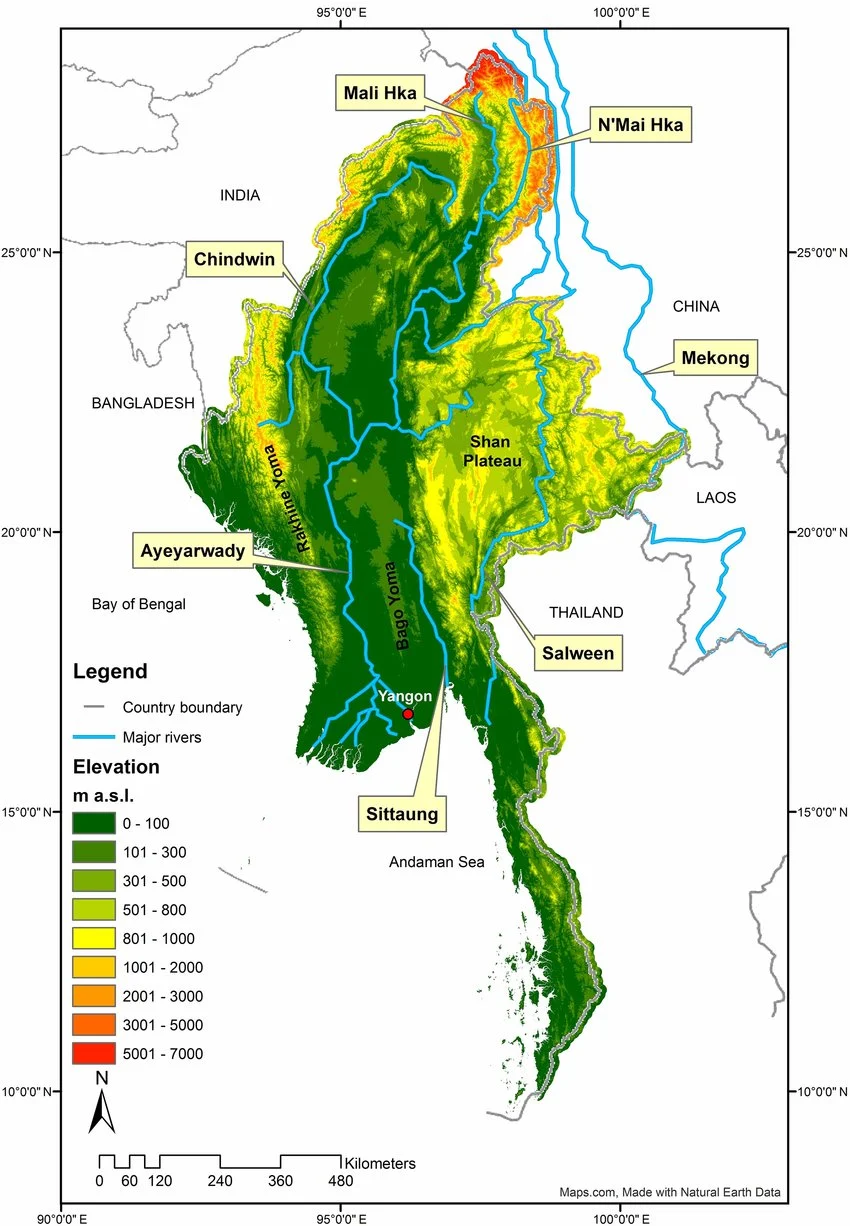
Map Credit: Mariele Evers University of Bonn. The world’s research
If we spread a large map of Asia on a table and place a finger on Burma, one fact immediately becomes clear.
Burma was never at the edge of Asia.
It was at its crossroads.
To the west lay the great civilizations of the Indian subcontinent. To the north stretched the highlands of Tibet and the ancient trade routes of China. To the east lived the peoples of mainland Southeast Asia, while to the south, the Bay of Bengal opened a maritime highway linking Burma with Sri Lanka, Arabia, and lands far beyond.
Nature itself invited movement.
The mighty Ayeyarwady, Chindwin, Salween and Sittaung rivers were not obstacles; they were highways long before roads were built. They carried traders, farmers, monks, fishermen, and explorers into the fertile plains of central Burma. Beyond the rivers, mountain passes connected the country with Yunnan, Assam, Manipur, and the Shan Plateau. Across the sea, the dependable monsoon winds carried ships between India and Burma with remarkable regularity.
For thousands of years, people did not travel because they wished to change the world’s history. They travelled because they wanted to improve their own lives.
Some sought fertile land.
Some searched for precious stones, timber, elephants, or metals.
Others came to exchange goods in growing markets.
Monks carried religious teachings. Scholars brought new ideas. Craftsmen introduced fresh skills. Soldiers marched with expanding kingdoms. Families simply looked for peace, safety, and a better future for their children.
Many never returned.
Instead, they settled, married, raised families, and gradually became part of the land itself.
This simple truth explains one of the greatest misunderstandings in Burma’s history.
No single people built Burma alone.
Like the strands of a finely woven cloth, many communities contributed their own colours and strengths. Over centuries, they exchanged languages, beliefs, technologies, customs, and traditions. The result was not a civilization copied from India, China, or any other neighbour, but something uniquely Burmese.
Understanding this is the key to understanding Burma itself.
In the next chapter, we shall begin meeting some of the earliest peoples whose journeys helped shape this remarkable land.
Continue to read 4/ The Making of Myanmar: A History of Migrations, Civilizations and Peoples. Part Four