(A Satire Inspired by the Seven Sleepers of the Cave)
By Dr Ko Ko Gyi @ Abdul Rahman Zafrudin with the help of Chat GPT
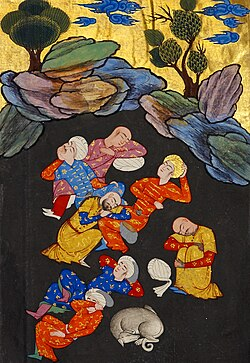
Picture Source: Wikipedia, Islamic Persian miniature of the Sleepers from a 1577 Stories of the Prophets manuscript.
I left Myanmar in 1986.
Like many migrants, I told myself:
“I will work abroad for a few years, save some money, and return home.”
Forty years later, I was still in Kuala Lumpur.
One night, after finishing my teh tarik and reading old news from Myanmar, I fell asleep in my chair.
When I opened my eyes again, I was no longer in Kuala Lumpur.
I was standing in Yangon.
At first, I thought Allah had performed a miracle similar to the story of the Companions of the Cave (Aṣḥāb al-Kahf).
I became excited.
“Surely,” I thought, “after forty years, Myanmar must look like Singapore.”
The Seven Sleepers of Ephesus slept for centuries and woke to a better world.
Perhaps I too had awakened into a modern paradise.
So I hailed a taxi.
The taxi driver looked at me strangely.
“Where have you been, U Lay?”
“I have been sleeping in Kuala Lumpur for forty years.”
He nodded.
“That explains why you still have hope.”
As we drove through the city, I noticed many buildings.
Some were new.
Others were ruins.
Many roads were broken.
Electricity disappeared and reappeared like a magician’s rabbit.
“What happened?” I asked.
The driver shrugged.
“Civil war.”
A few minutes later he added:
“Also earthquakes.”
Another few minutes later:
“Also corruption.”
Another few minutes later:
“Also bad luck.”
Then he paused.
“Although some people say bad leadership.”
I decided to visit my old village.
Halfway there, I thought I had entered an archaeological site.
Broken houses.
Collapsed schools.
Destroyed clinics.
Entire villages looked as if they were competing to become UNESCO historical ruins.
I asked a villager:
“How old are these ruins?”
He answered:
“Three years.”
I became worried.
Perhaps I had not returned to Myanmar.
Perhaps I had accidentally travelled to the Stone Age.
To confirm my suspicion, I searched for a mosque I had known as a young man.
I found only a fence.
“Where is the mosque?” I asked.
An elderly man laughed.
“Brother, that question is too modern.”
“Can we rebuild it?”
He laughed even louder.
“Now you are speaking science fiction.”
As I wandered around, I noticed another mystery.
Everywhere I looked, people were chewing betel nut.
Young men.
Old men.
Shopkeepers.
Drivers.
Politicians.
Retired officials.
Even some people who appeared to have no teeth left were still chewing.
I asked a doctor:
“Why are so many people visiting hospitals?”
He replied:
“Kidney stones.”
I looked around.
Suddenly everything made sense.
The houses were becoming stones.
The roads were becoming stones.
The politics were becoming stones.
The hearts were becoming stones.
And now even the kidneys were producing stones.
Myanmar had achieved total national stone self-sufficiency.
Confused, I went to a monastery and asked a wise monk:
“Venerable Sir, have I travelled backward through time?”
The monk smiled.
“No.”
“Then why does everything feel older than when I left?”
The monk answered:
“Because technology can move forward while minds move backward.”
I wrote down his words.
They sounded dangerous.
That night I fell asleep again.
In my dream, I met the Seven Sleepers of the Cave.
They asked me:
“Brother, how long did you sleep?”
“Forty years.”
They were impressed.
Then they asked:
“What wonders did you find when you woke up?”
I became silent.
One Sleeper said:
“We found a society that had progressed.”
Another said:
“We found freedom to practise our faith.”
A third said:
“We found that persecution had ended.”
Finally they asked:
“And what did you find?”
I replied:
“I found that some people still argue about who belongs in the country.”
“I found villages destroyed by war.”
“I found houses destroyed by earthquakes.”
“I found religious buildings waiting for permission to breathe again.”
“I found citizens surviving despite everything.”
The Sleepers looked at each other sadly.
Then the eldest among them smiled.
“Do not lose hope.”
“Empires fall.”
“Tyrants disappear.”
“Caves open.”
“Stones crack.”
“And people eventually wake up.”
The next morning I awoke once more.
This time I was back in Kuala Lumpur.
My chair was still there.
My unfinished cup of tea was still there.
My Malaysian neighbours were arguing about football instead of civil war.
I thanked Allah.
Then I made a silent prayer:
“O Lord,
Please let Myanmar one day experience the same miracle as the Seven Sleepers.
Not the miracle of sleeping for centuries,
but the miracle of finally waking up.”
Amen.
I continued my journey to Mandalay.
Surely, I thought, the city of my youth would have risen from the ashes.
After all, even Tokyo and Hiroshima rebuilt themselves from wartime destruction.
Forty years is enough time for a child to become a grandfather.
Forty years is enough time for a sapling to become a tree.
Forty years is enough time for a nation to become an economic tiger.
Yet as my bus approached Mandalay, I rubbed my eyes in disbelief.
Had I travelled to the wrong city?
Had I accidentally entered a historical museum?
Had the Mandalayans also discovered a magical cave and slept there for centuries?
The houses looked tired.
The roads looked exhausted.
The infrastructure appeared to have surrendered.
The city seemed frozen between memory and reality.
Then, in classic satire:
I asked a local man,
“Brother, when will this reconstruction finish?”
He scratched his head.
“Which reconstruction?”
“The one after the great fire.”
He looked puzzled.
“Which great fire?”
“The 1984 fire.”
He laughed.
“Ah, U Lay, since then we have had so many disasters that we need serial numbers.”
Reference: Wiki
Al-Kahf ‘the Cave’ is the sūrah of the Quran. The story of believers falling asleep in a cave for a long time is present also in the Christian tradition (Seven Sleepers). The Seven Sleepers in Christianity as the Seven Sleepers of Ephesus, and in Islam as Aṣḥāb al-Kahf Companions of the Cave), is a late antique Christian legend, and a Qur’anic Islamic story. It speaks about a group of youths who hid inside a cave around the year 250 AD to escape Roman persecutions of Christians and emerged many years later.
The Seven Sleepers have been venerated as Christian saints since at least the 5th century as the “Holy Seven Youths” in the Orthodox church; in the Catholic Church.
The story says that during the persecutions by the Roman emperor Decius, around AD 250, seven young men were accused of following Christianity. They were given time to recant their faith but refused to bow to Roman idols. Instead, they chose to give their worldly goods to the poor and retire to a mountain cave to pray, where they fell asleep. The Emperor, seeing that their attitude towards paganism had not improved, ordered the mouth of the cave to be sealed.
The story says that during the persecutions by the Roman emperor Decius, around AD 250, seven young men were accused of following Christianity. They were given time to recant their faith but refused to bow to Roman idols. Instead, they chose to give their worldly goods to the poor and retire to a mountain cave to pray, where they fell asleep. The Emperor, seeing that their attitude towards paganism had not improved, ordered the mouth of the cave to be sealed.
In Islam…The Quran tells that the polytheists (mushrikin) of Mecca, after consulting with the people of the Book, tested Muhammad by asking him three questions, and Surah Al-Kahf was sent down in answer to them.[clarification needed] The mushriks inquired about the identity of the Sleepers of the Cave.