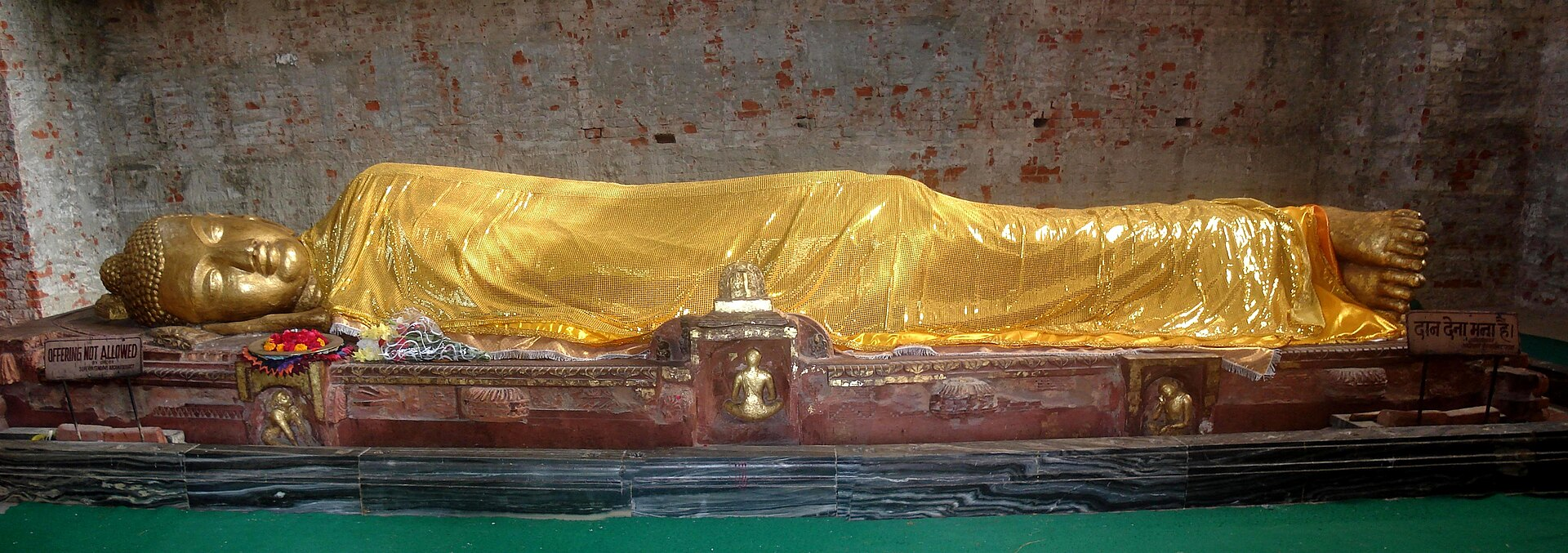
By myself – Own work, CC BY-SA 2.5, https://commons.wikimedia.org/w/index.php?curid=1766418
The matching physical positions between Islamic burials in India and the reclining Buddha at the Parinirvana Stupa is not a historical or theological connection, but a geometric outcome of geographical alignment. While the two traditions share an emphasis on resting on the right side, their requirements for cardinal directions stem from completely independent principles.
The Islamic Burial Alignment (Geographical Direction)
In Islamic law, the foundational requirement is that the deceased must face the Qibla (the direction of the Kaaba in Mecca).
• The Right Side Rule: It is a universal Islamic practice (Sunnah) to place the deceased on their right side.
• The North-South Orientation: Because Mecca is located west of India, a deceased person in India must face west. To face west while lying on the right side, the body must naturally be oriented with the head to the north and the feet to the south.
Note: This specific north-head orientation only happens in regions located east of Mecca (like India, Pakistan, or Southeast Asia). If a Muslim is buried in South Africa (south of Mecca), their head points south to face north. If they are buried in Europe (north of Mecca), their head points north-west or east depending on the angle needed to face south.
The Buddhist Parinirvana Alignment (Cosmological Tradition)
The posture of the Reclining Buddha at the Mahaparinirvana Temple in Kushinagar commemorates the exact physical posture Gautama Buddha took when he died.
• The Right Side Rule: According to Buddhist texts, the Buddha chose to pass away resting on his right side in the “lion posture” (Sihasayya).
• The Fixed North Orientation: Unlike the shifting nature of Islamic burials, ancient Indian and Buddhist traditions dictated that great teachers or kings pass away with their head pointing north. In ancient Indian cosmology (including Vastu Shastra), the north is considered the direction of liberation, the heavens, and spiritual transcendence.
Comparison of the Two Traditions
Feature Islamic Burial (in India) Buddha’s Parinirvana Posture
Primary Requirement Must face the Kaaba in Mecca (West of India) Head must point to the North (Cosmological significance)
Body Side Right side (Sunnah tradition) Right side (“Lion posture”)
Head Direction North (Logically required to face West) North (Fixed spiritual direction)
Face Direction West (Toward Mecca) West
Summary
The two positions align because Islam mandates facing a specific global point (Mecca), whereas Buddhism mandates a specific cosmic cardinal direction (North). Because India happens to sit directly east of Mecca, the mathematical geometry of the Islamic rule creates an identical physical layout to the ancient Indian Buddhist tradition.
•
Islam Stack Exchange
What is the reason for being buried lying on your right side?
1 Answer It is preferred to bury the deceased on their right side, but it is also permissible to bury them on their left side. Fac…
•
Wikipedia
Parinirvana Stupa – Wikipedia
The Parinirvana Stupa or Mahaparinirvana Temple is a Buddhist temple in Kushinagar, India which is said to be the place of death