Facebook post by KoWin Ko, added to the album “Memorable Books” (Odyssey) Translated, lightly edited for English readability, and fact-checked, with reference notes added
Re-reading the books written by Burmese Muslim authors in the late 19th and early 20th centuries, one notices something striking: Islamic literary material is presented through the vocabulary, prose style, and jataka-style narrative conventions that were already familiar to Burmese readers of classical literature — the two traditions woven together.
I became more aware of this while reading Dr. Shaikh Abdur Rahman’s The Great Tale of the Pasi, Told over a Thousand and One Nights (တထောင့်တစ်ည ပသီပုံပြင်ကြီး), published by Khin Cho Tun Sarpay. The volume also reproduces an essay by Thiripyanchi U Tha Myat titled “The Works of Our Great Burmese Muslims” (တို့ဗမာမူစလင်ကြီးများ၏ လက်ရာများ). [Fact-check: this essay is confirmed to exist and is attributed to U Tha Myat; one bibliographic citation found during fact-checking lists it as first published in the magazine Shumawa (ရှုမဝ), February 1959, rather than Myawaddy as stated in the original post — see note under References below.] The essay was originally a magazine article, and it recovers translated works produced by major Burmese Muslim writers within the older Burmese literary tradition.
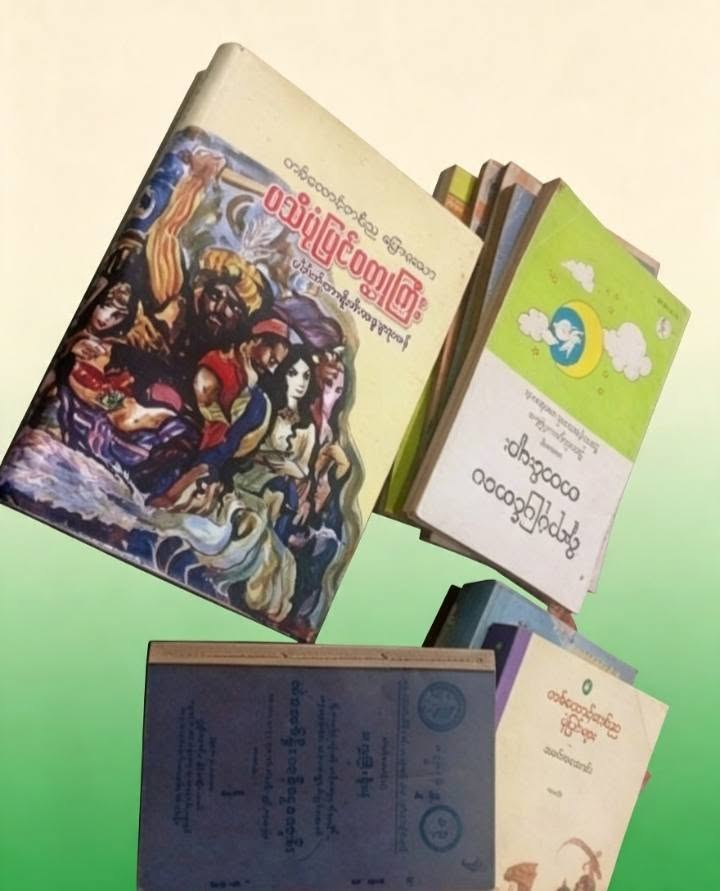
In discussing the history of Burmese translated fiction, U Tha Myat notes that while U Hla Kyaw’s 1904 Maung Yin Maung Ma Me Ma is well known, translated works by great Burmese Muslim writers had already appeared before it. He lists among these earlier translated works: The Great Story of Hatin Tayi (1889), The Great Jataka-Style Tale of Prince and Princess Yusuf Zulaikha (1904), and The Great Tale of the Pasi, Told over a Thousand and One Nights (1896). [Fact-check: independently corroborated. A library catalogue of old Burmese novels held at the British Library lists Hatin Tayi Wuthtudaw Gyi as printed in Rangoon in 1889 and Pasi Pon Pyin Wuthtu as printed in Rangoon in 1896, matching the dates given here. Burmese-language Wikipedia’s article on early Burmese-language novels likewise records that Maung Yin Maung Ma Me Ma (1904) is conventionally treated as the starting point of the “modern-era Burmese novel,” while noting these two earlier Muslim-authored translations predate it.]
Looking again at Hatin Tayi on this list, it turns out to be a novel printed roughly fifteen years before Maung Yin Maung Ma Me Ma (1904). But because it was a translation, it was never recorded in the canon of “modern-era” Burmese novels. I also came across a rather aggrieved blog post by a scholar on this very point. According to U Tha Myat’s account, the book runs to about 520 pages — the size of U Tun Nyein’s dictionary — and was set in movable type at the Hanthawaddy Press in Rangoon. A note at the end of the book records that typesetting was completed on 1 Nayon waning, 1251 ME, corresponding to 13 June 1889. [Fact-check: consistent with the 1889 print date corroborated above.]
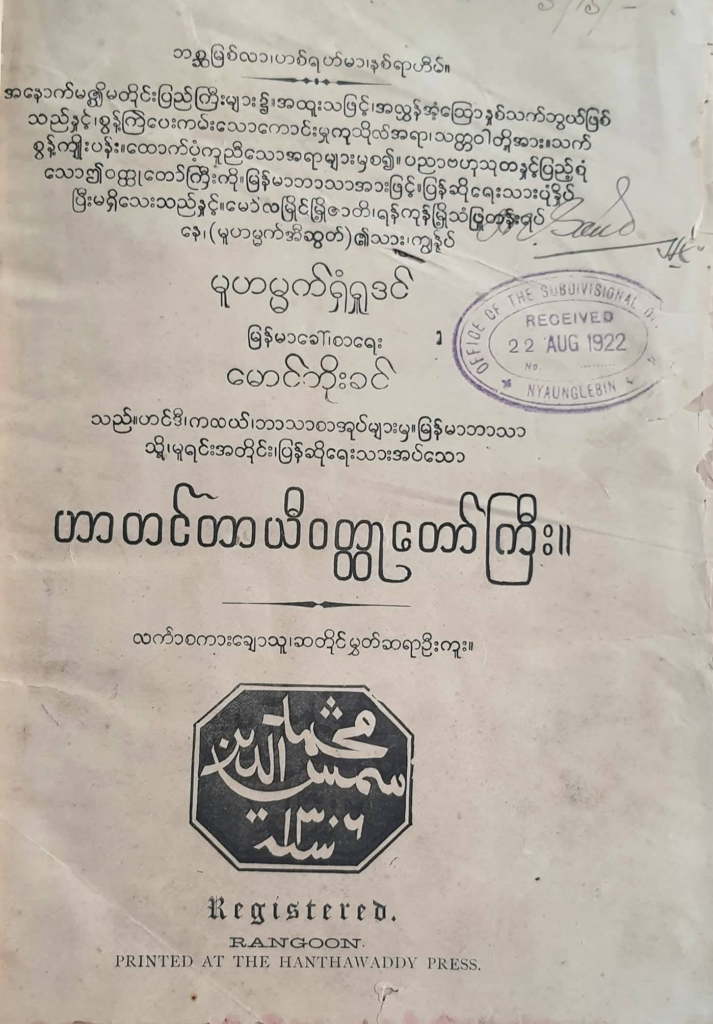
Reading the sample passage U Tha Myat quotes is genuinely interesting. Although this is a translated novel, it doesn’t read like one — nothing about it announces itself immediately as translated literature. U Tha Myat himself remarks that it is a pleasure to read because it is “so richly stocked with courtly, palace-register vocabulary.” The novel opens with the line “In the beginning of the world, as ordained by fate, in ancient times…,” and goes on to tell of the Prophet Noah and the Prophet Muhammad using the same ornamented diction found in Burmese chronicles, court literature, and religious texts. Although the subject matter is an Islamic story, the manner of telling it sits close to the flavour of old Burmese scripture. Later, on seeing the cover of the original Hatin Tayi volume that someone had posted on Facebook, I noticed it credited the translator as “Sitaing Hmwat Sayar U Ku, a master of polished verse.” (Credit for the image goes to that poster.) U Tha Myat’s own account does not mention this name. Checking further to see who else has documented this work of Sitaing Hmwat U Ku, I found it mentioned in Professor Aung Zaw’s History of Islamic Literature in Myanmar and in Hla Thamein’s Biographies of Celebrated Literary Figures, but not in Bo Thaung’s Biographies of Poets. It’s a detail that should certainly be included if anyone ever compiles Sitaing Hmwat U Ku’s bibliography. [Fact-check — important discrepancy: a British Library catalogue list of old Burmese novels and Burmese Wikipedia’s article on Burmese-era fiction both credit the translator of Hatin Tayi Wuthtudaw Gyi (1889) as “Hammat Shamsuddin,” also known as Maung Bo Khin — not “Sitaing Hmwat Sayar U Ku.” This is either two different names/titles for the same person, an error in one tradition of sources, or a case where the FB-posted cover and the mainstream bibliographic record genuinely disagree. This is worth verifying against the original book cover or a physical/scanned copy before treating either name as settled.]
The same pattern appears on revisiting Dr. Shaikh Abdur Rahman’s 1896 Pasi Pon Pyin. In translating the tale of Ali Baba and the Forty Thieves, the grandeur of the city of Persia is rendered using Burmese descriptions of royal cities — terms like pyi-oo (city gate towers), tanzaung (pavilions), kyaung-myaung (moats), and yin-tà tagà-taryoan (breastwork gates and turrets). In the book’s opening pages, too, one finds vocabulary drawn from brahmavihara (the four sublime states), apariha-niya (conditions for non-decline), and mingyin-taya (the duties of kings) — concepts chosen, it seems, to make the material accessible to readers of that era.
In the story of Aladdin as well, when Aladdin’s father admonishes his son, the text uses phrases such as “the seven-tiered golden palace of the heavens” and “the crow that rests atop the palace spire.” According to Maung Khin Min (Danuphyu), this phrasing echoes the passage admonishing the young man Hatthipala in Shin Mahayathathara’s Koe Gan Pyo (“Nine-Chapter Verse”). [Fact-check: this attribution to Maung Khin Min (Danuphyu) and the specific stylistic parallel could not be independently verified through the sources consulted; it is presented here as the original author’s citation and should be checked against Maung Khin Min’s own writings if a precise reference is needed.]
Dagon U Ba Din, Dr. Shaikh Abdur Rahman’s son, has written that his father was deeply fond of Burmese language and literature, having studied everything from palace dramas and Burmese chronicles to Shin Mahayathathara’s Koe Gan Pyo, and that traces of this literary grounding can be seen in the 1896 Pasi Pon Pyin. [Fact-check: a citation located during fact-checking — Dagon U Ba Din, “The First Author of the Pasi Pon Pyin Novel,” published in Shumawa magazine, February 1959 — appears to correspond to this same claim, though it lists the venue as Shumawa rather than Myawaddy as stated in the original post. See References below.]
Taking all this together, it becomes clear that late-19th-century Burmese Muslim literature did not exist as a separate world of its own, but was part of a shared literary culture in ongoing exchange with mainstream Burmese literature. The translators were not simply substituting Burmese words for the source text; they were reconstructing the original material using the literary language, idioms, jataka conventions, and religious vocabulary already familiar to readers of their own time.
Tracing this pattern back further still, one finds works such as the senior writer U Nu’s Sadaw U Tin Hlwa Sar (“Petition Presented to the Throne”). This was a memorandum on religious affairs that U Nu submitted on behalf of the Islamic community when King Bodawpaya inquired into the various religions practised in his realm.
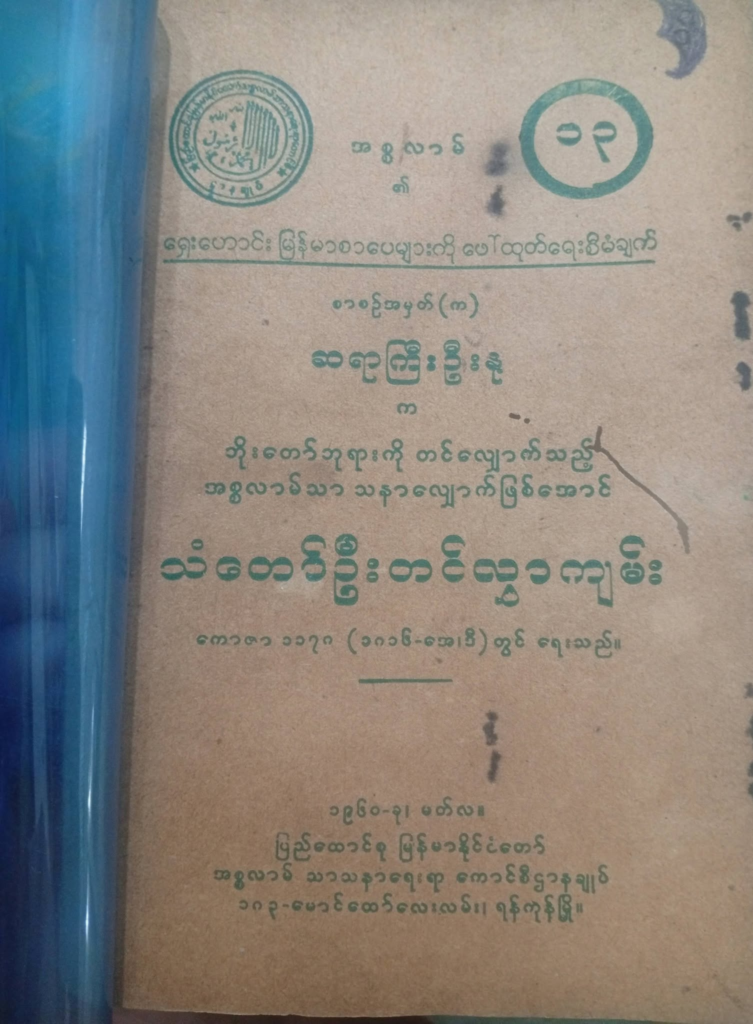
Sadaw U Tin Hlwa Sar sets out, in plain Burmese prose, matters concerning the Creator, the attributes of God, the origin of humankind, the prophets, moral conduct, sharia, the Holy Qur’an, the Prophet Muhammad, and Islamic doctrine generally. A document of this kind is early evidence of how Islamic subject matter was rendered in prose that ordinary Burmese readers could follow.
I have also come across a further piece of evidence that makes the point even clearer: U Htun Kywe’s 1938 compendium Collected Islamic Scripture (အစ္စလာမ်ပေါင်းချုပ်ကျမ်း). I once had the chance to hold a copy — a memory I recall vividly, holding it upstairs in the ordination hall before the chandelier came down. In size and format it resembles the Hatin Tayi Ta Nya Pasi Pon Pyin volume reissued by Khin Cho Tun Sarpay. It runs to more than 500 pages. Of the two volumes originally published, only the first came my way; I had it delivered to the Ledi Sayadaw’s monastery in Pathein about fifteen years ago, and I believe it is likely still there in the monastery library.
If such volumes as Collected Islamic Scripture can be tracked down and read again, the subject becomes even more interesting. In the passage where the wealthy Muslim merchant instructs his son, the text uses admonitions that resemble in meaning those found in the Sigalovada Sutta, and I also recall encountering phrasing echoing the Mangala Sutta. It isn’t enough to read such books one at a time — bringing together the Burmese, Muslim, religious, and translated literature that emerged from a single era and examining it as a body of work would likely reveal much more clearly how the literary cultures of that period borrowed from and exchanged with one another.
For that reason, if books such as Hatin Tayi and Pasi Pon Pyin are read only as story collections, an important structural feature of literary history is missed. Within these books, one needs to study together how archaic Burmese vocabulary, jataka-style narrative conventions, the ornamented language of religious literature, and Islamic subject matter came to be combined.
(Odyssey)
Fact-check summary
The post is a personal literary-history essay/reflection rather than a hard-news report, so most of it consists of the author’s reading and interpretation of older sources. The verifiable factual claims — book titles, translators, and publication dates for early Burmese-Muslim translated literature — largely check out against independent bibliographic sources (a British Library catalogue list and Burmese Wikipedia’s article on early Burmese novels):
- Confirmed: Maung Yin Maung Ma Me Ma (1904) by James Hla Gyaw, adapted from Dumas’s The Count of Monte Cristo, is conventionally regarded as the first “modern-era” Burmese novel.
- Confirmed: Hatin Tayi Wuthtudaw Gyi was printed in Rangoon in 1889 — about 15 years before Maung Yin Maung Ma Me Ma — but as a translation, it was not counted among “modern-era” Burmese novels.
- Confirmed: Pasi Pon Pyin Wuthtu, translated by Dr. Shaikh Abdur Rahman, was printed in Rangoon in 1896.
- Unresolved discrepancy: Mainstream bibliographic sources credit Hatin Tayi‘s translator as “Hammat Shamsuddin” (also called Maung Bo Khin), not “Sitaing Hmwat Sayar U Ku” as the post states was written on a Facebook-posted book cover. This is flagged for the reader rather than resolved, since it may reflect a genuine naming/attribution puzzle in the historical record rather than a simple error.
- Possible venue mix-up: The post states U Tha Myat’s essay first appeared in Myawaddy magazine (1959). The closest matching citation found during fact-checking — an essay by Dagon U Ba Din on the same book, from the same year — is recorded as published in Shumawa magazine, not Myawaddy. It’s possible these are two distinct 1959 articles by different authors on the same subject, in which case there is no error; this should be checked against the original magazine issue if precision matters.
- Not independently verifiable: The claim attributed to Maung Khin Min (Danuphyu) linking a phrase in the Aladdin story to Shin Mahayathathara’s Koe Gan Pyo, and the account of Dr. Shaikh Abdur Rahman’s personal reading history from his son Dagon U Ba Din, could not be checked against primary sources in this pass and are presented as the original author’s own citations.
References
- “Maung Yin Maung Ma Me Ma (novel).” Burmese Wikipedia. https://my.wikipedia.org/wiki/မောင်ရင်မောင်မမယ်မ_(ဝတ္ထု)
- “Myanmar-Era Novels.” Burmese Wikipedia. https://my.wikipedia.org/wiki/မြန်မာကာလပေါ်_ဝတ္ထုများ
- “Some Old Burmese Novels at the British Library, London.” Shan Yoe Mae Library (blog), citing a bibliographic list including Hatin Tayi Wuthtudaw Gyi (1889) and Pasi Pon Pyin Wuthtu (1896). https://shanyomaelibrary.wordpress.com/2026/01/26/
- “Shaikh Abdur Rahman, Doctor.” Burmese Wikipedia, citing Maung Khin Min (Danuphyu), Pasi Pon Pyin: Passing through Literary Milestones (2004), pp. 86–89; and Dagon U Ba Din, “The First Author of the Pasi Pon Pyin Novel,” Shumawa magazine (February 1959). https://my.wikipedia.org/wiki/ရှိတ်အပ္ပဒူရာမန်၊_ဒေါက်တာ
- “The Works of Our Great Burmese Muslims” (တို့ဗမာ မူစလင်ကြီးများ၏လက်ရာများ) — Thiripyanchi U Tha Myat. Republished excerpt, Shan Yoe Mae Library (blog). https://shanyomaelibrary.wordpress.com/2025/10/14/
Note on sourcing: items 1–2 and 4 are Wikipedia and a personal blog respectively; they are useful for cross-checking dates and names but are not peer-reviewed sources. For anything you intend to publish or cite formally, I’d recommend verifying against the primary printed sources (the books themselves, or the original 1959 magazine articles) where possible.
KoWin Ko added photos to the album: အမှတ်တရစာအုပ်များ။
“ဟာတင်တာယီ၊ တထောင့်တည ပသီပုံပြင်တို့ မှတဆင့် အတွေးပွားမိခြင်း”
၁၉ ရာစုနှောင်းပိုင်းနဲ့ ၂၀ ရာစုအစပိုင်းမှာ မြန်မာမူစလင်စာရေးဆရာတွေ ရေးသားခဲ့တဲ့ စာအုပ်တွေကို ပြန်ဖတ်ကြည့်မိရင် အစ္စလာမ်စာပေ ဆိုင်ရာ အကြောင်းအရာတွေကို မြန်မာစာဖတ်သူတွေနဲ့ ရင်းနှီးပြီးသား ရှေးမြန်မာစာပေရဲ့ စကားအသုံးအနှုန်း၊ ရေးဟန်၊ ဇာတ်နိပါတ်ပုံစံတွေနဲ့ ပေါင်းစပ်ဖော်ပြထားတာတွေကို တွေ့ရပါတယ်။
ခင်ချိုထွန်းစာပေက ထုတ်ဝေထားတဲ့ ဒေါက်တာရှိတ်အဗ္ဗဒူရာမန်ရဲ့ “တစ်ထောင့်တစ်ည ပသီပုံပြင်ကြီး” စာအုပ်ကို ဖတ်ရင်း ဒီအချက်ကို ပိုပြီး သတိထားမိလာပါတယ်။ ဒီစာအုပ်ထဲမှာ သီရိပျံချီ ဦးသာမြတ်ရေးသားခဲ့တဲ့ “တို့ဗမာမူစလင်ကြီးများ၏ လက်ရာများ” ဆိုတဲ့ ဆောင်းပါးကိုလည်း ထည့်သွင်းဖော်ပြထားပါတယ်။ အဲဒီဆောင်းပါးဟာ မူလအားဖြင့် ၁၉၅၉ ခုနှစ်ထုတ် မြဝတီမဂ္ဂဇင်းမှာ ပါဝင်ခဲ့တဲ့ ဆောင်းပါးဖြစ်ပြီး၊ ရှေးမြန်မာစာပေထဲမှာ မြန်မာမူစလင်စာရေးဆရာကြီးတွေ ရေးသားခဲ့တဲ့ ဘာသာပြန်လက်ရာတွေကို ပြန်လည်ဖော်ထုတ်ပေးထားတာ ဖြစ်ပါတယ်။
ဦးသာမြတ်က မြန်မာဘာသာပြန်ဝတ္ထုသမိုင်းကို ပြောရာမှာ ၁၉၀၄ ခုနှစ်ထုတ် ဦးလှကျော်ရဲ့ “မောင်ရင်မောင် မမယ်မ” ကို လူသိများပေမယ့် အဲဒီမတိုင်မီကတည်းက မြန်မာမူစလင်စာရေးဆရာကြီးတွေရဲ့ ဘာသာပြန်လက်ရာတွေ ပေါ်ထွက်နေခဲ့ကြောင်း ထောက်ပြထားပါတယ်။ ၁၈၈၉ ခုနှစ်ထုတ် “ဟာတင်တာယီဝတ္ထုတော်ကြီး”၊ ၁၉၀၄ ခုနှစ်ထုတ် “ယူဆွတ်ဇိုလိုင်ခါ မင်းသမီးမင်းသား ဇာတ်နိပါတ်ဝတ္ထုတော်ကြီး” နဲ့ ၁၈၉၆ ခုနှစ်ထုတ် “တစ်ထောင့်နှင့်တစ်ည ပြောရသော ပသီပုံပြင်ဝတ္ထုကြီး” တို့ကိုလည်း အဲဒီအစောပိုင်းဘာသာပြန်စာပေလက်ရာတွေထဲမှာ ထည့်သွင်းဖော်ပြထားပါတယ်။
ဒီစာရင်းထဲက “ဟာတင်တာယီ ဝတ္ထုတော်ကြီး” ကို ပြန်လှန်ကြည့်မိတဲ့အခါ ၁၉၀၄ ခုနှစ်မှာ ထုတ်ဝေခဲ့တဲ့ “မောင်ရင်မောင် မမယ်မ” ထက် ဆယ့်ငါးနှစ်ခန့် စောပြီး ပုံနှိပ်ထုတ်ဝေခဲ့တဲ့ ဝတ္ထုကြီးတစ်အုပ် ဖြစ်နေပါတယ်။ ဘာသာပြန်ဖြစ်တဲ့အတွက် ကာလပေါ် မြန်မာဝတ္ထု စာရင်းဝင်ထဲတော့ မှတ်တမ်းတင်မခံရပါဘူး။ အဲ့ဒီကိစ္စကို ဆရာတစ်ယောက်က မကျေမချမ်းရေးထားတဲ့ ပိုစ့်တခုဖတ်မိပါသေးတယ်။ ဦးသာမြတ်ရဲ့ မှတ်တမ်းအရ စာအုပ်ဟာ ဦးထွန်းငြိမ်းအဘိဓာန်အရွယ် စာမျက်နှာ ၅၂၀ ရှိပြီး ရန်ကုန်မြို့ ဟံသာဝတီပုံနှိပ်တိုက်မှာ စက်တင်ပုံနှိပ်ခဲ့တာ ဖြစ်ပါတယ်။ ဝတ္ထုအဆုံးမှာ ၁၂၅၁ ခုနှစ်၊ နယုန်လဆုတ် ၁ ရက်၊ ၁၈၈၉ ခုနှစ် ဇွန်လ ၁၃ ရက်နေ့မှာ စက်တင်ပုံနှိပ်ပြီးဆုံးကြောင်း မှတ်တမ်းတင်ထားပါတယ်။
ဦးသာမြတ်ရဲ့ နမူနာကောက်စာပြထားတာကို ဖတ်ကြည့်တဲ့အခါ စိတ်ဝင်စားစရာကောင်းတာ တွေ့ရပါတယ်။ ဒီစာအုပ်ဟာ ဘာသာပြန်ဝတ္ထုတစ်အုပ်ဖြစ်ပေမယ့် ဖတ်ကြည့်တဲ့အခါ ဘာသာပြန်စာပေလို့ ချက်ချင်းသိသာနေတဲ့ ရေးဟန်မျိုး မဟုတ်တာပါပဲ။ ဦးသာမြတ်ကလည်း “ထီးသုံးနန်းသုံးစကားလုံးများ ကြွယ်ဝလှသဖြင့်” ဖတ်ရှု၍ မငြီးနိုင်ကြောင်း သုံးသပ်ထားပါတယ်။ ဝတ္ထုအစမှာ “လောကဓာတ်ဟု၊ ပညတ်ရိုက်ကျူး၊ ရှေးလွန်ဦး၌ …” ဆိုတဲ့ အဖွင့်နဲ့ စတင်ပြီး နဘီနူဟူ၊ နဘီမူဟမ္မက်တို့အကြောင်းကို မြန်မာစာပေထဲက ရာဇဝင်၊ နန်းတွင်းစာပေ၊ ဘာသာရေးစာပေတွေမှာ တွေ့ရတတ်တဲ့ စကားအဖွဲ့အနွဲ့နဲ့ ရေးသားထားပါတယ်။ အစ္စလာမ်ပုံပြင်ဆိုင်ရာ အကြောင်းအရာကို ပြောနေပေမယ့် ဖော်ပြဟန်က ရှေးမြန်မာကျမ်းစာတွေရဲ့ အရသာနဲ့ နီးစပ်နေပါတယ်။ နောက်ပိုင်း Fb မှာ တစ်ယောက် တင်ထားတဲ့ “ဟာတင်တာယီ ” မူရင်းဝတ္ထု မျက်နှာဖုံးကို မြင်ရတော့မှ ” လင်္ကာစကားချောသူ၊ ဆတိုင်မွှတ်ဆရာဦးကူး” ဆိုတဲ့ မှတ်တမ်းတင်ထားတာကိုတွေ့မိပါတယ်(ပုံအတွက် Credit, ပေးပါတယ်) ။ အဲ့ဒီအချက်ကို ဆရာဦးသာမြတ်ကတော့ ထည့်မရေးထားပါဘူး။ ဆတိုင်မွှတ်ဦးကူးရဲ့ အခုလက်ရာကို ဘယ်သူတွေ မှတ်တမ်းတင်ထားသေးသလဲ ဆိုပြီး နီးစပ်ရာစာအုပ်ထပ်လှန်တော့ ပါမောက္ခအောင်ဇော် ရဲ့ မြန်မာနိုင်ငံ အစ္စလာမ်စာပေသမိုင်း၊ လှသမိန်ရဲ့ ဂန္ထဝင်ပုဂ္ဂိုလ်ကျော်များ အထုပ္ပတ္ထိ စာအုပ်ထဲမှာလည်း ရေးတို့ထားတာတွေ့ရပါတယ်။ ဗိုလ်မှူး ဘသောင်းရဲ့ စာဆိုတော်များ အထုပ္ပတ္တိမှာတော့ မတွေ့ရပါဘူး။ နောင်ကို ဆတိုင်မွှတ်ဦးကူး စာစုစာရင်းလုပ်ရင် မဖြစ်မနေ ထည့်ရမယ့် အချက်တခုပါပဲ။
ဒေါက်တာရှိတ်အဗ္ဗဒူရာမန်ရဲ့ ၁၈၉၆ ခုနှစ်ထုတ် “ပသီပုံပြင်” ကို ပြန်ကြည့်တဲ့အခါလည်း ဒီအချက်ကို တွေ့နိုင်ပါတယ်။ အလီဘာဘာနဲ့ ဓားပြလေးဆယ်ပုံပြင်ကို ဘာသာပြန်ရာမှာ ပိရ်သျှပြည်ကြီးရဲ့ မြို့ပြအလှအပကို “ပြအိုး၊ တန်ဆောင်း၊ ကျုံးမြောင်းပစ္စင်၊ ရင်တားတံခါးတုရိုဏ်” စတဲ့ မြန်မာ့မြို့ပြဖော်ပြချက်တွေကို အသုံးပြုပြီး ပုံဖော်ထားပါတယ်။ ဝတ္ထု မျက်နှာဖွင့် အစပိုင်းမှာလည်း ဗြဟ္မစိုရ်တရား၊ အပရိဟာနိယတရား၊ မင်းကျင့် တရား စသည်ဖြင့် ထိုခေတ်က လူများ နားလည်လွယ်စေရန် အတွက် အကွက်ဆိုက်အောင် စကားလုံး ဝေါဟာရကို အသုံးပြုထားတာကို မြင်တွေ့ရပါတယ်။
အာလာဒင်နဲ့ ပတ်သက်တဲ့ ဇာတ်လမ်းမှာလည်း အာလာဒင်ရဲ့ဖခင်က သားဖြစ်သူကို ဆုံးမတဲ့အခါ “ရွှေအိမ်ဘုံမြင့်ခုနှစ်ဆင့်” နဲ့ “ပြာသာဒ်ဖျားတွင် နားသောကျီး” ဆိုတဲ့ စကားအဖွဲ့ကို အသုံးပြုထားပါတယ်။ ဒါဟာ ရှင်မဟာရဋ္ဌသာရရဲ့ “ကိုးခန်းပျို့” ထဲက ဟတ္ထိပါလသတို့သားကို ဆုံးမတဲ့အခန်းနဲ့ ဆက်စပ်နေတဲ့ အသုံးအနှုန်း ဖြစ်တယ်လို့ မောင်ခင်မင်(ဓနုဖြူ)က ဆိုပါတယ်။
ဒေါက်တာရှိတ်အဗ္ဗဒူရာမန်ဟာ မြန်မာစာ၊ မြန်မာမှုကို အလွန်နှစ်ခြိုက်သူဖြစ်ကြောင်း၊ နန်းတွင်းဇာတ်တော်ကြီးတွေကစပြီး မြန်မာရာဇဝင်၊ ရှင်မဟာရဋ္ဌသာရရဲ့ ကိုးခန်းပျို့အထိ ဖတ်မှတ်လေ့လာခဲ့သူဖြစ်ကြောင်း သူ့သားဖြစ်သူ ဒဂုန်ဦးဘတင်က ရေးသားထားပါ သေးတယ်။ ၁၈၉၆ ခုနှစ်က ရေးသားခဲ့တဲ့ “ပသီပုံပြင်” ထဲမှာ အဲဒီစာပေလေ့လာမှုရဲ့ အရိပ်အယောင်တွေကို တွေ့နိုင်တယ်လို့လည်း ဆိုထားပါတယ်။
ဒီအမြင်နဲ့ဒီအချက်တွေကို ပြန်ကြည့်ရင် ၁၉ ရာစုနှောင်းပိုင်းက မြန်မာမူစလင်စာပေဟာ သီးခြားကမ္ဘာတစ်ခုအနေနဲ့ တည်ရှိနေတာမဟုတ်ဘဲ မြန်မာ့စာပေယဉ်ကျေးမှုထဲမှာ အပြန်အလှန်ယူငင်ဖလှယ်နေတဲ့ စာပေကမ္ဘာတစ်ခုဖြစ်နေခဲ့ပုံကို မြင်ရပါတယ်။ ဘာသာပြန်သူက မူရင်းစာသားကို မြန်မာစကားလုံးတွေနဲ့ အစားထိုးပေးရုံမျှ မဟုတ်ဘဲ မူရင်းအကြောင်းအရာကို မိမိခေတ်က စာဖတ်သူတွေ နားလည်နိုင်အောင် မိမိတို့ရင်းနှီးပြီးသား စာပေစကား၊ စကားပုံ၊ ဇာတ်တော်နဲ့ ဘာသာရေးအယူအဆတွေနဲ့ ပြန်လည်တည်ဆောက်ပေးတာမျိုးတွေ တွေ့နေရပါတယ်။
အဲဒီအချက်ကို ပိုပြီး စောစောပိုင်းအထိ ပြန်လိုက်ကြည့်ရင် ဆရာကြီး ဦးနုရဲ့ “သံတော်ဦးတင်လွှာကျမ်း” လို စာပေလက်ရာတွေကိုလည်း တွေ့ရပါတယ်။ ဗဒုံမင်းလက်ထက်မှာ သာသနာပေါင်းစုံနဲ့ ပတ်သက်ပြီး ဘုရင်က စူးစမ်းမေးမြန်းတော်မူရာ အစ္စလာမ်သာသနာဘက်ကနေ ဦးနုက ရေးသားတင်ပြခဲ့တဲ့ သာသနာ လျှောက်စာတမ်းဖြစ်ပါတယ်။
“သံတော်ဦးတင်လွှာကျမ်း” မှာ ဖန်ဆင်းရှင်အကြောင်း၊ အရှင်မြတ်ရဲ့ ဂုဏ်တော်၊ လူသားတို့ရဲ့အစ၊ နဗီတမန်တော်များ၊ ကျင့်ဝတ်တရား၊ ရှရီအတ်၊ ကုရ်အာန်ကျမ်းမြတ်၊ မုဟမ္မဒ်သခင်နဲ့ အစ္စလာမ်ဘာသာဆိုင်ရာ အယူအဆတွေကို မြန်မာစကားပြေရေးဟန်နဲ့ ရှင်းလင်းဖော်ပြထားပါတယ်။ ဒီလိုစာတမ်းမျိုးကလည်း အစ္စလာမ်ဘာသာဆိုင်ရာ အကြောင်းအရာတွေကို မြန်မာစာဖတ်သူနားလည်နိုင်တဲ့ စကားပြေဟန်နဲ့ ဘယ်လိုတင်ပြခဲ့ကြသလဲဆိုတာ လေ့လာနိုင်တဲ့ အစောပိုင်းအထောက်အထားတစ်ခု ဖြစ်ပါတယ်။
အချက်ကို ပိုသိသာစေတဲ့ နောက်ထပ်မှတ်တမ်းတစ်ခုကိုလည်း တွေ့ဖူးပါတယ်။ ၁၉၃၈ က ဦးထွန်းကြွယ် ရေးခဲ့တဲ့ “အစ္စလာမ်ပေါင်းချုပ်ကျမ်း” စာအုပ်ကို ရခဲ့ဖူးပါတယ်။ သိမ်ကြီးအပေါ်ထပ်က ချန်ဒရားမဆုံးခင် စာအုပ်ကို ဘိုင်နင်းကိုင်ပေးခဲ့တာ အမှတ်တရပါပဲ။ စာအုပ်အရွယ်အစားနဲ့ ပုံစံက ခင်ချိုထွန်းစာပေက ပြန်ထုတ်ထားတဲ့ “တထောင့်တည ပသီပုံပြင်” စာအုပ်ဆိုဒ်မျိုးပါပဲ။ စာမျက်နှာ ၅၀၀ ကျော် ရှိပါတယ်။ နှစ်တွဲ ထွက်ခဲ့တဲ့အနက် ပထမတွဲ တအုပ်သာရခဲ့ဖူူးပါတယ်။ အဲဒီစာအုပ်ကို လွန်ခဲ့တဲ့ ၁၅ နှစ်ခန့်က ပုသိမ်မြို့က လယ်တီဆရာတော်ထံ ဝယ်ပို့ပေးဖူးတာဖြစ်ပြီး အခုချိန်ထိ ကျောင်းတိုက်မှာ ရှိကောင်းရှိနေမယ်လို့ ထင်မိပါတယ်။
အဲဒီ “အစ္စလာမ်ပေါင်းချုပ်”ကျမ်း လို စာအုပ်တွေကို ပြန်ရှာဖတ်နိုင်ရင်တော့ ဒီအကြောင်းအရာဟာ ပိုပြီး စိတ်ဝင်စားစရာကောင်းလာနိုင်ပါတယ်။ အစ္စလာမ်သဌေးကြီးက သူ့သားကို ဆုံးမစကားပြောတဲ့နေရာမှာ “သိင်္ဂါလောဝါဒသုတ်” ထဲက စကားအဓိပ္ပာယ်တွေနဲ့ ဆင်တူတဲ့ အဆုံးအမတွေကို အသုံးပြုထားပါတယ်။ “မင်္ဂလသုတ်” ထဲက စကားရပ်တွေလည်း တွေ့ရတယ်လို့ ဖတ်မှတ်မိပါတယ်။ ဒီလိုစာအုပ်တွေကို တစ်အုပ်ချင်းစီ ဖတ်ကြည့်ရုံနဲ့ မပြီးဘဲ တစ်ခေတ်တည်းက ထွက်လာတဲ့ မြန်မာ၊ မူစလင်၊ ဘာသာရေးနဲ့ ဘာသာပြန်စာပေတွေကို တစ်စုတစ်စည်းတည်း ပြန်ကြည့်မယ်ဆိုရင် အဲဒီခေတ်က စာပေယဉ်ကျေးမှုတွေ ဘယ်လို အပြန်အလှန်ယူငင်ဖလှယ်ခဲ့ကြသလဲဆိုတာ ပိုမြင်လာနိုင်မယ်ထင်ပါတယ်။
ဒါကြောင့် “ဟာတင်တာယီ”၊ “ပသီပုံပြင်” စတဲ့ စာအုပ်တွေကို ပုံပြင်စာအုပ်အဖြစ်ပဲ ကြည့်မယ်ဆိုရင် ခေတ်သမိုင်းရဲ့ အရေးကြီးတဲ့ စာပေဖွဲ့စည်းပုံ တစ်ခုကို မမြင်မိနိုင်ပါဘူး။ အဲဒီစာအုပ်တွေအတွင်းမှာ မြန်မာ့စာပေထဲက ရှေးဟောင်းစကားလုံးတွေ၊ ဇာတ်နိပါတ်ရေးဟန်တွေ၊ ဘာသာရေးစာပေရဲ့ စကားအဖွဲ့အနွဲ့တွေနဲ့ အစ္စလာမ်ဘာသာဆိုင်ရာ အကြောင်းအရာတွေ တစ်ခုနဲ့တစ်ခု ဘယ်လိုပေါင်းစပ်သွားသလဲဆိုတာကိုပါ တွဲဖက်လေ့လာဖို့ လိုပါတယ်။
(Odyssey)