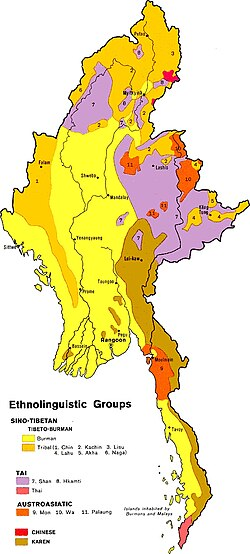
By Courtesy of the University of Texas Libraries, The University of Texas at Austin, Public Domain, https://commons.wikimedia.org/w/index.php?curid=1058044
From Ethnic and Religious Fragmentation to a Union of Equal Citizens
An MMNN Reflection on Ethnicity, Religion, Federalism, Union and the Future of Myanmar
A thought-provoking observation by a Myanmar compatriot living in the United States deserves wider reflection.
Myanmar-origin communities in America include Bamar, Karen, Mon, Chin, Kachin, Kayah, Rakhine, Pa-O, Shan and many other ethnic communities, as well as people of Indian, Muslim and other backgrounds. Yet migration to a multicultural country does not automatically erase the divisions people carried from their homeland.
In some cases, those divisions can become even more visible.
Communities may organise primarily according to ethnicity. Within the same ethnic group, religious differences can create further separation. Within the same religious community, language, dialect, geography or political affiliation can become additional boundaries.
A Karen may help another Karen—but perhaps not a Karen of another faith.
A Chin may identify strongly with other Chin—but language and church affiliation may divide Chin communities.
Similar patterns can occur among other ethnic communities.
This raises a fundamental question:
If people who have suffered from discrimination and conflict themselves continue to divide humanity into smaller and smaller categories, how can we build a peaceful and democratic Myanmar?
This question is not an accusation against any particular ethnic group.
It is a question for all of us.
The Mirror We Should Be Willing to Look Into
For decades, many Myanmar ethnic minorities have rightly complained about discrimination, centralisation, Burmanisation, unequal citizenship, military domination and the failure of successive governments to respect ethnic rights.
Those grievances cannot simply be dismissed.
The Bamar majority must honestly acknowledge the historical injustices experienced by many ethnic communities.
But there is another uncomfortable question that we should also be willing to ask:
Have we all learned enough from those injustices to avoid reproducing the same mentality among ourselves?
If discrimination by a majority is wrong, discrimination by a minority is also wrong.
If majoritarian domination is wrong, domination by an ethnic minority over another minority is also wrong.
If religious discrimination is wrong when directed against Muslims, it remains wrong when directed against Christians, Buddhists, Hindus or anyone else.
If linguistic discrimination is wrong when directed against an ethnic minority, it is equally wrong when one community discriminates against another community simply because its language is different.
The principle must be universal:
What is wrong when done to us is also wrong when we do it to others.
That is the foundation of a genuine democratic culture.
The Bamar Question
For years, the phrase “Burman/Bamar majoritarianism” has been used to describe the domination of the Bamar majority over other ethnic nationalities.
There are legitimate historical reasons why such criticism exists.
But sometimes the political narrative becomes dangerously simplified:
Bamar = oppressor.
Non-Bamar = oppressed.
History is rarely so simple.
Millions of ordinary Bamar people have also suffered under military dictatorship, civil war, poverty, displacement, censorship, forced labour, imprisonment and political repression.
The military cannot be equated with the Bamar people.
Likewise, ethnic armed organisations cannot automatically be equated with every member of the ethnic community they claim to represent.
A Karen civilian is not the same as a Karen armed organisation.
A Shan civilian is not the same as a Shan armed organisation.
A Bamar civilian is not the same as the Myanmar military.
A Muslim civilian is not the same as a Muslim political organisation.
We must learn to distinguish people from institutions, communities from armed organisations, and ethnic identity from political ideology.
Otherwise, we simply replace one form of collective stereotyping with another.
The Paradox of Separation
There is another paradox worth considering.
Some political movements have spent decades warning against Bamar domination and advocating greater ethnic autonomy.
Those demands can be legitimate.
But if the ultimate response is for every ethnic community to establish its own political, economic and social sphere—with each community becoming increasingly suspicious of the others—we may solve one problem only by creating many new ones.
Imagine Myanmar divided into increasingly separate political communities.
Then ask:
Who controls the rivers?
Who controls the roads?
Who controls the ports?
Who controls the electricity grid?
Who controls the natural resources?
Who controls cross-border trade?
Who protects minorities living inside another ethnic homeland?
Who protects people whose ethnicity does not correspond to the territory in which they were born?
And, most importantly:
What happens to a Karen living in a predominantly Shan area, a Muslim living in a predominantly Buddhist area, a Bamar living in an ethnic state, a Kachin living in Yangon, or a Chin living in Mandalay?
Myanmar’s people are not neatly arranged into separate geographical boxes.
We have lived together for centuries.
Our families, languages, religions, businesses and histories are intertwined.
We cannot simply redraw the map and expect human relationships to become simple.
A Country Is More Than Its Ethnicities
This is why the future Myanmar Union should not be built upon the idea that one ethnic group must dominate all others.
But neither should it be built upon the assumption that every community must eventually separate from every other community.
There is a third possibility:
A Union in which nobody needs to dominate and nobody needs to escape.
That is the essence of meaningful federal democracy.
Federalism should not mean:
“Let us divide Myanmar into competing ethnic fortresses.”
It should mean:
“Let us distribute power so that no centre can dominate everyone else, while allowing all communities to govern their own legitimate affairs within a democratic Union.”
That distinction is extremely important.
The United States Offers One Lesson—Not a Perfect Model
The original observation from America is particularly interesting because the United States itself is far from perfect.
America has experienced slavery, racism, segregation, religious discrimination, xenophobia and serious racial tensions.
It still struggles with them.
Therefore, nobody should romanticise America as a perfect society.
But America demonstrates something important:
People of enormously different ethnic, linguistic and religious backgrounds can live within one political system when citizenship, law and institutions are stronger than ethnic boundaries.
A person does not have to abandon his or her ethnic identity in order to become an American.
Likewise, a future citizen of Myanmar should not have to abandon being Karen, Kachin, Chin, Shan, Rakhine, Mon, Bamar, Pa-O, Kayah, Muslim, Christian, Buddhist, Hindu or any other identity in order to become a loyal citizen of Myanmar.
We should be able to say:
I am Karen—and I am Myanmar.
I am Shan—and I am Myanmar.
I am Bamar—and I am Myanmar.
I am Muslim—and I am Myanmar.
I am Christian—and I am Myanmar.
These identities should not have to compete.
They can coexist.
A Lesson From a Burmese Buddhist Monastery
There is also a beautiful example from the original account that deserves attention.
In Fort Wayne, Indiana, a Burmese Buddhist monastery reportedly became a place where Myanmar Muslims could also seek assistance.
That is a powerful reminder.
A monk helping a Muslim does not make him less Buddhist.
A Muslim helping a Buddhist does not make him less Muslim.
A Karen helping a Bamar does not make him less Karen.
A Bamar helping a Rohingya does not make him less Bamar.
Humanity does not require us to surrender our identity.
It requires us to recognise the humanity of others.
This is perhaps one of the most important lessons Myanmar desperately needs.
The Old Metaphor of the Broken House
Years ago, in one of my Burma Digest writings, I used the metaphor of a troubled relationship and a damaged house.
If the roof leaks, can we blame only the house?
What about the rain?
If darkness covers the house, should we simply abandon it?
Or should we repair the roof, obtain a generator, install solar power and light a lamp?
That metaphor remains relevant to Myanmar.
Our country is a damaged house.
The roof leaks.
The electricity is failing.
Some rooms have been burned.
Some family members have left.
Some have been expelled.
Some have been imprisoned.
Some have taken up arms.
Some no longer trust the others.
Some want to renovate the house.
Some want to build another house.
Some want to divide the house.
Some want to leave permanently.
And some believe they alone should own the house.
But perhaps we should ask a different question:
Why don’t we repair the house together?
The Divorce Metaphor
In another old Burma Digest piece, I used the metaphor of a troubled marriage.
The wife was thinking about divorce and considering other partners.
The husband could not simply force her to remain.
But he could ask her to think carefully.
Would another marriage necessarily solve all the problems?
Would another household be free from conflict?
Would the new partner necessarily treat her equally?
Would separation automatically produce happiness?
The metaphor was ultimately about Myanmar’s ethnic nationalities and the Union.
Today, I would refine that metaphor.
The issue is not whether anyone should be forced to remain in a Union.
A genuine Union cannot be based on coercion.
Rather, the goal should be to create a Union so fair, safe and prosperous that its peoples choose to remain together because remaining together benefits everyone.
That is a much more powerful Union than one maintained by military force.
Don’t Confuse Union With Domination
This distinction is essential.
The old Myanmar system often treated the Union as if unity required centralised authority.
That was a mistake.
A Union does not require everyone to be identical.
A family does not require every child to have the same personality.
A garden does not require every flower to be the same colour.
A symphony does not require every instrument to play the same note.
Unity is not uniformity.
Myanmar can be united while remaining wonderfully diverse.
The real question is:
Can we build institutions strong enough to protect diversity while maintaining cooperation?
The Five Cs: From Ceasefire to Confidence
This is where our earlier Five Cs framework becomes relevant.
Peace cannot be achieved merely by declaring a ceasefire.
We need a process.
1. Ceasefire
First, the guns must stop.
A nationwide ceasefire should create humanitarian space and allow meaningful political dialogue.
2. Conciliation
Those who have fought one another must eventually sit together.
Not because they suddenly trust one another—but because there is no other realistic route out of permanent war.
3. Consensus
Myanmar cannot be redesigned by one military authority, one political party, one ethnic group or one armed organisation.
The process must include the major stakeholders and, importantly, ordinary citizens.
Women, youth, civil society, religious communities and minorities must not simply be spectators.
4. Constitution
The political settlement must eventually be translated into constitutional guarantees.
Federalism.
Democracy.
Equal citizenship.
Human rights.
Minority protection.
Independent courts.
Rule of law.
Civilian control of the security sector.
These cannot remain slogans.
They must become institutions.
5. Confidence
Finally, people must regain confidence in one another.
Confidence cannot be ordered.
It must be built through action.
Humanitarian assistance.
Reconstruction.
Return and reintegration of displaced people.
Economic opportunity.
Justice.
Security-sector reform.
Protection of minority rights.
And ultimately credible elections.
Peace is not merely the absence of shooting. Peace is the presence of confidence.
From Five Cs to a New Social Contract
Our earlier discussions also led us toward the idea of a Transitional National Consensus Government (TNCG).
The precise name can be debated.
The principle is more important.
Myanmar needs a transitional mechanism whose limited purpose is not to allow one group to seize permanent power, but to create the conditions under which former enemies can negotiate a new political settlement.
The ultimate objective should be neither:
Bamar rule,
nor
ethnic fragmentation,
nor
military rule,
nor
rule by any single political organisation.
The objective should be:
Equal citizenship under a federal democratic Union.
What About Independence?
This is one of the most difficult questions.
If an ethnic community genuinely wishes to discuss greater autonomy, confederation or even independence, simply shouting “traitor” will not solve the underlying problem.
At the same time, independence should not automatically be regarded as a magical solution.
The experiences of neighbouring and regional countries demonstrate that separation can create new borders, new minorities, new security dilemmas and new disputes.
Former partners may become competitors.
Water, trade, transport, territory, migration, resources and security can all become sources of conflict.
Therefore, before breaking a political relationship, we should ask:
Can we reform the relationship instead?
Can we create a federal arrangement?
Can we guarantee genuine self-administration?
Can we share resources fairly?
Can we protect minorities inside every state?
Can we guarantee freedom of movement?
Can we establish common economic institutions?
Can we create shared infrastructure?
Can we maintain a common security framework under democratic civilian control?
If the answer is yes, then cooperation may be far more valuable than separation.
The ASEAN Lesson
Southeast Asia itself provides an important lesson.
Countries that once experienced serious conflict have learned, imperfectly, to cooperate.
ASEAN is not a federal state.
Its members retain sovereignty.
Yet they have discovered that cooperation can produce benefits that isolation cannot.
Trade.
Investment.
Infrastructure.
Education.
Tourism.
Regional diplomacy.
Security cooperation.
The same principle can apply within Myanmar.
Our ethnic states do not need to surrender their identities in order to cooperate.
They need institutions that make cooperation worthwhile.
Even Neighbours Need Rules
Consider Malaysia and Singapore.
They were once part of the same political federation, and Singapore later separated.
Yet separation did not eliminate disagreements.
Water, airspace, maritime boundaries, land reclamation, transport and other issues have periodically required negotiation.
This does not mean separation is always wrong.
It means that separation does not eliminate interdependence.
Geography remains.
Rivers remain.
Trade routes remain.
People remain connected.
History remains.
And neighbours still need rules.
The same principle applies to Myanmar.
The Danger of Balkanisation
There is a word that should make every Myanmar political thinker pause:
Balkanisation.
When political, ethnic and territorial fragmentation continues without strong institutions for cooperation, the process can become self-reinforcing.
One group demands greater autonomy.
Another group becomes frightened.
A third group responds by demanding its own protection.
Borders harden.
Minorities become vulnerable.
Economic systems fragment.
Armed groups become more powerful.
Neighbouring powers gain greater influence.
And yesterday’s oppressed can potentially become tomorrow’s local majority.
That is why minority protection must exist at every level.
A federal state can protect ethnic communities from central domination.
But federalism must also protect individuals and smaller minorities inside ethnic states.
Otherwise, we merely move discrimination from the Union level to the state level.
The Most Important Minority Is the Individual
This may be the most important principle of all.
A democratic constitution should protect both:
Collective rights
and
Individual rights.
Ethnic communities need cultural, linguistic and political rights.
But individuals must also have the right to live, work, worship, marry, travel, own property, educate their children and participate politically without discrimination.
A Muslim living in an ethnic state should be protected.
A Christian living in a Buddhist-majority area should be protected.
A Bamar living in an ethnic state should be protected.
An ethnic minority living in a Bamar-majority area should be protected.
And the same principle must apply everywhere.
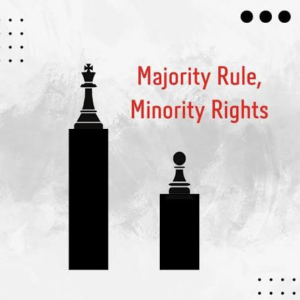
No majority should have the right to oppress a minority.
But equally:
No minority should have the right to oppress another minority.
That is what genuine rule of law means.
We Need a Bigger Identity, Not the Destruction of Smaller Ones
Perhaps our greatest mistake has been thinking that identities must compete.
They do not.
A person can simultaneously be:
Bamar, Myanmar, Asian and a citizen of the world.
Karen, Myanmar, Christian and a citizen of the world.
Shan, Myanmar, Buddhist and a citizen of the world.
Muslim, Myanmar and a citizen of the world.
These identities overlap.
They do not have to cancel one another.
The problem begins when one identity becomes an excuse to deny the humanity of another.
The Myanmar We Should Build
I do not dream of a Myanmar where everyone becomes the same.
I dream of a Myanmar where nobody is afraid of being different.
A Myanmar where a child can speak his or her mother tongue without shame.
A Myanmar where religious worship is protected.
A Myanmar where ethnic cultures are preserved.
A Myanmar where no community is told that it is less Burmese—or less Myanmar—because of its ancestry.
A Myanmar where the Bamar majority does not fear losing its identity simply because minorities receive equal rights.
A Myanmar where minorities do not fear Bamar domination because constitutional institutions genuinely protect them.
A Myanmar where military power is subordinate to civilian constitutional authority.
A Myanmar where disputes are settled by negotiation and courts rather than bullets.
A Myanmar where economic opportunity crosses ethnic boundaries.
A Myanmar where a young Kachin entrepreneur can invest in Yangon, a Bamar engineer can work in Kachin State, a Muslim doctor can serve in Rakhine, a Karen teacher can work in Shan State, and everyone knows that the law protects them equally.
That would be a real Union.
Don’t Teach the Next Generation to Hate
Perhaps the most important responsibility belongs to parents, teachers, religious leaders and political leaders.
Do not teach children:
“You are better because you are Bamar.”
Or:
“You are better because you are Karen.”
Or:
“You must distrust Muslims.”
Or:
“You must distrust Buddhists.”
Or:
“You must hate Christians.”
Or:
“Those people are foreigners.”
Or:
“Those people do not belong here.”
Children are not born carrying centuries of political hatred.
Much of it is taught.
Therefore, hatred can also be untaught.
We can teach something else:
Know your history—but do not become a prisoner of it.
Love your culture—but do not despise another person’s culture.
Protect your community—but do not persecute another community.
Demand justice—but demand it equally for everyone.
A Message to Every Myanmar Community
To the Bamar:
Do not fear equality.
A federal democratic Union does not diminish the Bamar people. It frees the Bamar people from the burden of being blamed collectively for the crimes of military rulers.
To the ethnic nationalities:
Your cultures, languages and political rights deserve protection.
But your freedom should not require the exclusion of other communities.
To Muslims:
We must continue demanding equal citizenship and protection against discrimination—but we should extend the same principle to everyone.
To Christians:
Protect your churches and communities, but also protect the rights of people of other faiths.
To Buddhists:
Buddhism does not need political domination to survive. Compassion and justice are stronger foundations.
To everyone:
Do not build your freedom upon another person’s insecurity.
One House, Many Rooms
Perhaps the best metaphor for our future is not a marriage.
It is a house.
Myanmar is one house with many rooms.
The Bamar have their room.
The Shan have theirs.
The Kachin have theirs.
The Karen, Chin, Mon, Rakhine, Kayah, Pa-O and many others have theirs.
Religious communities have their own spaces.
Families have their own traditions.
But we share a roof.
We share roads.
We share rivers.
We share markets.
We share history.
And increasingly, we share the consequences of climate change, economic crisis, displacement, migration and regional geopolitics.
We do not need to knock down every wall.
But neither should we build walls so high that nobody can speak to the neighbour next door.
Federalism should give every room security while keeping the doors open.
That is the Union we should seek.
The Real Victory
The real victory in Myanmar will not be when one ethnic group defeats another.
It will not be when one political organisation captures the state.
It will not be when one armed group controls the largest territory.
And it will not be when one community finally forces another community to leave.
The greatest victory would be much more profound:
To create a Myanmar so peaceful, fair and prosperous that its own people—wherever they have migrated—once again choose to come home.
That is what I have previously called “brain recycle.”
For decades, war, dictatorship, discrimination and economic mismanagement have driven millions of Myanmar people abroad.
But the diaspora also represents enormous potential.
They have learned languages.
They have acquired professional skills.
They have accumulated capital.
They have established international contacts.
They understand modern institutions.
They have experienced other societies.
Instead of fearing our diaspora, a future Myanmar should welcome them home.
Imagine thousands of doctors, engineers, teachers, entrepreneurs, scientists, technicians and skilled workers returning—not because they are forced to return, but because Myanmar has become a place worth returning to.
That would be a victory beyond any battlefield victory.
From “Who Owns Myanmar?” to “How Do We Share Myanmar?”
Perhaps the question we have asked for too long is:
“Which ethnic group owns Myanmar?”
That is the wrong question.
The better question is:
“How can all the peoples of Myanmar share this country fairly?”
And the answer requires:
Ceasefire.
Conciliation.
Consensus.
Constitution.
Confidence.
The Five Cs.
Then:
Equal citizenship.
Federal democracy.
Rule of law.
Human rights.
Minority protection.
Economic cooperation.
Education.
Reconciliation.
And above all:
A change in political culture—from domination to cooperation.
Let the Birds Fly Again
In my old Burma Digest writing, I once compared Myanmar’s democracy to a bird trapped inside a cage.
The Fighting Peacock could not fly freely.
The military authorities had built the cage.
But a bird is born to fly.
And nature cannot be defeated forever.
Today, perhaps we should extend that metaphor.
Myanmar has many birds.
Bamar birds.
Karen birds.
Chin birds.
Kachin birds.
Shan birds.
Rakhine birds.
Mon birds.
Muslim birds.
Christian birds.
Buddhist birds.
Hindu birds.
Many colours.
Many songs.
Many languages.
But they all need one thing:
Freedom to fly.
The answer is not to put every bird into a separate cage.
Nor is it to force every bird to sing the same song.
The answer is to open the cages and create a country where every bird can fly safely.
A Final Appeal
Let us stop asking:
Who is the real Myanmar?
Let us stop asking:
Who deserves more rights?
Let us stop teaching our children whom they should hate.
Let us stop confusing ethnic pride with ethnic superiority.
Let us stop confusing federalism with fragmentation.
Let us stop confusing Union with centralised domination.
Let us stop believing that separation automatically solves conflict.
Instead, let us build a political system in which:
The majority is secure.
The minorities are secure.
The individual is secure.
Religions are secure.
Languages are secure.
Cultures are secure.
And the Union itself is secure because everyone has a stake in it.
Myanmar does not need another cycle of domination and rebellion.
It needs a new social contract.
Not a country where one group wins and another loses.
But a country where every community can say:
“This is my home too.”
And perhaps, after generations of conflict, that is the simplest definition of peace.
A Myanmar where nobody needs to escape in order to be safe.
A Myanmar where nobody needs to dominate in order to belong.
A Myanmar where diversity is not a weakness—but our greatest national strength.
— Dr Ko Ko Gyi @ Abdul Rahman Zafrudin
English Editor, Myanmar Muslims News Network (MMNN)
Inspired by and developed from the observations of Kyaw Tun (USA), together with themes and metaphors from earlier Burma Digest/MMNN writings by the author.