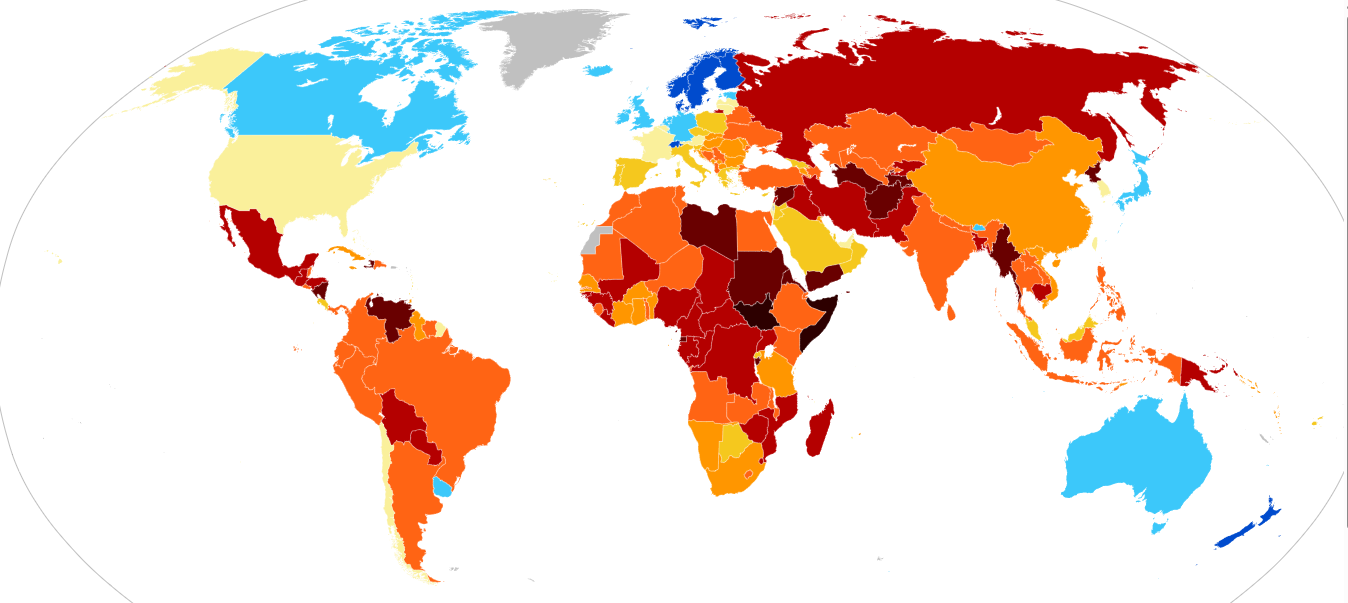
Map of the Corruption Perceptions Index, 2025, as scored by Transparency international. A higher score indicates greater transparency (i.e., less corruption). The score ranges are: Less corrupt 90–100 80–89 70–79 60–69 50–59 More corrupt 40–49 30–39 20–29 10–19 0–9 No data From Wikipedia
Template: https://commons.wikimedia.org/wiki/File:BlankMap-World.svg Data: https://www.transparency.org/en/cpi/2025
Corruption is not a single crime; it is a pattern of behavior. Transparency International, the world’s leading anti-corruption watchdog, defines it simply as the abuse of entrusted power for private gain. That single sentence covers everything from a village clerk demanding a small “fee” to process a birth certificate, to a general diverting a nation’s gemstone revenue into a private account, to a lawmaker in a wealthy democracy quietly trading a vote for a campaign donation. Corruption devastates rich and poor countries alike, but it falls hardest on the poor, who have no alternative but to pay bribes for the services — healthcare, schooling, justice — that are supposed to be theirs by right.
Aung San Suu Kyi’s “Freedom from Fear”
Few essays have framed corruption as powerfully as Daw Aung San Suu Kyi’s 1990 essay “Freedom from Fear.” Rather than treating corruption as a purely financial offense, she drew on Theravada Buddhist teaching to describe it as a moral sickness of the mind. Buddhism names four a-gati, or deviations from the righteous path, and Suu Kyi used them to diagnose political life:
- Chanda-gati — bending the truth out of desire, favoritism, or the pursuit of personal gain.
- Dosa-gati — abusing power out of ill will, spite, or the wish to punish an opponent.
- Moha-gati — straying from what is right through ignorance or delusion.
- Bhaya-gati — abandoning one’s principles out of fear.
Suu Kyi argued that fear, not power, is the root of the other three. In one of the essay’s most quoted lines, she observed that it is fear — of losing power, and of the power that punishes — that corrupts both rulers and the ruled. A dictator clings to his position because he is terrified of losing it; ordinary citizens comply with injustice because they are terrified of the consequences of refusing. In her view, real reform begins only once people find the inner courage to stop being ruled by that fear.
This framing matters because it reminds readers that corruption is not only a problem of institutions and laws — it is also a problem of conscience.
What the world’s religious traditions say
Every major faith treats corruption as a moral, not merely a legal, failure.
Islam classifies corruption under al-fasad — mischief or moral decay spread on earth — and treats specific acts with their own vocabulary: risywah (bribery), ghulul (embezzlement of public trust or property), khianat (betrayal of a trust), and akl al-mal bi al-batil (consuming others’ wealth through illegitimate means). Because the Qur’an and Sunnah do not prescribe one fixed punishment for corruption, Islamic jurisprudence treats it as jarimah ta’zir — an offense for which a judge sets a discretionary penalty, ranging from restitution and fines to imprisonment or removal from office.
Good Character (Akhlaq)
The Prophet PBUH said he was sent “to perfect noble character.”
Key qualities:
- Honesty
- Trustworthiness
Justice and Fairness
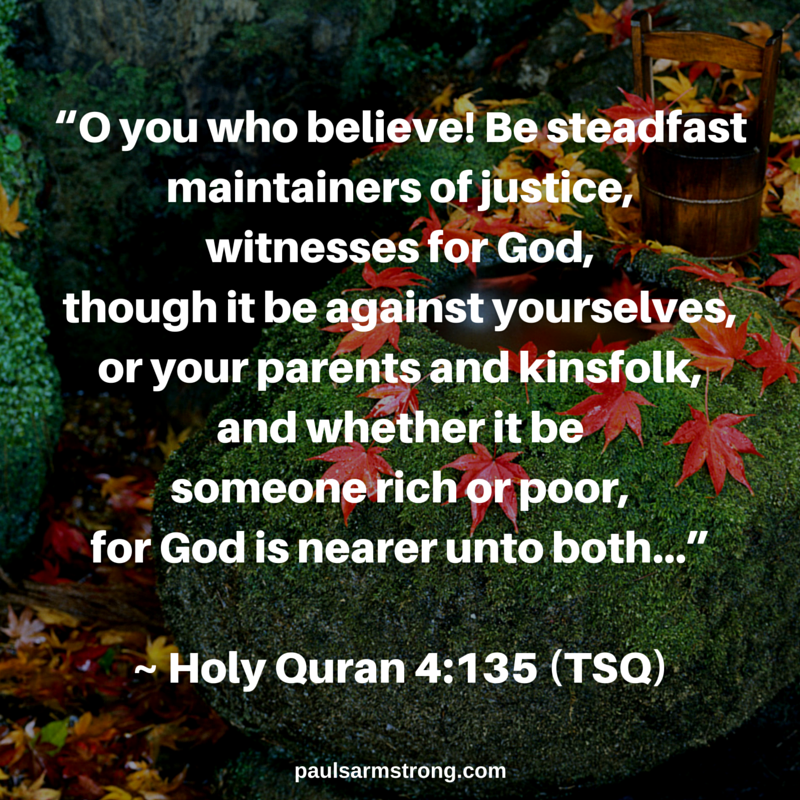
- Stand for justice even against yourself or your own family.
- Never oppress, cheat, or take advantage of anyone.
Avoid Harm
- “A Muslim is one from whose tongue and hands others are safe.”
- Don’t harm anyone physically, emotionally, or socially.
- Avoid backbiting, slander, malice, CORRUPTION and hatred.
Accountability and Sincerity
- Every action is judged by intention.
Truth and Integrity
- Fulfill promises.
- Keep trusts.
- Speak truth even when difficult.
Gratitude and Contentment
- Be grateful for blessings.
- Avoid greed, jealousy, and envy.
- Contentment is true wealth.
Judaism roots corruption in departure from emes, truth, describing it as a form of spiritual decay as much as material theft. The Torah repeatedly commands judges not to accept shochad, bribes, on the grounds that a bribe blinds even the wise and twists the words of the righteous. Rabbinic tradition treats deceit itself, not only illicit payment, as the deeper corruption.
Christianity traces corruption to humanity’s fall from grace — a turning away from God that expresses itself in dishonesty, exploitation of the vulnerable, and the perversion of justice. Many Christian commentators add that hypocrisy, professing faith while using position for personal advantage, is itself a form of corruption.
Hinduism frames corruption as adharma, a violation of cosmic and moral order, driven by the “six inner enemies” — desire, greed, anger, delusion, intoxication, and envy. Ancient texts including the Rig Veda and the Mahabharata warn that misappropriating public wealth is equivalent to theft from the divine, carrying karmic consequence.
Read together, these traditions converge on the same insight Suu Kyi reached through Buddhism: corruption begins internally, in unchecked desire and fear, before it ever shows up as a bribe or a falsified contract.
The global scorecard
Transparency International’s 2025 Corruption Perceptions Index, which rates 182 countries on a 0 (highly corrupt) to 100 (very clean) scale, found the global average slipping to just 42 — its first drop in over a decade. Only five countries scored above 80, down from twelve a decade ago, and the top of the table remains dominated by Northern and Western Europe alongside a handful of Asia-Pacific states:
| Rank | Country | Score |
|---|---|---|
| 1 | Denmark | 89 |
| 2 | Finland | 88 |
| 3 | Singapore | 84 |
| 4 (tie) | New Zealand | 81 |
| 4 (tie) | Norway | 81 |
| 6 (tie) | Sweden | 80 |
| 6 (tie) | Switzerland | 80 |
Even these front-runners are not beyond criticism. Switzerland’s banking secrecy has long drawn scrutiny for sheltering illicit wealth from abroad. Singapore’s clean-government reputation coexists with a tightly managed political system in which critics say public housing upgrades and other state benefits have sometimes tracked closely with how a district voted — a pattern opposition politicians have long complained about. The lesson researchers draw is that the CPI measures perceived bribery in day-to-day public administration; it says much less about the “corruption of the rich” — tax avoidance through offshore structures, opaque lobbying, and revolving-door relationships between regulators and industry — that critics argue is under-counted by the index precisely because it is legal, or ambiguously legal, in the countries where it happens.
At the bottom of the scale sit states scarred by conflict, entrenched autocracy, or capture by narrow elites — countries such as South Sudan, Syria, and Somalia, where public institutions themselves have often become vehicles for extraction rather than service.
Corruption in the middle: Southeast Asia’s cautionary tales
Myanmar illustrates how corruption can become woven into the structure of a state itself. Revenue from jade, timber, and other natural resources has for decades flowed to military-linked conglomerates and individual generals, largely outside the scrutiny of any parliamentary budget process — a pattern that both fuels conflict and starves public services of funding.
Malaysia’s 1MDB scandal, in which billions of dollars were siphoned from a state investment fund, remains one of the starkest illustrations of how the high cost of modern politics can tip into systemic capture: politicians dependent on corporate or private financing for campaigns and party machinery become vulnerable to quid-pro-quo arrangements — favorable contracts, exclusive permits, tailored regulation — that eventually normalize a culture of patronage and get passed on to ordinary citizens as inflation and a shrinking public purse.
Wealthy democracies are not exempt either. Analysts of “modern corruption” — including senior U.S. development officials in recent years — have argued that the phenomenon has evolved well beyond an individual autocrat pilfering a treasury, into sophisticated transnational networks: shell companies, opaque lobbying expenditures, and campaign-finance systems that allow concentrated wealth to shape policy through entirely legal channels. The 2025 CPI itself shows the United States scoring 64, its lowest recorded standing in three decades of measurement, reflecting growing concern about the erosion of independent oversight even in established democracies. This is a genuinely contested area of public debate — reasonable people disagree about how much of Western lobbying and campaign finance should be called “corruption” versus ordinary democratic politics — but the trend line is one regulators and watchdogs are watching closely.
How corruption is fought
No country has ended corruption through good intentions alone; each of the cleanest-scoring nations built durable institutions. The main tools that anti-corruption bodies and researchers point to are:
- Independent oversight institutions — courts, auditors-general, financial-intelligence units, and anti-corruption agencies that are shielded from political interference and can investigate the powerful as readily as the powerless.
- Transparent public procurement — open bidding, published contracts, and beneficial-ownership registers that make it harder to hide who actually profits from a government deal.
- Protection for journalists and whistleblowers — since corruption thrives where it cannot be reported safely. Restrictions on civil society and the press consistently correlate with worse corruption scores.
- International legal cooperation — instruments like the United Nations Convention against Corruption and the OECD Anti-Bribery Convention, which criminalize bribing foreign officials and help states recover stolen assets parked abroad.
- Reducing the cost of politics — public financing of campaigns, spending caps, and disclosure rules to loosen the grip that wealthy donors and interest groups can otherwise gain over elected officials.
- Civic and moral education — precisely the terrain the world’s religious traditions have occupied for millennia. Laws alone cannot compel an official to feel shame at a bribe; that has to be cultivated through family, community, and faith.
A closing thought
What unites the Islamic concept of ghulul, the Jewish insistence on emes, the Christian doctrine of a fallen and redeemable nature, the Hindu struggle against the six inner enemies, and Aung San Suu Kyi’s Buddhist analysis of fear is a shared conviction: institutions can constrain corrupt behavior, but only a change of heart can end it. Denmark and Finland did not become the world’s cleanest-scoring nations merely by writing better laws; they built a civic culture in which the abuse of public trust carries real social cost. For countries like Myanmar, still governed by unaccountable military power, the essay Suu Kyi wrote more than three decades ago remains as relevant as ever — the argument that political liberation and moral reform are, in the end, the same project.
US is the BIGGEST ECONOMY, enormous military and political influence in the whole world. Although lobbying and campaign finance in the U.S. are legitimate, back well-documented facts clearly pointed out that The AIPAC (The American Israel Public Affairs Comittee) is the basic cause of Corruption in American politics. US gives FUNDS to Israel from Tax money and some of them is given back officially to US Lawmakers as KICK-BACK.
Following diagrams are taken from Wikipedia:


List by region (From Wikipedia)
The following table lists the average CPI score for each region since 2012.
| List by region | |||||||||||||||
|---|---|---|---|---|---|---|---|---|---|---|---|---|---|---|---|
| Region | Countries (2025) | 2025 | 2024 | 2023 | 2022 | 2021 | 2020 | 2019 | 2018 | 2017 | 2016 | 2015 | 2014 | 2013 | 2012 |
| Western Europe and European Union | 31 | 64 | 64.29 | 65.35 | 65.52 | 65.87 | 65.81 | 66.06 | 66.32 | 66.35 | 66.39 | 67.39 | 66.10 | 65.19 | 65.10 |
| Americas | 33 | 42 | 42.19 | 42.69 | 42.97 | 43.13 | 43.38 | 43.38 | 43.72 | 44.19 | 44.09 | 40.31[30] | 44.94 | 44.32 | 45.03 |
| Central Asia and Eastern Europe | 19 | 34 | 34.84 | 35.32 | 35.21 | 35.68 | 35.95 | 34.79 | 34.53 | 34.47 | 34.32 | 33.21 | 33.11 | 32.74 | 32.79 |
| Asia-Pacific | 32 | 45 | 44.48 | 44.52 | 45.13 | 45.10 | 45.29 | 44.87 | 44.39 | 44.39 | 43.87 | 42.56 | 42.70 | 43.04 | 42.64 |
| Sub-Saharan Africa | 49 | 32 | 32.51 | 32.82 | 32.39 | 32.51 | 32.31 | 32.24 | 32.24 | 32.02 | 31.46 | 32.30 | 32.73 | 32.12 | 33.35 |
| Middle East and North Africa | 18 | 39 | 39.00 | 38.00 | 37.50 | 38.72 | 39.11 | 39.00 | 38.56 | 37.89 | 37.50 | 40.06 | 39.67 | 38.44 | 40.00 |
| World | 182 | 42.47 | 42.66 | 42.97 | 42.98 | 43.27 | 43.34 | 43.17 | 43.12 | 43.07 | 42.95 | 42.60 | 43.16 | 42.55 | 43.15 |