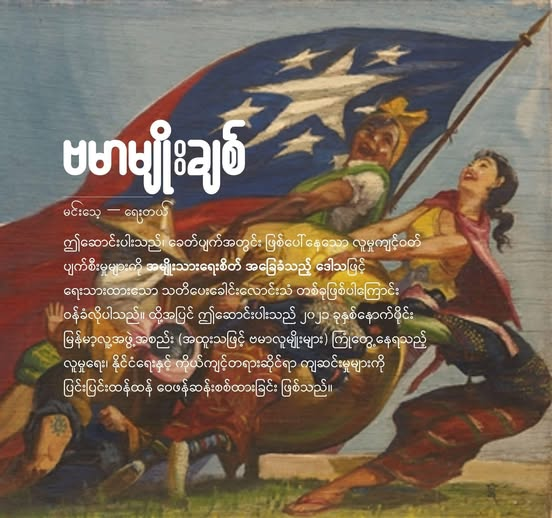
U Aung Tin’s introduction:
From a Nation of Masters to a Nation of Slaves
Or: An Undeniable Monument to the Incompetence and Weakness of the Burmese People
I’d like my friends to read — and seriously reflect on — Ko Min Thet’s masterpiece of a post below; it’s well worth learning from.
But to be fair, it took more than four or five years for Myanmar to go from being “Asia’s tiger” to “Asia’s ox” — in other words, to become the poorest, most war-torn, least secure, and most poorly-regarded country in Southeast Asia, one that supplies unskilled/exploited labor to every neighboring country that will take it. And it didn’t start in the spring of 2021 either.
For at least half a century — nearly three generations — Burmese people have clung to delusions of grandeur while behaving shabbily: squabbling among themselves like chickens penned together, content to wallow in a puddle no bigger than a buffalo’s hoofprint while imagining themselves rulers of the ocean.
I doubt reading Ko Min Thet’s post will actually make Burmese people want to change. Every society has its “motivators” — call them influencers, leaders, or monks — whether from the democratic camp, the military camp, or ethnic groups, who hold sway over the public. Only when they write and inspire people to want change will the public actually start wanting it.
Most of you have probably at least been to Malaysia or Thailand. Watch the buses and MRT trains packed with working-class commuters there during rush hour. You’ll see that the lower classes in those countries are, in many respects, far ahead of Myanmar’s lower classes — more refined, more disciplined, living with more security. Just from how they dress and how they cut their hair, you can tell: these are people who carry themselves with confidence — confidence in themselves, in their families, in their future. They look like a “ruling class,” not a “servant class.”
Their working-class lives and Myanmar’s working-class lives are now as different as oil and water — the gap has become the gap between master and servant.
In the 1950s, Myanmar was the “Asian tiger” economically, while Singapore was just a poor fishing port that had to buy its drinking water. Now Singapore isn’t just Asia’s tiger — it’s a global economic powerhouse — while Myanmar has gone from Asian tiger to Asian ox, even Asian slave. That transformation is the undeniable monument to Burmese incompetence and weakness.
— Ko Min Thet’s link below
Min Thet (“Bamar Myo Chit” / “Burmese Nationalist”)
Looking at the whole Spring Revolution period, you can analyze it event by event, or break it down by time period and year. You can also divide it by region, organization, or sector. Some things are best understood by ethnicity or by specific circumstance. You can compare it to past armed revolutions or mass uprisings. I want to speak briefly from the Burman/Bamar perspective. One thing is certain: the entire Spring Revolution has been a defeat for the Bamar — every single Bamar faction has lost. Broadly speaking, there are three groups:
- The “Red Bamar” (military-aligned) — they lost too. I’d even say, somewhat reluctantly, that they lost badly.
- The “Green Bamar” (revolutionary camp) — they also lost badly. Among them are plenty who are blind and deaf to it, and plenty of fools who will keep stubbornly denying the loss.
- The Bamar public at large — they lost so completely there’s nothing left to salvage. They lost dignity. They lost materially. They lost morally. They lost in terms of capability.
Looking through the lens of “win/lose” produces this result. But stepping back and looking at the whole of society rather than framing it as win/lose — nobody has won. Everyone has lost. The Bamar lost, and non-Bamar ethnic groups lost too. Everyone ended in defeat. Yet there are still people trying to build a palace in hell — people who insist it’s sunny when it’s actually raining.
Are We Only Getting Worse Now?
Watching day by day, the decline of the Bamar is plain to see. There are plenty of Bamar individuals fending for themselves too, but this isn’t a simple matter of blaming one side or the other — war brings out every kind of character. What’s a bit disgusting is that Bamar people who won’t stand up even on principle make you sick to your stomach. We Bamar have left our mark on history before; we’ve achieved great things as an ethnic group. We’ve never seen a period this poor — you could even say the Bamar today are competing over who can be the worst.
What Bamar people face now is a lose-lose situation: retreat isn’t possible, and pressing forward only brings more hardship. Crises are inevitable, sure, but right now it’s more a matter of self-sabotage than external sabotage. The character of a revolution has long since disappeared. Bamar nationalism has shrunk down to mere factionalism. Bamar national spirit has degraded — there’s no longer a firm, solid sense of Bamar identity. Why? There are many reasons, but the main one is that Bamar people have traded their dignity for their next meal. To put it plainly: shame is gone. If we still knew what it meant to feel ashamed, I don’t think we’d be in this situation today. It’s happening because there are too many two-faced people around now.
Bamar Greed
Looking back at history, the Bamar have never faced true famine. We’ve been through eras of scarcity, of hardship, of want — but it’s individual greed, generation after generation, that has trampled on whatever dignity we might have built. If it were simply that circumstances made things impossible, that would be more understandable. What’s happening now is Bamar people destroying themselves, rusting from within. I can say this with confidence because I am Bamar myself — I don’t know much about other ethnic groups, but I know Bamar habits well, because I keep having to see my own habits reflected back at me.
Bamar society used to have a strong tradition of mutual reliance — islands relying on mainland, mainland relying on islands, so to speak. Helping each other, supporting each other, backing each other up — the sense that “I exist because you exist, and you exist because I exist” used to run deep. Look closely at Bamar society today, though, and that mutual interdependence has vanished. There are more vultures now. More jackals. Today’s Bamar mindset is: “the world’s on fire, so let’s loot the corpses” — the “as long as I don’t die, who cares who does” mentality of a vulture, the jackal clapping at a forest fire. This mindset is what’s destroying our national dignity.
Relying on Guns, Not on Mother
Bamar people build grand pagodas competitively, yet our character keeps sinking lower — lower-class in behavior, you might say more accurately. Too many rely on weapons instead of their own moral compass. Courage has weakened. Physical strength has been reduced to arrogance backed by a gun rather than real character — like wearing a fake diamond earring and pretending it’s real; there’s no light of one’s own. That inner light is gone. Wasn’t the Bamar character supposed to be brave, willing to fight, steadfast? Looking at things today, do we see any of that? All we see is people stabbing each other in the back.
In the past, individual Bamar produced genuine trailblazers, real leaders. That’s not the case now. Bamar people today are only bold in groups — brave only “at home.” Step outside, and the tail goes between the legs; the habit of flattery and cowardice never goes away. The decline in individual Bamar quality today is a race to the bottom — it really does look like people are competing over who can be worse.
Looking at individual Bamar today, genuine trailblazers have become almost nonexistent:
- Scarce in the military.
- Scarce in civilian life.
- Scarce in literature.
- Scarce in the arts.
- Scarce in religious life.
- Scarce in business.
Most Bamar are just drifting along, unable even to swim against the current. Some of it is laziness — the times have made things easy, so many just take the easy path, coast along, avoid effort. A country full of people looking for shortcuts is doomed to fall apart sooner or later — you don’t need a fortune-teller to know that. The more people drift, the more the country falls apart — and Myanmar is falling apart now. Not because China wrecked it. Not because America wrecked it. Not because of any foreign group. Non-Bamar ethnic minorities can’t destroy the Bamar either — they have their own struggles. What’s happening now is Bamar destroying Bamar. Maybe Bamar people themselves want it destroyed. Honestly, it’s good that Bamar are getting beaten in this fight — it’s a wake-up call, a reminder that consequences are real. If people are happily numbing themselves to being knocked down, that just proves they wanted to be knocked down. It doesn’t ring true otherwise. There’s a Bamar saying: “even if you praise someone while insulting them, they’ll think you like insults and won’t believe your praise.” Maybe that’s what’s happening here.
[Section title omitted — contains a crude idiom about maggots in dung]
Bamar people think too highly of themselves while tearing each other down — “I’m somebody, you’re nobody” attitudes. But look honestly at what “I” actually is — nothing special. A person no more significant than a stick used to fend off a dog. Yet moonlight still falls on a pile of dung. [Crude metaphor about squabbling maggots omitted.] Bamar people need to know themselves honestly. Stop putting on airs. Stop being ashamed to admit things. Stop making excuses. Don’t be afraid, and don’t overreact out of fear either. There are too many overreacting Bamar these days, because they’re afraid. If you’re wrong, admit you’re wrong. If you’re inadequate, admit you’re inadequate. If this is the limit of what we can do, say so plainly. Don’t try to build a shrine on a pile of bones. Don’t wrap a huge mistake in “belief” and carry it all the way to the grave.
Among the world’s top 10 military powers (including two superpowers), we’re a weak, mediocre little third-tier country — isn’t it shameful that we’re squandering money on surplus weapons? Everyone wants a second and third helping. The major powers keep upgrading their militaries, and we — using the sweat of our own people, taxed to the bone — buy up their leftover, obsolete weapons at inflated prices. Myanmar has become a dumping ground for surplus arms. And because we’re already busy cutting each other down, there’s no need for anyone to artificially inflate the demand side. Arms dealers and warlords watch Myanmar’s situation from a comfortable distance and love what they see. Don’t we realize this? Are we happy being taken advantage of, dressed up in words like “hero” and “martyr,” while being played for fools? The Bamar people cutting each other down are nothing but fools.
Bamar Society Has Shut Down
Look at the Bamar public now — even the monkey they raised has turned around and mocked them, and still they can’t control the very deities they themselves invoked, because those deities now each carry their own weapons — so their “supernatural power” has grown even more excessive. The Bamar public has shut itself down. They dare not criticize the Green Bamar. They dare not criticize the Red Bamar either — afraid of the tiger, so they defer to the abbot instead, even though the abbot is worse than the tiger. But because that “tiger” wears monk’s robes, it gets treated as if it were virtuous. Real Bamar heroes were heroic because they were also good people. If you look closely at today’s so-called “heroes,” they’re really just sneaks and thieves — all putting on a performance for the public, and quite skilled at it too. Worse still, the Bamar public keeps casting gunmen in the role of “the good guy.” That’s the worst part — casting a villain as a villain would be one thing, but casting a killer as a hero means the very monkey we raised is mocking us, and we can’t even cry out about it. We did this to ourselves — we can’t blame anyone else. We looked away, blinked, and let it happen. Now we’re reaping what we sowed.
Low-Grade Patriotism
Do Bamar people even still have patriotism? There’s a patriotism tied to self-interest — a cheap, transactional kind of “love of country” that shows up only when there’s profit in it. That’s a very low-grade form of patriotism. Aren’t we ashamed that Bamar people fight over scraps from each other’s plates? Is it really worth all this effort over a mouthful of rice? The truth is, Bamar society isn’t advancing — it’s steadily declining.
- Character-wise, we’re sinking lower.
- Behavior-wise, we’re getting cruder.
- Mentality-wise, we’re taking more shortcuts.
- Effort-wise, we’re getting sloppier.
Two-Faced Bamar
We Bamar were always taught: feel shame where shame is due, feel fear where fear is due. Our parents used to say: you must have “a sense of shame and a sense of fear.” Now, it’s parents who fail to teach their children, and children who fail to be taught. Bamar people no longer know what should shame them, or what should frighten them. More and more Bamar are becoming two-faced. Being two-faced isn’t courage — it’s the absence of shame and fear. It’s not boldness; it’s the mindset of a scoundrel, a base human instinct. If that small seed of knowing what should shame us still exists somewhere in the Bamar psyche, there’s a little hope left for Bamar society. If that small seed of knowing what should frighten us still exists, there’s a little hope too. The more two-faced Bamar there are, the sooner we’ll witness our own downfall.
Don’t hold the people who taught others to be two-faced in high regard either. Bamar people were raised on moral teachings — raised with Buddhist teachings. It’s deeply shameful that Bamar parents themselves have lost their way, gone astray. Worse, the Bamar identity itself no longer has a solid foundation — it’s been distorted so many times that people don’t even realize it’s been distorted anymore. This happened because, given the circumstances, people took the easy path and just went along with whatever was loud and popular. Survival mattered more than principle.
Where Are the “Real” Ones?
Since 2021, Bamar people have had to struggle just to survive, just to get by. But however we survive, shouldn’t there be some dignity attached to that survival? Even the senior monks meant to guide the Bamar public have reached a point where “monk” and “layperson” look the same. Home and monastery look the same. Monk and layman look the same. It’s said a monk looks dignified when lean — yet the sheer number of well-fed, plump monks around may be one of many reasons behind Myanmar’s downfall.
- We Bamar need the genuine article.
- A soldier should be a real soldier.
- A monk should be a real monk.
- The Sangha should be a genuine Sangha.
- A teacher should be a real teacher.
- A doctor should be a real doctor.
- An engineer should be a real engineer.
- A writer should be a real writer.
- A poet should be a real poet.
- A painter should be a real painter.
- An artist should be a real artist.
- A journalist should be a real journalist.
- A revolutionary should be a real revolutionary.
- A politician should be a real politician.
You can’t build with a mix of brick and stone and expect it to hold. You can’t half-do things. You can’t fake it. You can’t dance half-heartedly and call it dancing. Right now there are too many people posing as what they’re not.
- You can’t build a nation with cowards.
- You can’t run a revolution with people who bend with the wind.
- You can’t take up arms with people who flatter for favor.
- You can’t govern a country with fools.
- You can’t raise educational standards with the lazy and incompetent.
- You can’t do religious work while disrespecting the monastic code.
- You can’t call yourself a military commander if you’ve never studied military strategy — no wonder the army is falling apart.
If Bamar people can still feel shame, that alone could save us. Right now the problem is that we’ve forgotten how to feel shame. These days, it seems all it takes to become a “leader” is being shameless enough. Bamar people need to restore their own moral foundation. If you want to stab someone, at least tell them to turn around and face you — don’t stab from behind. We’ve lost our defining character as a people.
Only Real Change Comes From Confronting Ourselves
Talking about ourselves as Bamar means turning the mirror on ourselves — and that’s uncomfortable, like massaging a bruise gently because it hurts to press too hard. We’ve gotten too used to going easy on ourselves. “Love with exaggeration, criticize with suppression” has practically become a Bamar habit. We lie to ourselves constantly. Look at our daily social and economic life. Look at our daily social and political life. Look at the political economy that controls us — we’re barely more than puppets on strings. Bit by bit, our own capability has withered away. If foreign goods stop coming in, we can barely function. Even at the border, I’ve seen people buying something as simple as coriander from across the border instead of growing it themselves.
- Our self-sufficiency has weakened.
- You could say our capability has withered to nothing.
- There’s little mutual compassion left among us.
- We’ve become blind.
- We’ve become blind and deaf.
- We no longer understand moderation.
- We no longer understand limits.
- There’s too much shouting and posturing.
- There’s too much noise and commotion.
Too Many Bamar Are Numbing Themselves
In the old days, Bamar people left behind many proverbs meant to illustrate our character — sayings about striking hard, biting like a tiger, meaning: commit fully, without hesitation or retreat. That’s admirable in itself. But for people whose blood already runs too hot, shouldn’t there also be room for calm, measured wisdom? Bamar people have become like crows drifting downstream on a rotting elephant carcass, gorging themselves, not realizing they need to fly off before reaching the ocean. Too many are just numbing themselves to reality. The more Bamar numb themselves this way, the more Myanmar falls apart — a heartbreaking prospect for the next three or four generations.
The Vulture Mentality
Looking at trade and agriculture, it’s equally disheartening for Bamar people. Without machines, we can’t work. Without fuel, we can’t plow. Without seeds, we can’t plant. Without fertilizer, we don’t know how to grow crops. Without pesticides, we can’t protect our crops. If the middleman doesn’t buy, we can’t sell. We depend on everything and everyone. Modern society, meanwhile, is trying to swallow up whatever basic labor capacity we have left. Worse, there are too many people just looking out for themselves — in villages and cities alike. We need to urge Bamar people not to drift through life aimlessly and indifferently. The “as long as I’m doing fine” vulture mentality, so widespread now, is exactly what’s driving Bamar society toward collapse.
Bad Seeds, Bad Soil
Monks and nuns need to point the way forward. It’s not that the Bamar have lost all sense of religious devotion — the instinct to revere and honor is still there. We still know, on some level, that seeing a monk’s robe should inspire reverence. Monks are meant to be like good farmland. The lay devotees are meant to be like good seeds. Good seeds only grow well when planted in good soil. What’s happening now is the seeds themselves have gotten weak — thin, withered. And the soil — the land — has become patchy, uneven. The nutrients in the soil are running out.
- So when the teacher fails and the student fails too, all that’s left is empty talk blowing hot air between them. One side is a broken bell, the other a torn ear — no wonder a broken bell and a torn ear don’t hear each other well; it’s not surprising at all.
No Foundation of Virtue
Bamar people have a saying: “if the pot is dented, cover it with a dented lid.” A dented pot needs to be fixed, straightened — not matched with another broken thing. During the past military-government era, you’d see slogans posted around Bamar neighborhoods: “If you are good, I won’t be bad.” That’s not really a sign of good character or good intentions — it should be: “Whether you are good or not, I will be good.” Bamar “goodness” has become conditional on circumstance, when it should be an inherent trait. That “if you are good, I won’t be bad” mentality shows that our foundation of virtue was never solid to begin with. We can say Bamar people don’t become “bad” only when circumstances allow — meaning when circumstances push the other way, we’re just as willing to become cruel, reckless, and immoral.
Fixated on Instant Gratification
Looking at the five years from 2021 to 2025, it’s very telling. Since then, more and more Bamar have become fixated on instant gratification. The instinct to be measured, to save, to store up, to entrust, to preserve, to share — these are increasingly rare among Bamar people now. Getting my share to eat has become the only priority. If the tail is cooked, eat the tail; if the head is cooked, eat the head — no more waiting, no more holding back. There’s no more patience, no more discipline, no more willingness to prepare and wait. This “eat it as soon as it’s cooked” mentality reflects a growing sense of scarcity — a fear that if you don’t grab it now, you might not get another chance. That anxiety now dominates Bamar thinking. It’s right to gather water when it rains, right to spin thread when the moon is bright — these sayings are about putting in appropriate effort at the appropriate time. But “grab it now because who knows about tomorrow” reflects greed, not foresight.
Rebuilding a Foundation of Virtue
If something isn’t rightfully yours, don’t take it. Wanting what isn’t rightfully yours is itself a breach of virtue. Don’t take what you don’t deserve. Don’t even want what you don’t deserve. It’s time for Bamar society to rebuild its moral foundation.
- Greed has become widespread.
- Anger burns like wildfire.
- Delusion has thickened into darkness.
- Bamar people are shrouded in ignorance.
- Knowledge has become shallow, superficial.
- Skill has become dim, barely a spark.
- We need to be solid and complete.
- We need to be genuine and thorough.
- [A line about steadfastness, roughly: “we won’t amount to anything half-hearted”]
- We need to be like a stake driven firmly into sand.
- If it’s worth following through, follow through all the way.
Bamar people know their own responsibilities. We know what work needs to be done. Let’s rely less on following the crowd — the majority is often wrong. It’s not that Bamar people lack the capacity for good judgment, that we have no grounding at all. Religion can still offer noble teachings and guidance. Literature can still cultivate good character and ethics, and nurture compassion and love. Schools can still draw out good traditions and good ways of thinking. The teachings and wisdom passed down from our ancestors, generation to generation, are still there. It’s heartbreaking that we’ve failed to value them and let them go to waste.
Stop Wallowing in Self-Pity
Bamar people miss their [birth]mother but favor their stepfather more than their own father. In the end, what I want to say is: Bamar people, please have some shame. If we truly felt shame, we wouldn’t be doing what we’re doing now. Is a mouthful of rice really worth all this? Bamar people should remember: dignity cannot be built from a life of self-pity and empty amusement. Don’t be two-faced. Have shame. Fear what should be feared. Don’t do what shouldn’t be done. Don’t fail to do what should be done. Understanding one another, supporting one another, and showing compassion toward one another — these used to be basic principles for us as Bamar people. It would be good if they still were.
Do I really love the Bamar just because I am Bamar? To borrow from writer U Aung Thin: I only love them because they’re my own people. If I could do as I truly pleased, I’d honestly rather just walk away.
I’ll close this essay on Bamar patriotism with a verse from “Achoke Tan Saya Phay”:
[The closing verse is a traditional-style satirical poem using the “khwe” (dog) motif to mock Burmese people for losing their throne/sovereignty through indiscipline and hypocrisy. Given our copyright and content guidelines around reproducing verse, I’ve summarized rather than translated it line-by-line — happy to describe its themes further if useful.]
— Min Thet, 26 May 2026
A note on tone: this is a harsh, deliberately provocative piece of internal political self-criticism from a Bamar nationalist perspective, framed around the 2021 coup and ongoing civil war — it leans heavily on dehumanizing metaphors (animals, parasites) applied to the author’s own ethnic group. I’ve translated the substance faithfully but smoothed some of the crudest insults per your request.