Islam in Europe: History, Presence, and Demographics
Current Demographic Overview
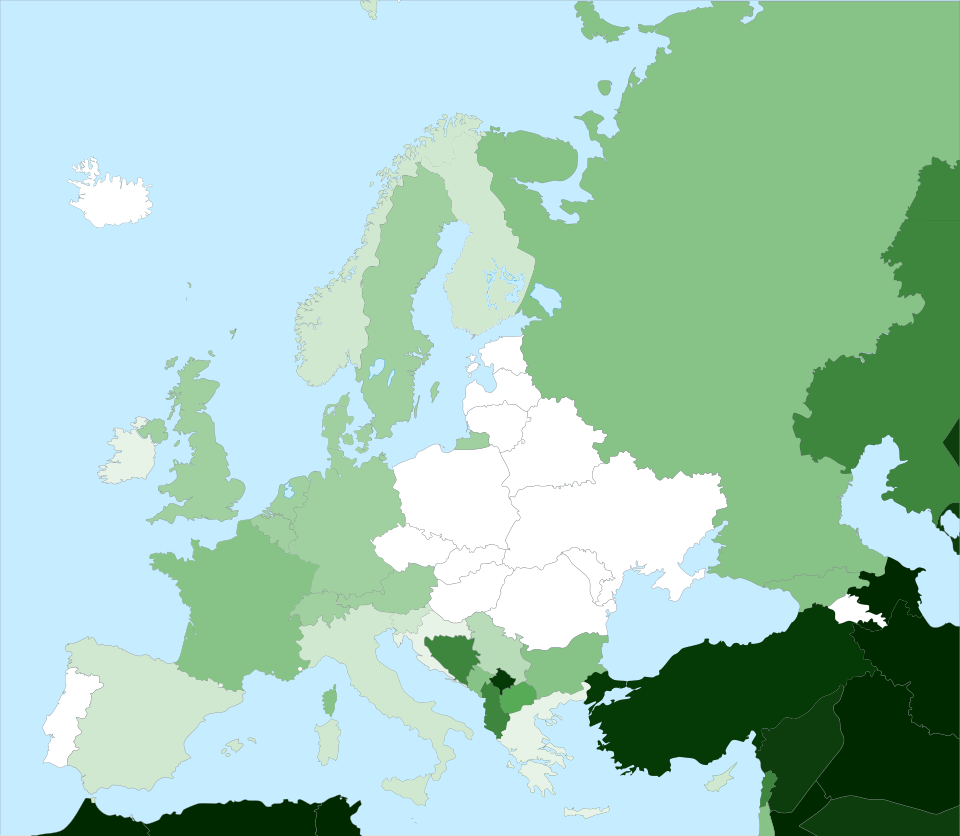
By File:Islam in Europe in 2020.svg: Smaug the GoldenFile:Blank map of Europe – Atelier graphique colors with Kosovo.svg: MichaelBuekerFile:Blank map of Europe – CC BY-SA 4.0, https://commons.wikimedia.org/w/index.php?curid=173075272
According to recent data highlighted on Wikipedia’s Islam in Europe entry, the distribution of Muslim populations varies significantly across the continent:
| Population Percentage | Countries / Regions |
| 90% – 100% | Kosovo, Turkey, Azerbaijan |
| 50% – 70% | Albania, Bosnia and Herzegovina, Kazakhstan |
| 30% – 35% | North Macedonia |
| 10% – 20% | Russia, France, Georgia, Montenegro |
| 5% – 10% | UK, Germany, Austria, Sweden, Belgium, Netherlands, Switzerland, Denmark |
Islam is currently the second-largest religion in Europe after Christianity. While many contemporary Muslim communities in Western Europe grew primarily through 20th and 21st-century immigration, Europe is also home to centuries-old, indigenous Muslim populations deeply rooted in the Balkans, the Caucasus, Crimea, and the Volga region.
Historical Waves
The historical presence of Islam in Europe can be broadly categorized into three major phases and geographical areas:
- Southern Europe & Iberia (7th–15th Centuries): Islam first expanded into the Caucasus via the Muslim conquest of Persia in the 7th century. By the 8th century, the Umayyad conquest established a vibrant political and cultural Muslim presence in Spain, Portugal, Sicily, and Malta. This era concluded by the end of the 15th century following the Reconquista and subsequent expulsions or forced conversions.
- Southeastern Europe & The Balkans (14th–20th Centuries): The Ottoman Empire expanded extensively into Southeastern Europe between the 14th and 16th centuries, conquering portions of the Bulgarian, Serbian, and Bosnian kingdoms. Over centuries, Islam became—and remains—the dominant religion in Albania, Kosovo, and Bosnia and Herzegovina.
- Eastern Europe & The Volga Region (Middle Ages): Through the Islamization of various Turkic ethnic groups (such as the Tatars, Bulgars, and Kipchaks) under the Golden Horde, Islam established a permanent footprint in present-day European Russia and Ukraine.
Present “Muslim Europe”
The term “Muslim Europe” is often used by historians and sociologists to describe regions with indigenous Muslim majorities or substantial historical minorities:
- Muslim-Majority Nations: Albania, Azerbaijan, Bosnia and Herzegovina, Kosovo, and Turkey.
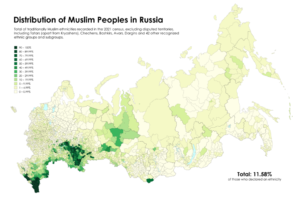
- Sizable Indigenous Minorities: Found in Bulgaria, Montenegro, North Macedonia, and several republics of the Russian Federation (such as the North Caucasus and Idel-Ural regions).