By Dr Ko Ko gyi @ Abdul Rahman Zafrudin with the help of Chat GPT
History is often remembered through dates, wars, elections, and revolutions. Yet beneath all those events lies a much older struggle—the eternal conflict between good and evil, justice and oppression, truth and deception.
Every civilization, every religion, and every nation tells this story in different forms.
The names change.
The costumes change.
The languages change.
But the drama remains remarkably similar.
The Eternal Pairing
The Holy Quran reminds us that Allah created all things in pairs.
Night and day.
Male and female.
Life and death.
Reward and punishment.
Truth and falsehood.
Good and evil.
Human beings seem instinctively drawn to these opposites because they reflect realities that exist not only in nature but also within our own hearts.
Electricity requires positive and negative charges.
A magnet has north and south poles.
The human body possesses both healing and destructive capacities.
Likewise, societies produce both builders and destroyers, protectors and aggressors, reformers and tyrants.
Perhaps this is part of Allah’s divine design: not to make life easy, but to make moral choice meaningful.
Without temptation, there is no virtue.
Without oppression, courage cannot be measured.
Without evil, goodness remains untested.
The First Rebel
Islam traces the story of rebellion to Iblis.
Unlike the angels, who possess no free will, Iblis was a Jinn created from smokeless fire.
Through devotion, he attained an exalted position among the angels.
Yet when Allah commanded him to bow respectfully before Adam, he refused.
His downfall was not ignorance.
It was pride.
“I am better than him.”
Those words echo throughout history.
Most tyrants, dictators, racists, and oppressors ultimately share the same disease.
They believe they are superior.
Superior by race.
Superior by religion.
Superior by class.
Superior by birth.
Superior by power.
The sin of Iblis was not merely disobedience.
It was arrogance.
After his expulsion, he vowed to mislead the children of Adam until the Day of Judgment.
His weapons would not be armies or bombs.
Instead, they would be whispers.
To beautify evil.
To justify oppression.
To disguise selfishness as patriotism.
To make wrong appear right.
The battlefield would be the human mind.
Every Religion Tells a Similar Story
The remarkable thing is that nearly every major religion contains a similar lesson.
Christianity speaks of Satan, the tempter who fell through pride, and Judas Iscariot, the trusted disciple who betrayed Jesus.
Judaism tells of ha-Satan as the tester of human sincerity and of Korah, who rebelled against Moses and attempted to divide the community.
Hindu traditions speak of Kali Purusha, who spreads greed, lust, and corruption during the Kali Yuga.
Buddhism distinguishes between Mara, the tempter who tried to prevent enlightenment, and Devadatta, the jealous insider who sought to destroy the Buddha and divide the Sangha.
Different names.
Different settings.
The same warning.
Humanity faces dangers from both external enemies and internal betrayers.
Devadatta and the Politics of Jealousy
The story of Devadatta is particularly fascinating.
He was not an ignorant man.
He was highly learned.
According to Buddhist tradition, he possessed extraordinary spiritual attainments.
Yet knowledge alone did not save him.
Intelligence without humility can become dangerous.
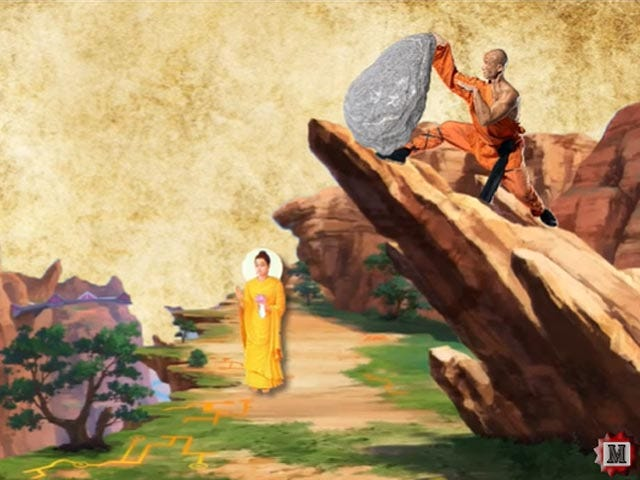
Devadatta attempted to replace the Buddha.
He challenged legitimate authority.
He allegedly hired assassins.
He released the enraged elephant Nalagiri.
He rolled a massive rock down a mountain.
Each attempt failed.
Why?
Because evil often misunderstands the source of true authority.
Power gained through fear is fragile.
Power earned through moral legitimacy is far more difficult to destroy.
Throughout history, many movements have collapsed because ambitious insiders valued personal power more than truth itself.
David and Goliath
The world repeatedly celebrates stories where the weak confront the strong.
David versus Goliath.
Moses versus Pharaoh.
The Buddha versus Mara.
Prophet Muhammad (PBUH) versus the Quraysh elite.
These stories resonate because most ordinary people see themselves not as Goliath but as David.
Not as Pharaoh but as the oppressed Israelites.
Not as emperors but as common citizens.
The lesson is not that the weak always win.
The lesson is that moral courage can outweigh physical strength.
History repeatedly demonstrates that tanks, prisons, and armies cannot permanently suppress ideas whose time has come.
Political Heroes and Villains
Modern politics offers countless examples.
General Aung San envisioned an independent Burma founded on unity among diverse peoples.
His assassination altered the destiny of an entire nation.
Had he lived, Myanmar’s history might have been profoundly different.
Benigno “Ninoy” Aquino Jr. challenged dictatorship in the Philippines and paid with his life.
His assassination ultimately helped ignite the movement that ended the Marcos dictatorship.
Mahatma Gandhi preached non-violence yet was murdered by an extremist.
President John F. Kennedy was assassinated at the height of his influence.
His brother, Robert Kennedy, suffered the same fate.
Malcolm X was silenced by bullets.
Israeli Prime Minister Yitzhak Rabin, pursuing peace with the Palestinians, was assassinated by a Jewish extremist who believed peace was betrayal.
In each case, one gunshot changed the trajectory of a nation.
Sometimes history turns not on armies but on a single trigger.
Myanmar’s Continuing Struggle
Myanmar’s political history also reflects this eternal conflict.
Many people view the struggle between democratic aspirations and military authoritarianism through the lens of heroes and villains.
Different groups may disagree about personalities, methods, and political strategies.
Yet few would deny that the central question remains unchanged:
Should power serve the people?
Or should the people serve power?
This question has haunted Myanmar since independence.
It continues to haunt the nation today.
The Assassination That Started a World War
Perhaps the most striking example of how one act can reshape history occurred in 1914.
The assassination of Archduke Franz Ferdinand in Sarajevo triggered a chain reaction that led to World War I.
Millions died.
Empires collapsed.
Borders were redrawn.
The seeds of World War II were planted.
All from a single assassination.
History reminds us that individual actions matter.
The choices of one person can influence the lives of millions.
The Real Battlefield
Ultimately, the greatest battle is not between armies.
It is not between political parties.
It is not even between religions.
The real battlefield lies within every human heart.
The Quran teaches that Iblis can only whisper.
He cannot force.
Devadatta could tempt.
He could not compel.
Judas could betray.
He could not destroy truth itself.
Every day, each human being chooses.
Honesty or deception.
Justice or oppression.
Humility or arrogance.
Service or selfishness.
The struggle between good and evil therefore begins not in parliament buildings, palaces, monasteries, churches, mosques, or temples.
It begins inside us.
Conclusion
History remembers heroes and villains because they reveal possibilities hidden within humanity itself.
Aung San and U Saw.
David and Goliath.
Buddha and Devadatta.
Moses and Pharaoh.
The Prophets and their opponents.
Democrats and dictators.
The names differ, but the lesson remains.
Evil is often powerful.
Good is often vulnerable.
Yet history repeatedly shows that physical power alone cannot guarantee victory.
Empires disappear.
Dictators die.
Tyrants are forgotten.
But ideas rooted in truth, justice, compassion, and human dignity continue to inspire generation after generation.
Perhaps that is why the struggle between good and evil never truly ends.
It is not merely a conflict between people.
It is Allah’s test of humanity itself.