The Mandala Reversed: When Myanmar Began Losing Its People Instead of Winning Them
From the Age of Human Capture to the Age of Human Flight
There is an interesting historical irony in Southeast Asia.
For centuries, kingdoms fought not only for land, gold, cities and royal treasures. They fought for something even more valuable in a region where fertile land was relatively abundant but skilled labour was scarce:
People.
Artisans, craftsmen, architects, monks, scholars, scribes, administrators, soldiers and farmers were human capital. Whoever controlled them could strengthen his own capital, economy, army and culture.
This was one of the realities behind what historian O. W. Wolters and other scholars later described as the Southeast Asian “Mandala” political system — a world of overlapping spheres of influence rather than today’s rigid nation-state borders. Power radiated from strong centres and contracted when those centres weakened.
In such a world, the people could be more valuable than the territory itself.
The ancient pattern: conquer — capture — transfer — rebuild
The historical record contains many examples of victorious rulers taking skilled populations from defeated centres.
When King Anawrahta of Pagan conquered Thaton in 1057, traditional accounts describe the transfer of Mon monks, artisans, scribes and scholars to Pagan. Modern scholarship also recognises the broader importance of importing scarce skilled labour into Pagan for building monuments, strengthening administration and developing the kingdom.
Whatever the precise numbers or details of the traditional chronicles, the underlying historical phenomenon is important:
Pagan did not merely acquire territory. It acquired human skills.
The same broad pattern can be seen elsewhere in mainland Southeast Asia.
Angkor and the Khmer world suffered repeated wars with neighbouring powers, and after the fall of Angkor, Ayutthaya became an important centre for the absorption and continuation of Khmer court traditions. Siamese, Burmese, Mon, Rakhine and other kingdoms likewise fought, conquered capitals, carried away treasures and sometimes transferred populations and skilled people.
The history of Champa, Cambodia, Siam, Burma, Mon kingdoms and Rakhine was therefore not a simple story of one ethnic group permanently conquering another.
It was a circulating system of power, people, culture and skills.
Champa itself experienced invasions and pressure from several powerful neighbours, including Chinese, Khmer and Javanese powers. Khmer cultural traditions were subsequently absorbed and transformed in neighbouring Siamese kingdoms. In the Burmese world, the conquest of Mon and Rakhine centres likewise brought people, religious traditions, artistic skills and political institutions into new centres of power.
A defeated capital could be destroyed.
But its human capital could be carried away and reused elsewhere.
That is why the history of Southeast Asian kingdoms should not be understood only as a history of changing borders.
It was also a history of human migration — sometimes voluntary, sometimes forced, and sometimes caused by war.
Pagan, Ava, Pegu, Mrauk-U and Mandalay
The cycle repeatedly appeared in the history of what is now Myanmar.
Pagan absorbed important Mon religious and artistic influences.
Later, Pegu/Hanthawaddy, Ava/Inwa, Mrauk-U and other centres rose and fell through war and political competition.
In 1599, the destruction of Pegu by the combined forces of Rakhine and Portuguese allies was accompanied by the removal of people and royal treasures to Mrauk-U. In 1752, Hanthawaddy forces captured and destroyed Ava. Five years later, Alaungpaya’s forces defeated the Mon kingdom and re-established Bamar dominance over much of the country.
The identities of the winners and losers changed.
But the basic logic of the age remained remarkably similar: human beings were among the prizes of victory.
This is why we should be careful when describing Southeast Asian history through today’s concepts of ethnicity and national borders.
Bamar conquered Mon.
Mon forces conquered Bamar territory.
Rakhine forces attacked Pegu.
Shan, Siamese, Khmer, Cham, Vietnamese and Javanese powers fought one another.
No single ethnic group possessed a monopoly on conquest.
The ancient political system was far more complicated than the modern idea of one nation permanently oppressing another.
And Then the Mandala Was Reversed
Here lies the great irony of Myanmar’s modern history.
For centuries, rulers tried to bring people into their capitals.
Today, Myanmar is increasingly losing its people to other countries.
The direction of human capital has been reversed.
Instead of Pagan importing skilled people to build Pagan, or later capitals absorbing the human resources of defeated kingdoms, modern Myanmar is exporting — voluntarily and involuntarily — doctors, engineers, teachers, researchers, entrepreneurs, technicians, students, artists and other educated young people.
This is the Mandala Reversed.
For nearly eight decades of civil war, political instability, military rule, economic crisis and, most recently, the devastating conflict following the 2021 coup, millions of Myanmar people have sought safety and opportunity outside the country.
Some are refugees.
Some are asylum-seekers.
Some are documented migrant workers.
Some are undocumented.
Some are students.
Some are highly trained professionals.
And many are simply young people who have concluded that their future may lie somewhere else.
Thailand alone tells part of the story
According to the International Organization for Migration, approximately 4.18 million Myanmar migrants were living in Thailand in July 2024, including an estimated 1.82 million in irregular situations. IOM’s 2025 data also recorded more than 2.27 million registered Myanmar migrant workers in Thailand as of January 2025.
These figures are far larger than the number of people normally described as “refugees.”
That distinction matters.
Myanmar’s human exodus is not only a refugee crisis. It is also a migration and human-capital crisis.
Malaysia
Malaysia has also become one of the major destinations.
As of the end of February 2026, UNHCR recorded 193,824 refugees and asylum-seekers from Myanmar among those registered in Malaysia. They included Rohingya, Chin and people from other conflict-affected communities.
And this is only the registered refugee/asylum-seeker population.
It does not represent every Myanmar national living and working in Malaysia.
Australia and the wider developed world
The same story can be seen farther away.
Australia’s 2021 Census recorded 39,171 Myanmar-born residents. Among employed Myanmar-born people, 3,138 were classified as professionals. The census recorded 1,247 working in hospitals and 619 in general-practice medical services.
These figures are already significant, although they should not be exaggerated into an unsupported claim that there are “thousands of Myanmar doctors” in Australia.
And Australia is only one destination.
Myanmar professionals and educated young people have also established communities in Singapore, Malaysia, Thailand, the United States, Canada, the United Kingdom, Europe, Japan, South Korea, New Zealand and elsewhere.
The exact number of Myanmar doctors, engineers, scientists, IT specialists and other professionals abroad is difficult to establish because there is no single global database covering all Myanmar nationals and because many migrants are not classified by profession in publicly available migration statistics.
But the direction is unmistakable:
Human capital is flowing outward.
From Human Capital Accumulation to Human Capital Depletion
This is perhaps the deepest tragedy.
A country can lose a factory and build another.
It can lose a bridge and reconstruct it.
It can lose a building and replace it.
But when a country loses a generation of doctors, engineers, teachers, scientists, entrepreneurs, administrators and skilled workers, rebuilding becomes much harder.
A university can produce another doctor.
But it takes years.
A country can train another engineer.
But it takes years.
A nation can educate another generation.
But if its best educated young people leave continuously, the country may lose not merely today’s workers but tomorrow’s teachers, researchers and mentors who would have trained the next generation.
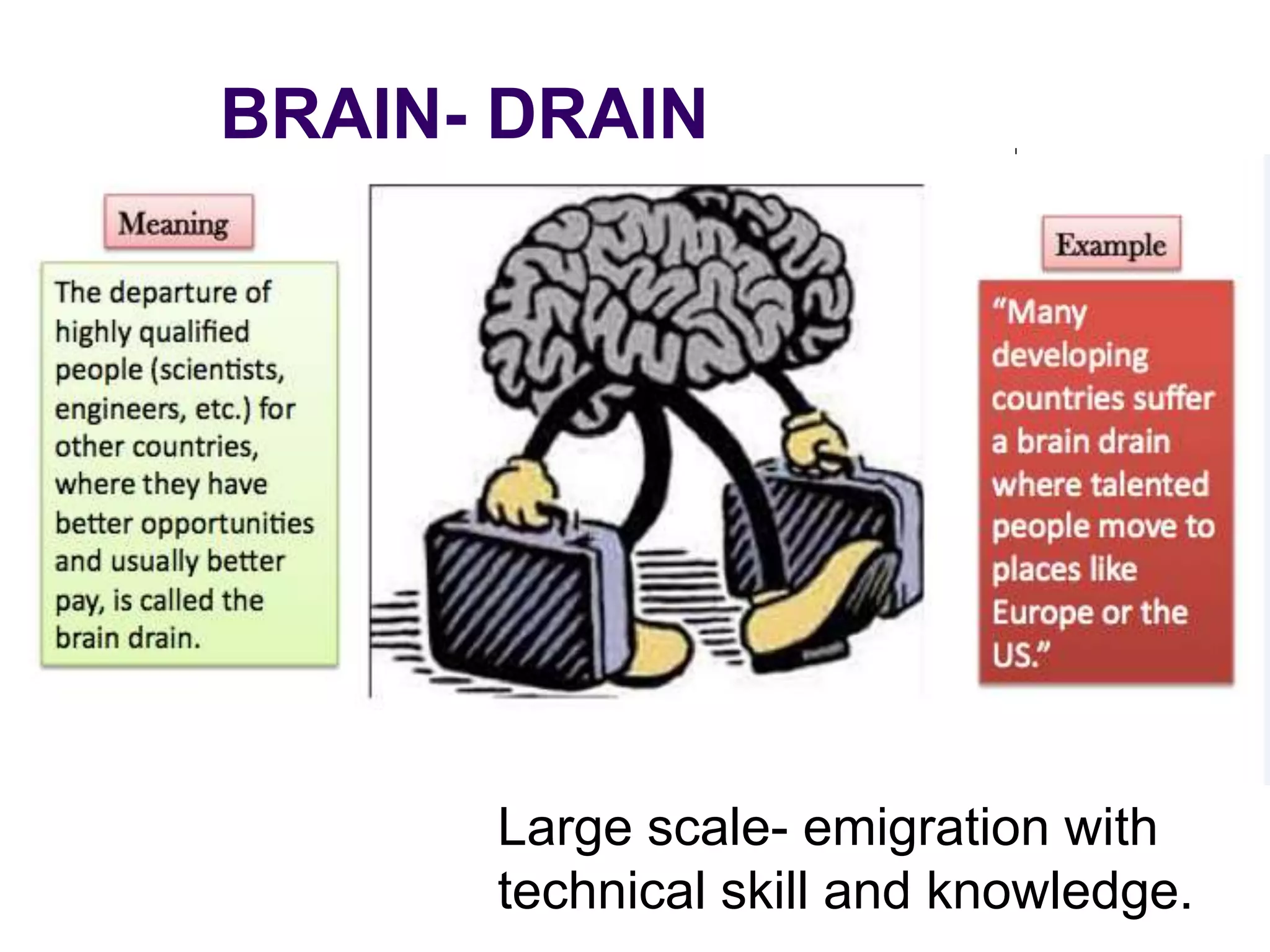
That is what makes brain drain so dangerous.
And Myanmar’s problem is even larger than brain drain.
It is human-capital drain.
The country is losing not only professors and specialists, but also millions of ordinary working-age people whose labour, taxes, businesses, skills and children would otherwise contribute to Myanmar’s future.
The Great Historical Irony
Once upon a time, victorious rulers marched into defeated cities and asked:
“What can we take?”
They took gold.
They took royal treasures.
They took elephants.
They took books.
They took artisans.
They took monks and scholars.
They took administrators.
And sometimes they took entire communities.
Today, however, the question has been reversed.
Young Myanmar people themselves are asking:
“What can we find outside Myanmar that we cannot find at home?”
Safety.
Peace.
Education.
Employment.
Rule of law.
Professional opportunities.
A predictable future.
And dignity.
So the ancient Mandala has been turned upside down.
Then:
Strong capital → attracts people → gains skills → becomes stronger.
Today:
Weak state → loses people → loses skills → becomes weaker.
That is the Mandala Reversed.
Myanmar’s Greatest Natural Resource Is Not Under the Ground
Myanmar possesses oil, gas, jade, timber, minerals, fertile land, rivers and enormous agricultural potential.
But its most valuable resource has always been something else:
Its people.
The monks who preserved knowledge.
The teachers who educated children.
The doctors who saved lives.
The engineers who built infrastructure.
The farmers who feed the nation.
The workers who keep industries alive.
The entrepreneurs who create employment.
The scientists and researchers who create knowledge.
The young people who carry the future.
If the ancient kingdoms understood that human beings were the ultimate resource, modern Myanmar must understand it even more clearly.
A country that cannot retain its people cannot retain its future.
The Mandala Must Be Reversed Again
The solution is therefore not to blame those who leave.
Nor should Myanmar migrants be condemned as disloyal simply because they seek safety and a better life.
We should ask instead:
Why are so many people leaving?
And more importantly:
What would make them want to return?
Peace.
Political stability.
Federal democratic institutions.
Equal citizenship.
Rule of law.
Security.
Independent universities.
Professional freedom.
Economic opportunity.
Freedom of thought.
Protection of minorities.
And above all, confidence that their children can grow up safely and build a future at home.
Then the direction of the Mandala can change once again.
Instead of:
Myanmar → Thailand → Malaysia → Singapore → Australia → Europe → America
we should eventually see:
Myanmar diaspora → Myanmar
Doctors returning.
Engineers returning.
Teachers returning.
Scientists returning.
Entrepreneurs investing.
Students coming home.
Professionals bringing back international experience.
Diaspora communities helping rebuild their ancestral towns and villages.
That would be the Mandala Reversed Again.
Not through conquest.
Not through forced repatriation.
Not through nationalism.
But through peace, justice, reconciliation and opportunity.
The greatest victory for Myanmar would therefore not be conquering another kingdom.
It would be creating a country so peaceful, free and prosperous that its own people choose to come home.
The ancient rulers fought to capture human capital.
Modern Myanmar is losing human capital through conflict.
The task of the next generation must be to reverse that flow.
Land can be recovered.
Buildings can be rebuilt.
Economies can be reconstructed.
But a lost generation cannot simply be replaced.
Myanmar’s greatest treasure has always been — and remains — its people.
Brain Drain → Brain Circulation → Brain Recycle → Brain Return.
Not forcing people back. Making home worth returning to.
And perhaps the most beautiful line is:
“My dream is not to stop Myanmar’s people from going abroad. My dream is to make Myanmar a country they want to come home to.”
Then:
“Like salmon returning to the river where they were born, may Myanmar’s doctors, engineers, teachers, scientists, entrepreneurs and young people one day return—not because they are forced to, but because peace, freedom and opportunity call them home.”
That is a very fitting final vision for The Mandala Reversed.
Brain Drain → Brain Gain → Brain Recycle → Brain Return.
And perhaps, one day:
“The Mandala turns full circle.”
— Dr Abdul Rahman Zafrudin @ Ko Ko Gyi