Ludu Daw Amar’s Essay and the Art of Speaking with Monks
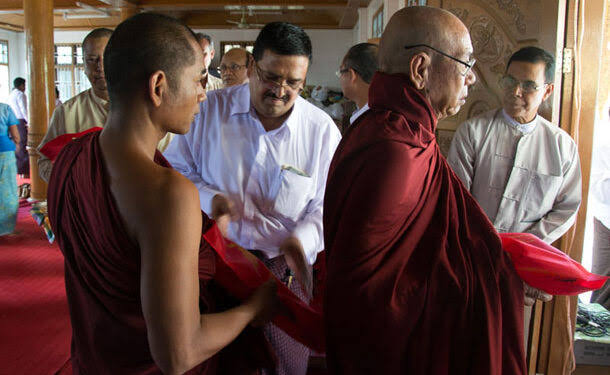
Photo: Mandalay Muslim Organization Makes Offerings to Buddhist Monks
Ludu Daw Amar did not begin her celebrated essay with Daw Mya the plate seller. She began with an observation that troubled her deeply.
She had witnessed a scene at a Swoon Kywae — a noon alms-giving ceremony — where a donor mother asked her son to go and invite the monks (Phonggyi Pint). The young Buddhist man refused, confessing with embarrassment that he did not know how to speak properly with monks. This failure of a young Burmese Buddhist to observe the most basic monastic etiquette became the springboard for her essay.
It was then that she turned her gaze, with characteristic sharpness, toward an unexpected example: the Burmanized Muslims of Mandalay — particularly those of Zay Cho Market. She observed that unlike many contemporary Burmese Buddhist youths, these Muslim traders spoke to monks with natural grace, proper courtesy, and cultural fluency. They knew the language, the tone, the customs. They had absorbed Burmese Buddhist social culture so completely that in this regard they surpassed some who were born into it.
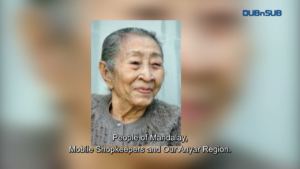
To illustrate this living example of cultural integration, she introduced us to Daw Mya — the legendary plate seller of Zay Cho — as the embodiment of this spirit.
This observation resonates personally with me. My clinic was situated in Pae Poke Tan, near the Third Shwe In Pyin Monastery and close to the First and Second Ma Soe Yein Monasteries. While working at Mandalay General Hospital and the Medical University, I ran the clinic after office hours, seeing between fifty and seventy patients daily — at least one third of whom were monks and their relatives who had travelled from their hometowns seeking medical treatment.
I was not alone in this. Another Burmese Muslim physician, Dr. U Kyaw Nyein, was perhaps the most celebrated example of this bond between communities. He treated monks and nuns entirely free of charge, and such was his reputation that patients waited hours simply for the privilege of being seen by him. When his daughter passed away following an operation in Australia — and her funeral rites were conducted according to Islamic tradition — monks and nuns came to his home and offered prayers for seven consecutive days. Faith did not divide them. Humanity united them.
The Bridge That Was Built — and Later Broken
My late brother, Maung Maung Shwe Keraweik, was a man of extraordinary warmth and personal connections. He had cultivated genuine and close friendships with the leading figures of the Mandalay Buddhist monastic world — including the monks of Maha Myat Muni Phayar Gyi, and notably with U Wirathu and Thidagu Sayadaw themselves. These were not ceremonial relationships. They were real human bonds, built on mutual respect and years of genuine fellowship.
It was precisely because of these relationships that Mandalay Division Chief Minister General Ye Myint — formerly of Military Intelligence — found himself unable to ignite racial riots in Mandalay during that period. The human bridges my brother had built held firm against those who sought to burn them.
But the Military Government was patient and resourceful. When force could not work, they turned to persuasion — the classic carrot and stick. Gradually, through a combination of pressure, incentives, and political manipulation, they succeeded in pulling key monastic figures away from the bonds they had built with the Muslim community.
The methods they used were not always subtle. Military cyber-troops — among them the notorious Professor Dr. Seik Phuar and Ludu Maung Karlu — began targeting my brother directly. They published posts on Facebook falsely claiming that his restaurant, Shwe Keraweik, was a launching point for jihad. It was deliberate, calculated provocation.
Then came the moment that revealed the truth more powerfully than any rebuttal could.
U Wirathu himself called Maung Maung Shwe Keraweik and arranged to visit the restaurant. He came — with his followers — and they were welcomed and fed. The entire visit was documented in a series of photographs published on Facebook: arriving at the entrance, entering, sitting together, eating, with Maung Maung serving them personally. This was before Facebook had live video capability, so each photograph was a deliberate, considered act of public testimony.
Those images said what words could not: this man is not your enemy. We have eaten at his table.
It was an act of courage — and of friendship — that history should not forget.