Dedicated to Ethnic Minorities and Religious Minorities in Myanmar
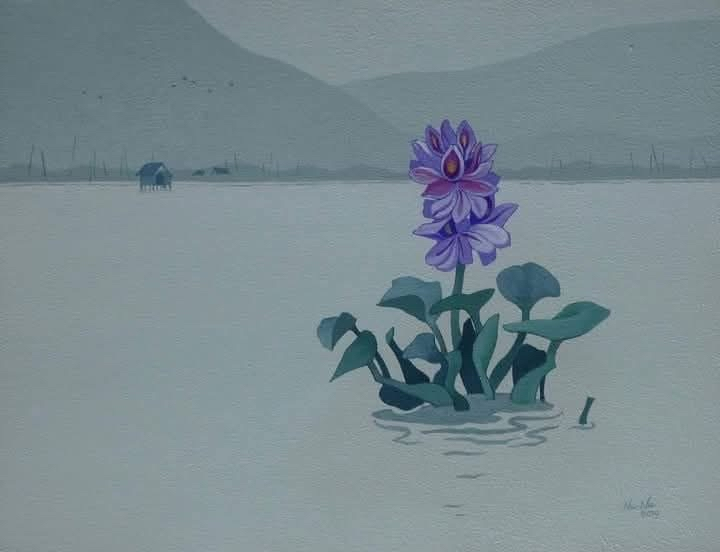
The water hyacinth (Eichornia crassipes) is known as “Beda” in Myanmar. It grows in the deltaic creeks and streams, floating up and down with the ebb and rise of the tide. Throughout his series of poems, the poet Zaw Gyi uses the word “Ma Beda” — meaning “Miss Beda” — as a metaphor, likening the lovely hyacinth to a young woman.
Saya Zaw Gyi wrote a long series of poems about Beda, portraying her as a resilient woman struggling against the hardships of the world. One of the most beloved poems in the series is “Still Wearing the Flower”, in which Miss Beda — swept along by a rapidly flowing stream — encounters hundreds of ducks (representing men), withstands their harassment, endures the rough weather and turbulent waters, and emerges still wearing her flower. This poem has given strength and courage to countless readers facing difficulties in their own lives.
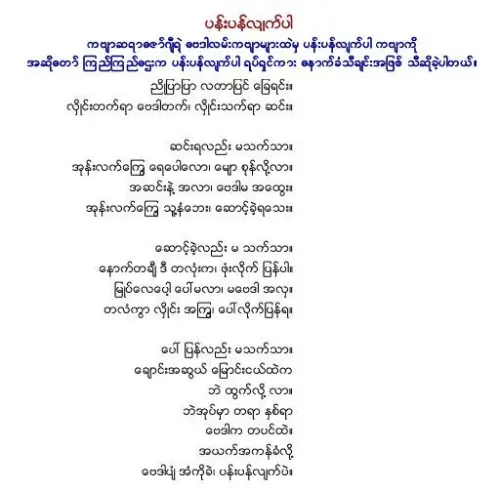
“Still Managed to Keep the Flower on Her Head”
(The author’s own translation)
- Rejoicing in the tidal creek, the blue-hued Miss Beda longs to dock at a nearby shore.
- A floating coconut drifts into her side and strikes her — a painful blow — pushing her away from the gentle landing she had hoped for.
- She is struck again by another tidal wave and pulled under.
- But she struggles and rises back to the surface.
- Even resurfacing is no easy thing.
- Out of the drains and into the stream come the ducks, swimming toward her.
- Alone, she endures the kicks and jostling of hundreds of them.
- But Miss Beda never gives up.
- She bites her lip, holds her smile, and keeps the flower upon her head —
- all while struggling through the rapidly flowing stream.
A Better Translation (sourced later)
From “Keep on Flowing, Ayeyarwaddy…” — an anthology of Myanmar poetry Zaw Gyi: “Hyacinth’s Way – This is My Way”
Rejoicing in the tidal creek, the blue-hued Miss Beda — giving pretext of the jasmine flower — longs to dock at the nearby shore.
Rejoicing in the tidal creek, Miss Beda of a bluish colour — giving pretext of the belle lady — fancies stopping at the shore right here.
Rejoicing in the tidal creek, bluish Miss Beda — giving pretext of the small stupa — desires to land at the shore hither.
With a sail aloft as she glides, she has learned to heed the piper’s call. Wearing the noble wish of escape like a sash, bluish lady Beda flows up and down in the tidal creek’s water — and says: this is my way; no other.
Note on “Noble wish of escape”: This refers to the Buddhist aspiration for liberation from the endless cycle of rebirth (Samsara) — in other words, the attainment of Nirvana. (Source: Wikipedia — Saya Zawgyi)
On the Theme of Never Giving Up
This poem resonates deeply with the universal human spirit of perseverance. Here are some of the most celebrated quotations on that theme:
Winston Churchill (World War II): “Never, never, never give up.”
Ralph Waldo Emerson: “Our greatest glory is not in never failing, but in rising up every time we fail.”
Brian Tracy: “Between you and every goal that you wish to achieve, there is a series of obstacles, and the bigger the goal, the bigger the obstacles. Your decision to be, have and do something out of the ordinary entails facing difficulties and challenges that are out of the ordinary as well. Sometimes your greatest asset is simply your ability to stay with it longer than anyone else.”
Albert Einstein: “It’s not that I’m so smart, it’s just that I stay with problems longer.”
Anonymous: “Never give up on what you really want to do. The person with big dreams is more powerful than one with all the facts.”
Winston Churchill (with a touch of humour): “Wars are not won by evacuations.”
Charles F. Kettering: “Keep on going, and the chances are that you will stumble on something, perhaps when you are least expecting it. I never heard of anyone ever stumbling on something sitting down.”
Brian Tracy: “Never consider the possibility of failure; as long as you persist, you will be successful.”
Henry Wadsworth Longfellow: “Perseverance is a great element of success. If you knock long enough and loud enough at the gate, you are sure to wake up somebody.”
Confucius: “It does not matter how slowly you go, so long as you do not stop.”
Anonymous: “A limit on what you will do puts a limit on what you can do.”
Pearl S. Buck: “All things are possible until they are proved impossible — and even the impossible may only be so as of now.”