“We must not merely stop the present fight. We must prevent the next fight.”
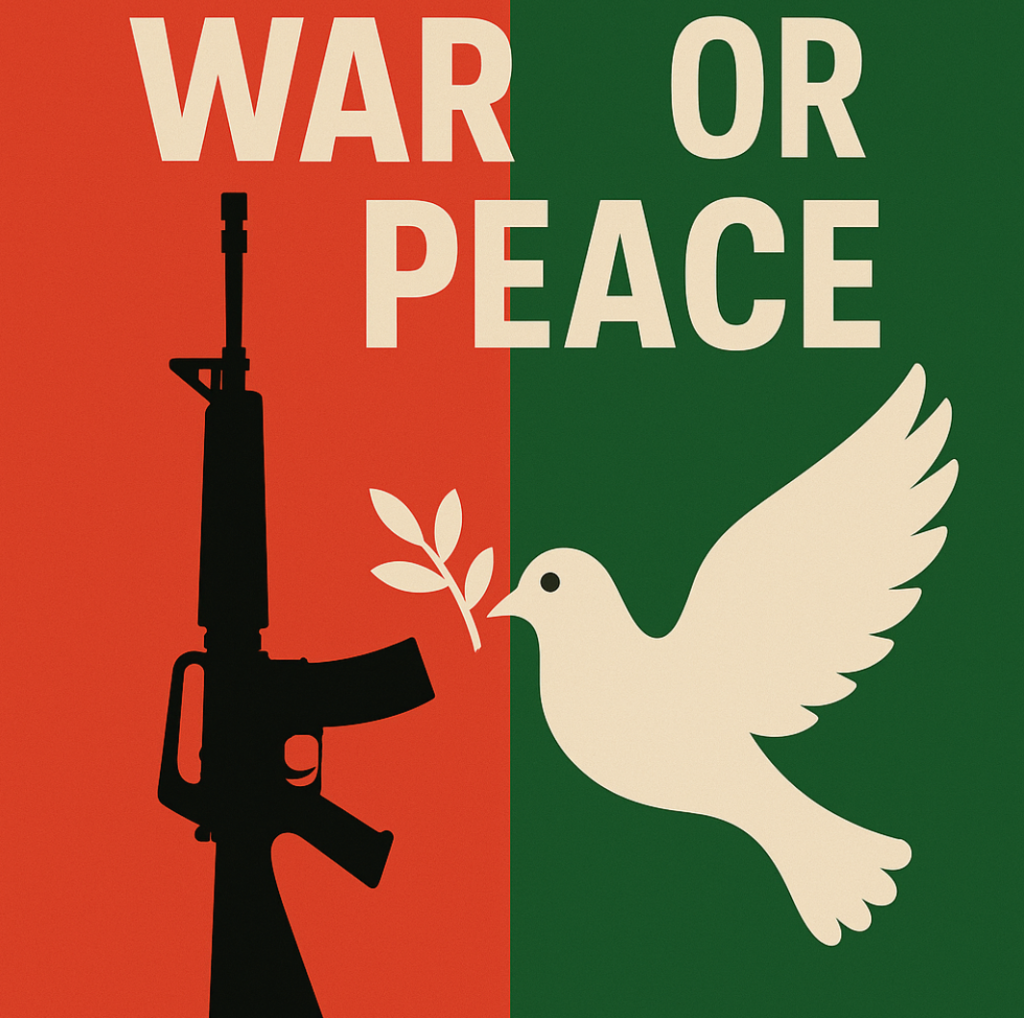
Don’t Win the War Only to Lose the Peace.
A military victory may end one organised war, but an inclusive negotiated settlement is needed to prevent its transformation into insurgencies, warlordism, organised crime and endless local conflicts.
Myanmar needs a negotiated peace involving all significant stakeholders, not merely a victorious army and a defeated population.
I think this is the central message worth preserving.
Total Victory or Total Defeat? Must the Loser Surrender Before Fighting Can Stop?
Part 1. English translation of Soe Naing’s story
Soe Naing recounts a sermon by the late Venerable Ashin Nyanā, known as Dhamma Vihari Sayadaw.
One day, a monk visited a monastery and saw two students fighting and wrestling with each other beneath the monastery building.
Thinking that the resident abbot might not know what was happening, the visiting monk decided to inform him.
“Your Reverence, two students are fighting and wrestling downstairs,” he reported.
The abbot replied:
“Just let them be. The fight will end when the loser accepts defeat. They are continuing to fight because neither has surrendered yet.”
And that was that!
The whole world seems to be behaving according to the resident abbot’s philosophy. Countries fight wars against one another, and as long as neither side accepts defeat, the fighting continues.
Myanmar is also experiencing civil war. According to this way of thinking, for the war to stop, one side must suffer a decisive and overwhelming defeat.
The Sayadaw described this principle as Khway Tayar and Nwar Tayar — the law of dogs and cattle.
When dogs fight or bulls lock horns, the fighting often stops when one animal backs down and submits to the other.
Despite all our scientific and technological progress, human beings seem to continue living according to the primitive laws of the animal kingdom, just as they did in the earliest days of human history.
Source: Soe Naing, Burmese-language Facebook post.
Total Victory or Total Defeat? Must the Loser Surrender Before Fighting Can Stop?
From the Animal Kingdom to Human Civilisation: Why Negotiated Peace Is Better Than Endless War
An editorial reflection inspired by Soe Naing’s account of a sermon by Dhamma Vihari Sayadaw Ashin Nyanā.
1. Are Human Beings Still Following the Laws of the Animal Kingdom?
The story of the two fighting students and the monastery abbot offers a simple but thought-provoking explanation of why conflicts continue.
According to the abbot, the fight would end when one student accepted defeat. Until then, neither would stop fighting.
The Sayadaw compared this to the behaviour of dogs and cattle. When dogs fight or bulls lock horns, one animal may eventually retreat, submit or acknowledge defeat, bringing the immediate confrontation to an end.
This is an interesting analogy, but human conflicts are much more complicated.
In nature, not all animal encounters follow the same pattern. Predators hunt prey, while animals also compete for territory, food, mates and survival. Some confrontations end with retreat; others end in injury or death. There is no single universal law governing all animals.
Human beings, however, possess something that distinguishes us from other animals: the ability to reason, communicate, establish laws, negotiate compromises and create institutions to prevent violence.
Humanity has also become extraordinarily successful at exploiting other living creatures. Every day, people kill and consume countless land animals and marine creatures for food. Yet when human beings fight one another, we often demonstrate less wisdom than we expect from a supposedly advanced civilisation.
We have developed nuclear weapons, artificial intelligence, sophisticated military technology and international institutions. Nevertheless, wars continue to destroy human lives, economies, cultures and generations.
If science has advanced so dramatically, why has our ability to make peace not advanced at the same speed?
2. Must One Side Be Completely Defeated Before Peace Is Possible?
The abbot’s argument contains an important truth: a conflict may continue when neither side is willing to stop fighting.
However, there is a major difference between ending a fight and establishing lasting peace.
An overwhelming military victory may stop organised resistance temporarily. But it does not necessarily eliminate resentment, injustice, discrimination, fear or the desire for revenge.
A defeated population may remain dissatisfied for generations. Former enemies may take up arms again when circumstances change.
History provides many examples of military victories that failed to produce lasting political stability.
Therefore, we should distinguish between three different outcomes:
- Military victory: One side defeats the other through superior force.
- Ceasefire: The opposing sides agree, or are compelled, to stop fighting.
- Sustainable peace: The parties establish a political and security arrangement that addresses the reasons for the conflict and reduces the likelihood of renewed violence.
A ceasefire is not necessarily peace. Equally, a negotiated settlement is not necessarily surrender.
Sometimes, the most courageous decision a leader can make is to stop a war that he or she might otherwise continue fighting.
3. The United Nations: An Institution Created to Prevent Another World War
After the devastation of the Second World War, the international community established the United Nations in 1945.
Its central purpose includes maintaining international peace and security, preventing future wars, encouraging peaceful settlement of disputes and promoting international cooperation.
Unfortunately, the UN has frequently been unable to act decisively when major powers have conflicting interests.
The Security Council has 15 members, including five permanent members:
- China
- France
- Russia
- The United Kingdom
- The United States
Each permanent member possesses veto power on substantive decisions. Consequently, a single negative vote by any one of these five countries can prevent a proposed resolution from being adopted, even when the majority of Council members support it.
This arrangement reflects the political realities of 1945, but it creates serious difficulties in the modern world.
The General Assembly, meanwhile, provides a forum in which all UN member states can express their positions. It can adopt important resolutions and recommendations, but it does not possess the same enforcement powers as the Security Council.
The General Assembly’s Uniting for Peace mechanism can provide an alternative avenue for collective recommendations when the Security Council is paralysed by a veto. Nevertheless, it cannot simply replace the Council’s enforcement authority.
My criticism is that the international community too often talks about peace without possessing the political will or unity necessary to secure it.
The UN should not become merely a platform for speeches, condemnations and repeated expressions of concern.
The Secretary-General and the international community should use every available diplomatic, humanitarian and legal mechanism to prevent further bloodshed.
The UN is not entirely powerless, but its effectiveness depends heavily on the cooperation of member states, especially the major powers.
4. What Should Be the Principles of Successful Peace Negotiations?
We should abandon the simplistic idea that peace is possible only when one side surrenders.
A more realistic approach is to negotiate an arrangement in which neither side needs to regard the agreement as complete humiliation or unconditional defeat.
Some important principles include:
A. Stop the killing first.
A humanitarian ceasefire should be pursued without waiting for a comprehensive political agreement. Civilians, children, displaced people and wounded combatants should not be made to suffer while politicians and military leaders argue.
B. Establish mutual security guarantees.
Each side must have reasonable confidence that the other will not use the ceasefire as an opportunity to prepare a surprise attack.
C. Use impartial monitoring and verification.
A ceasefire needs agreed monitoring arrangements, reliable reporting procedures, communication channels and mechanisms for investigating alleged violations.
D. Include all significant stakeholders.
Peace negotiations should not be restricted to two powerful leaders if numerous ethnic communities, political organisations and affected populations have legitimate interests at stake.
E. Address the underlying causes.
Political exclusion, discrimination, insecurity, competition over resources, lack of autonomy and violations of rights must be addressed.
F. Adopt phased implementation.
Instead of demanding that every difficult issue be settled immediately, parties can agree on practical stages: ceasefire, humanitarian access, prisoner arrangements, security measures, political dialogue and constitutional reform.
G. Provide guarantees and consequences.
Agreements must contain clear responsibilities, timetables, independent monitoring and procedures for resolving disputes. International and regional guarantors should help ensure that commitments are honoured.
H. Allow face-saving compromises.
Leaders must sometimes compromise on their public positions to save lives. A negotiated agreement should not require either side to publicly declare itself humiliated.
These principles are consistent with the United Nations’ Guidance for Effective Mediation and its Guidance on Mediation of Ceasefires.
5. Myanmar: Peace Cannot Be Achieved Through Military Victory Alone
Myanmar is perhaps one of the clearest examples of why the animal-kingdom approach to conflict resolution is inadequate.
The country has experienced decades of armed conflict involving the military, ethnic armed organisations and various resistance movements.
The political crisis following the military coup of February 2021 further expanded the conflict, bringing new resistance forces and communities into the fighting.
The different parties have their own histories, political objectives, security concerns and grievances.
Some seek federal democracy. Others demand greater autonomy or self-determination. Some are fighting against military rule, while others are concerned primarily with protecting their territories and communities.
These different objectives cannot realistically be resolved by assuming that one side will eventually defeat every other side.
Even if a particular military organisation wins important battles, the political problems that created the conflict may remain.
Myanmar needs a political settlement, not merely a military outcome.
I would suggest the following approach.
A. An inclusive national dialogue
Negotiations should involve all significant stakeholders, including:
- The military authorities and representatives of the State Administration Council, where they remain relevant to negotiations.
- The National Unity Government (NUG).
- The National Unity Consultative Council (NUCC), where appropriate.
- Ethnic Resistance Organisations (EROs).
- People’s Defence Forces (PDFs) and other resistance organisations.
- Political parties and civil society organisations.
- Representatives of ethnic and religious minorities, including Muslims, Christians, Hindus and other communities.
- Women’s organisations, youth representatives and displaced communities.
No single organisation should presume that it alone represents every community or political interest.
Likewise, no major stakeholder should be excluded merely because it is politically inconvenient to negotiate with it.
B. Immediate nationwide humanitarian ceasefire
The first priority should be to stop attacks on civilians, hospitals, schools, religious buildings and other protected civilian infrastructure.
All parties should agree to:
- Stop indiscriminate attacks and other violations of international humanitarian law.
- Allow humanitarian organisations safe and unhindered access.
- Facilitate the return or voluntary resettlement of displaced people when conditions permit.
- Establish arrangements for the release or exchange of prisoners and detainees.
- Protect religious and cultural heritage.
A ceasefire should be monitored by an agreed independent mechanism, with appropriate international and regional participation.
C. Federalism with equal rights and additional safeguards
Myanmar’s long-standing ethnic and political problems cannot be resolved without a credible federal constitutional settlement.
I support the principle:
Equal Rights for All, with Additional Safeguards for Ethnic Nationalities.
All citizens should enjoy equal fundamental rights regardless of ethnicity, religion, language or place of origin.
At the same time, ethnic nationalities should receive meaningful constitutional safeguards to protect their identities, languages, cultures, political participation and legitimate aspirations for self-government.
Federalism must be based on genuine power-sharing, not merely a change in the names of administrative units.
The distribution of legislative, executive, judicial and fiscal powers must be negotiated and constitutionally guaranteed.
D. Transitional justice without collective revenge
Accountability is essential, but collective punishment and revenge will create further conflicts.
Serious crimes should be investigated through credible and independent processes, with due process and equal application of the law.
Victims deserve recognition, justice and appropriate remedies. At the same time, the country needs reconciliation and a way for ordinary people to rebuild their lives.
E. International and regional assistance
ASEAN, the United Nations, China, India, Bangladesh, Thailand and other concerned countries could support a coordinated peace initiative.
However, external governments should not impose a settlement merely to protect their own strategic or economic interests.
Their role should be to facilitate dialogue, support humanitarian access, encourage compliance with agreements and provide credible guarantees where mutually accepted.
Myanmar’s people must have genuine ownership of their political future.
6. Three Other International Conflicts: Brief Lessons
A. The Russo-Ukrainian War
The war between Russia and Ukraine demonstrates the difficulty of reconciling territorial claims, national sovereignty and security guarantees.
Ukraine needs credible protection against renewed aggression. Russia has its own stated security and territorial demands, which cannot simply be assumed to determine Ukraine’s future.
A durable settlement must address sovereignty, territory, security guarantees, prisoners of war, displaced people and reconstruction.
A ceasefire without credible safeguards could merely postpone another war.
The principle should be that neither military conquest nor diplomatic pressure should erase the rights and security of the affected population.
B. Palestine and Israel
The Palestine question cannot be resolved permanently through military superiority.
Israel has legitimate security concerns, and Palestinian people have legitimate rights to freedom, dignity, self-determination and political independence.
A lasting settlement must address civilian protection, hostages and detainees, the status of Gaza, the West Bank and East Jerusalem, settlements, security arrangements and Palestinian political representation.
The international community should work towards a credible political settlement consistent with international law and relevant UN resolutions, including the long-standing two-state framework.
A ceasefire is essential, but rebuilding Gaza and securing the rights and safety of both Palestinians and Israelis are equally important.
C. The United States, Israel and Iran
The 2026 confrontation involving the United States, Israel and Iran illustrates how a military conflict can spread beyond its original battlefield.
Military strikes, retaliation, sanctions, nuclear concerns and threats to maritime commerce can create a dangerous regional crisis.
Pakistan and other regional actors have attempted to facilitate diplomatic engagement.
A lasting agreement requires serious negotiations over nuclear issues, regional security, sanctions, maritime navigation and non-aggression commitments.
Military superiority alone cannot provide a permanent solution to competing security concerns.
7. My Conclusion: Peace Requires More Wisdom Than War
The monastery abbot’s story teaches us that a fight may stop when one party accepts defeat.
But human civilisation should aspire to something better.
We should not wait until millions have died, cities have been destroyed and entire generations have lost their futures before beginning meaningful negotiations.
A good negotiator does not necessarily seek the complete humiliation of the opposing party. A wise negotiator seeks an arrangement that makes renewed fighting unnecessary.
There will be occasions when military resistance is necessary for self-defence, and there will be situations in which a ceasefire cannot be achieved immediately. Nevertheless, military action should never become a substitute for a political solution.
We must move from the mentality of:
“I win, you lose.”
Towards:
“We compromise, our people survive, and our country has a future.”
This does not mean abandoning justice, human rights or accountability. Peace without justice can become another form of oppression. Equally, justice pursued without a realistic path towards reconciliation can perpetuate violence.
For Myanmar, the answer is not simply for one armed organisation to defeat all the others.
The answer is an inclusive political settlement, a genuine federal democratic system, equal citizenship, constitutional safeguards for ethnic nationalities, justice and reconciliation.
The world established the United Nations after the Second World War because humanity had learned the terrible cost of global conflict.
Let us not wait for another world war to learn the same lesson again.
UNITY IN DIVERSITY. EQUAL RIGHTS FOR ALL. JUSTICE WITH RECONCILIATION. PEACE THROUGH NEGOTIATION.
1. Do not confuse ceasefire with surrender.
A ceasefire is an agreement to stop fighting, not necessarily an agreement to abandon political demands.
For Myanmar, this distinction is essential. We should not demand that all resistance organisations surrender before political negotiations can begin. Equally, no armed organisation should assume that battlefield gains give it unlimited political authority over other communities.
2. Consider a Five Cs framework for Myanmar peace negotiations.
I suggest using the following as a simple framework:
The Five Cs of Peace
- CeasefireStop hostilities and protect civilians.
- ConciliationRebuild trust and reduce hatred between opposing communities.
- ConsensusNegotiate a mutually acceptable political settlement.
- ConstitutionEstablish a federal democratic framework with equal rights and constitutional safeguards.
- ConfidenceBuild confidence through guarantees, monitoring, accountability and implementation.
3. Reform the international peace mechanism.
I agree with your criticism of the UN’s limitations, but I would avoid describing the Secretary-General and General Assembly as completely powerless.
The Secretary-General has diplomatic and mediation responsibilities. The General Assembly can mobilise international opinion and invoke the Uniting for Peace procedure. The Security Council has the strongest enforcement authority, but the veto can paralyse it.
Your expression N.A.T.O. — No Action, Talk Only — is memorable as political satire. I would retain it as an attributed rhetorical criticism, rather than present it as a factual description of everything the UN does.
Likewise, I would avoid the word “eunuch” in an MMNN editorial. “Paralysed by the veto system” is more precise and less likely to distract readers from your argument.
I think the most important message emerging from this story is that the objective of negotiation should not be to determine who deserves to be humiliated, but to determine how future violence can be prevented.
For Myanmar, I would particularly emphasise that peace must not mean replacing one form of domination with another.
We need:
- No military dictatorship.
- No ethnic domination.
- No religious discrimination.
- No collective punishment.
- No revenge politics.
- No exclusion of minorities from national decision-making.
We need equal citizenship, genuine federalism, justice, reconciliation and constitutional protection for all.
A country is not truly victorious when its opponents are defeated. It is victorious when its people can live together without fear.
That, in my opinion, is the difference between the law of the animal kingdom and the wisdom expected of human civilisation.
May Allah SWT guide humanity towards justice, wisdom and lasting peace.
One factual caution: the Iran section reflects the unsettled situation reported in October 2026. The June ceasefire arrangement and memorandum did not resolve the underlying disputes; subsequent accounts differ on the formal status of the arrangement and the extent of renewed hostilities.
The Bully, the Victim and the Nuclear Deterrence Dilemma
There is another important danger in the winner-and-loser mentality.
Sometimes, the victorious party does not stop after defeating its opponent. Having discovered that military superiority can produce political concessions, it may become increasingly demanding.
It may occupy additional territory, impose further conditions and threaten renewed military action whenever the defeated party refuses to comply.
This resembles the behaviour of a school bully who does not stop after defeating one student but continues demanding more from the same victim.
The defeated party, meanwhile, may develop deep resentment, seek powerful allies, rebuild its military strength and prepare for another confrontation.
Thus, we have two dangerous possibilities:
- The defeated party refuses to accept defeat and prepares for revenge.
- The victorious party becomes increasingly demanding and refuses to recognise the defeated party’s legitimate rights and security concerns.
This creates a vicious cycle of domination, resentment, rearmament and renewed conflict.
The experience of Ukraine raises another difficult question: Can a smaller country safely rely on international security assurances when its powerful neighbour is willing to use military force?
Following the dissolution of the Soviet Union, Ukraine gave up the nuclear weapons it inherited and joined the Nuclear Non-Proliferation Treaty. The 1994 Budapest Memorandum provided security assurances from Russia, the United States and the United Kingdom.
Russia subsequently occupied and annexed Crimea in 2014 and launched its full-scale invasion in 2022.
This history has raised serious questions about the credibility and enforceability of security assurances.
North Korea offers a contrasting example. Its nuclear capabilities significantly complicate any consideration of military intervention against it, although nuclear weapons do not provide complete protection against other forms of pressure or conflict.
These examples highlight a fundamental dilemma in international relations:
Should weaker countries rely entirely on the goodwill and promises of stronger countries, or must they possess credible means of protecting their sovereignty and independence?
Nuclear deterrence may discourage certain forms of military aggression, but nuclear proliferation also creates enormous risks for humanity. The possibility of accidental launches, miscalculation, escalation and catastrophic destruction must never be underestimated.
Therefore, the international community needs something more reliable than verbal assurances: credible security arrangements, collective guarantees, effective diplomacy, international law and mechanisms that impose meaningful consequences for aggression.
The ultimate objective should not be to encourage every country to acquire nuclear weapons. It should be to establish an international system in which no country needs nuclear weapons to protect itself from invasion or domination.
I would distinguish three concepts in our overall peace argument:
- Victory: Defeating an opponent.
- Deterrence: Preventing an opponent from attacking.
- Peace: Creating conditions in which neither side has a compelling reason to resume fighting.
A country may achieve victory without peace. It may achieve deterrence without reconciliation. But lasting peace requires justice, mutual security and trust.
For Myanmar, this lesson is equally important. We must not create a future in which whichever organisation possesses the strongest weapons becomes the next bully.
Military strength may prevent some wars. Justice and mutual respect are necessary to build a lasting peace.
8. Myanmar’s Greatest Danger: A Military Victory Followed by Endless Small Wars
Myanmar must learn from Iraq, Afghanistan and Syria.
Even if one side achieves a decisive military victory, it cannot assume that every defeated soldier, police officer, militia member or resistance fighter will surrender and accept the new political order.
Some may surrender and return to civilian life. Others may escape abroad, hide their weapons or continue fighting underground.
Former combatants may also split into smaller armed factions. Without a credible political settlement, legitimate security arrangements and economic opportunities, some armed networks could evolve into local warlord systems or criminal organisations.
The consequences for ordinary people could be devastating:
- Looting and extortion.
- Kidnapping and ransom demands.
- Illegal taxation and control of trade routes.
- Armed territorial disputes.
- Drug trafficking and other organised criminal activities.
- Retaliatory violence against communities suspected of supporting opposing sides.
The people who have already suffered decades of war would then face another form of insecurity, even if the main battlefield became quieter.
This is why a comprehensive negotiated settlement is particularly important for Myanmar.
It must include all significant stakeholders, including representatives of the military, police, Pyusawhti networks, NUG, PDFs, ethnic resistance organisations, political parties, civil society and affected ethnic and religious communities.
The objective must not be merely to make the losing side surrender its weapons.
There must be an agreed process for:
- Disarmament: Establishing transparent arrangements for weapons collection and control.
- Demobilisation: Dissolving or restructuring armed formations under an agreed timetable.
- Reintegration: Providing former combatants with opportunities for civilian employment, education and peaceful political participation.
- Security sector reform: Creating professional, accountable and inclusive security institutions under civilian constitutional authority.
- Justice and reconciliation: Addressing serious crimes through due process while avoiding collective punishment and revenge.
- Political participation: Allowing former opponents to pursue legitimate political objectives peacefully.
These are commonly discussed as Disarmament, Demobilisation and Reintegration (DDR), together with Security Sector Reform (SSR).
Myanmar’s previous experience also shows that simply converting armed organisations into government-controlled militias is not a sufficient solution. Without genuine political agreement and clear accountability, new armed factions and conflicts can emerge.
We should not exchange one nationwide civil war for hundreds of smaller local wars.
The ultimate objective must be to restore public security, the rule of law and the people’s confidence in the state.
A negotiated settlement involving all significant stakeholders is therefore not merely an alternative to military victory. It is an essential part of preventing the next generation of armed conflicts.
3. One more important point: Do not simply disarm everybody overnight
I would emphasise this to the peace negotiators.
If one party disarms while the other retains its weapons, it may feel dangerously exposed.
Therefore, disarmament must be reciprocal, phased, independently monitored and linked to political and security guarantees.
Former combatants also need a realistic future. We cannot expect thousands of young men who have spent years carrying weapons to become peaceful civilians overnight without employment, education, security and rehabilitation.
The UN’s DDR and peacebuilding literature discusses precisely these difficulties.
Part 3. Important factual references
1. The United Nations and its limitations
- United Nations Charter – Full Text. Particularly Articles 10, 11, 24 and 27.
- UN Security Council Voting System – The Veto Power.
- UN Peace and Security – Security Council and General Assembly.
2. Peace negotiation and ceasefire principles
- UN Guidance for Effective Mediation.
- UN Guidance on Mediation of Ceasefires.
- UN Ceasefires and Security Arrangements.
3. Myanmar
- ASEAN Leaders’ Review of the Five-Point Consensus, October 2025.
- ASEAN Foreign Ministers’ Statement, January 2026.
- Reuters: Myanmar Civil War Nears a Rare Opening for Talks, 5 August 2026.
- UNICEF Myanmar Humanitarian Situation Report, September 2026.
4. Other international conflicts
- Reuters: Ukraine-Russia-US Peace Talks, 28 October 2026.
- UN Report on Gaza and Palestine, September 2026.
- Council on Foreign Relations: Conflict with Iran, updated 23 October 2026.
EXTENDED THOUGHTS AFTER READING THE FOLLOWING POST:
ဓမ္မဝိဟာရီဆရာတော် အရှင်ဉာဏ ဆရာတော်ရဲ့ တရားတစ်ပုဒ်ထဲမှာနာဖူးတယ်
တစ်ခါသား ကျောင်းတစ်ကျောင်းကို ဆရာတော်ရောက်သွားတော့ ကျောင်းအောက်မှာ ကျောင်းသားနှစ်ယောက် ရန်ဖြစ်ပြီး နပန်းလုံးနေကြတယ် တဲ့
ဆရာတော်တွေ့တော့ ကျောင်းထိုင်ဘုန်းကြီး မသိလို့နေမယ် အကြောင်းကြားဦးမှ တွေးပီး
“ဆရာတော် ကိုယ်တော့ကျောင်းသားတွေ အောက်မှာ ရန်ဖြစ်နပန်းလုံးနေကြတယ်ဘုရာ့”
လိုလျှောက်တော့ ကျောင်းထိုင်ဘုန်းကြီးက
“ဖြစ်ပါစေကွာ ရှုံးတဲ့လူက အရှုံးပေးရင် ရန်ပွဲပီးသွားလိမ့်မယ် ခုဟာက အရှုံးမပေးသေးလို့ ဆက်ဖြစ်နေတာကွ”
တဲ့
ကဲ ပီးရော ဗျာ
လောကကြီးတစ်ခုလုံး တကမ္ဘာလုံး အဲ့ကျောင်းထိုင်ဘုန်းကြီးပြောသလိုဖြစ်နေတာပဲ တစ်နိုင်ငံနဲ့ တစ်နိုင်ငံစစ်ဖြစ်ကြတယ် တစ်ဖက်က အရှုံးမပေးသ၍ စစ်ပွဲမပီးဘူး
ခုပြည်တွင်းစစ်ဖြစ်နေတယ် စစ်မဖြစ်အောင် စစ်ရပ်သွားအောင်ဆိုရင် တစ်ဖက်ဖက်က အပြတ်အသတ်ရှုံးမှရမယ့်သဘော
အဲဒီသဘောတရားကို ဆရာတော်က *(ခွေးတရားနွားတရား*) လို့ပြောတယ် ခွေးတွေနွားတွေ ကိုက်ကြခွေ့ကြရင် တစ်ဖက်ကအရှုံးပေးလိုက်တာနဲ့ ဆက်မကိုက်ဆက်မခွေ့တော့တာကိုး
သိပ္ပံပညာတွေ ဘယ်လောက်ထွန်းကားထွန်းကား လူတွေကတော့ ကမ္ဘာဦးအစကလို
ခွေးတရား နွားတရားတွေနဲ့ ရှင်သန်နေကြတာပဲ