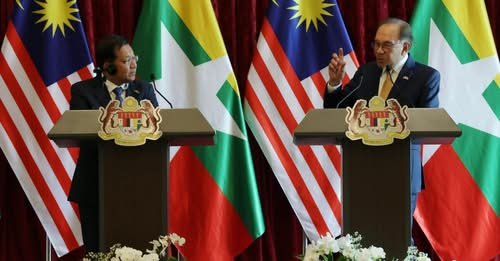
As Myanmar’s military junta continues its campaign of airstrikes, mass arrests, and attacks on civilians, increasing scrutiny is falling not only on the regime itself but also on the regional networks that help sustain its military capabilities, financial lifelines, and diplomatic legitimacy.
Investigations by the United Nations, Justice For Myanmar (JFM), Fortify Rights, and other international watchdogs have revealed that several ASEAN countries remain linked to the junta through commercial transactions, financial services, military engagement, energy investments, and diplomatic cooperation. While the degree of involvement varies significantly from country to country, these relationships continue to raise serious questions about ASEAN’s commitment to human rights, accountability, and its own Five-Point Consensus on Myanmar.
Malaysia: Aircraft Parts, Maintenance Services, and Alleged Support Networks
Recent investigations by Justice For Myanmar identified several Malaysian companies that allegedly supplied, sought to supply, or facilitated the procurement of aircraft components and maintenance services for the Myanmar military between 2023 and 2026.
According to leaked documents and trade records cited by JFM, one Malaysian company reportedly sought quotations from international suppliers for spare parts and critical components used in Myanmar military-operated aircraft and weapon systems. These included components for:
- K-8W light attack aircraft
- Orlan-10E drones
- Kamov Ka-28 helicopters
- Mi-17 transport helicopters
- Mi-2 helicopters
JFM further alleged that the same company received financing support from Perbadanan Usahawan Nasional Berhad (PUNB), an agency under Malaysia’s Prime Minister’s Department.
Another case involved Myanmar military engineers reportedly visiting a Malaysian government-linked aircraft maintenance company to discuss repairs to an Airbus A319 aircraft reportedly used by the Myanmar military leadership.
A third Malaysian company was accused of shipping aircraft-related parts to brokers known to supply Myanmar’s Air Force.
The allegations are particularly concerning because Myanmar’s Air Force has been repeatedly implicated in attacks on civilian populations. The United Nations Independent Investigative Mechanism for Myanmar and UN Special Rapporteur Tom Andrews have documented the military’s increasing reliance on aerial bombardment as ground resistance against the junta intensifies.
Justice For Myanmar warned:
“By knowingly providing support to the Myanmar military as it commits war crimes and crimes against humanity, businesses could be aiding and abetting those crimes.”
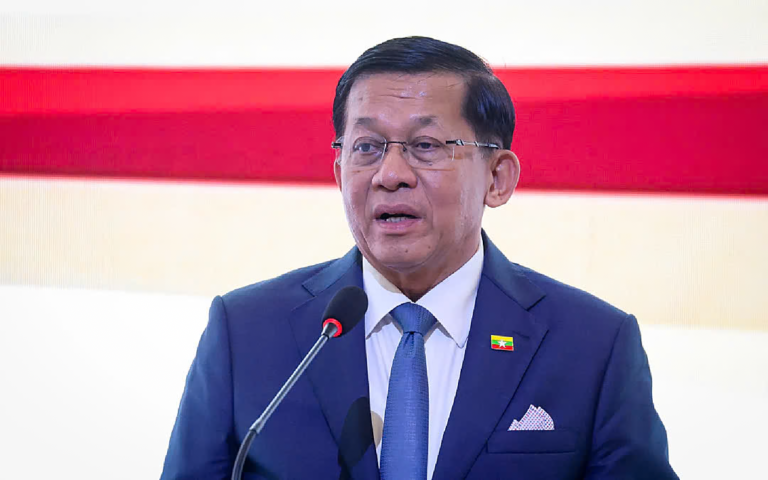
These allegations emerged amid controversy surrounding regional engagement with junta chief Min Aung Hlaing.
Singapore: From Key Procurement Hub to Tightened Enforcement
Singapore presents a more complex picture.
Unlike some regional governments, Singapore officially prohibits the transfer of arms and dual-use goods to Myanmar and has repeatedly condemned violence against civilians.
However, investigations by UN Special Rapporteur Tom Andrews found that Singapore-based companies and financial institutions had historically played a significant role in the junta’s procurement networks.
According to the UN report released in 2023:
- Singapore-registered entities were linked to approximately US$254 million worth of military-related supplies and dual-use equipment reaching Myanmar between 2021 and 2022.
- Singapore’s highly developed trade and banking systems were utilized by international arms brokers and front companies servicing the Myanmar military. [fortifyrights.org]
Following international scrutiny and investigations by Singaporean authorities, substantial changes occurred.
A subsequent UN report in 2024 found:
- Military procurement linked to Singapore fell by nearly 90%.
- Numerous supplier companies identified in earlier investigations ceased operations or were removed from company registers.
- Major banks including UOB reduced exposure to military-linked entities and strengthened compliance measures.
Singapore also remains one of the strongest ASEAN supporters of excluding junta leadership from high-level ASEAN summits and continues to reject recognition of the military regime as Myanmar’s legitimate government.
Consequently, evidence indicates that while Singapore once served as an important commercial hub exploited by procurement networks, official government policy has increasingly moved toward restricting and dismantling those channels.
Thailand: The Junta’s Most Important Regional Lifeline?
Human rights organizations have been far more critical of Thailand’s relationship with the Myanmar military.
Unlike Singapore, Thailand’s engagement has become increasingly visible and institutionalized.
Fortify Rights warned that Thailand’s growing engagement risks granting legitimacy to a military regime accused of war crimes and crimes against humanity. The organization urged Bangkok not to use diplomatic engagement in ways that normalize junta rule. [fortifyrights.org], [reuters.com]
Diplomatic Legitimization
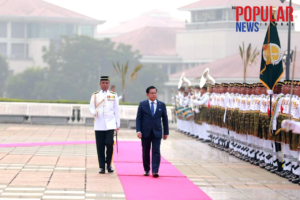
Recent years have witnessed unprecedented high-level contacts between Thailand and the junta.
These include:
- Official visits by senior Thai officials to Naypyidaw.
- Formal invitations extended to Min Aung Hlaing.
- Bilateral security and border meetings involving military leadership.
- Efforts to promote broader re-engagement between Myanmar and ASEAN. [fortifyrights.org], [reuters.com]
Critics argue that such meetings grant political legitimacy to a regime that ASEAN itself previously isolated following the 2021 coup.
Security Cooperation
Watchdog groups have also highlighted:
- Joint border security coordination.
- Discussions involving drone technologies and military cooperation.
- Restrictions on supplies reaching anti-junta resistance territories.
- Increased operational coordination along the Thai-Myanmar frontier.
Human rights advocates argue these actions indirectly strengthen the junta’s military position while weakening democratic resistance forces.
Economic Ties
Thailand remains one of Myanmar’s largest trading partners.
Particularly significant are Thai energy investments through companies such as:
- PTT
- PTTEP
These firms maintain substantial involvement in Myanmar’s natural gas sector.
Critics argue that revenue generated through these projects ultimately benefits military-controlled institutions, including the Myanmar Oil and Gas Enterprise (MOGE), providing crucial foreign currency to the regime.
Thailand has also hosted Thailand-Myanmar business forums aimed at expanding bilateral trade, a move activists contend risks strengthening the junta’s economic resilience despite ongoing conflict.
Other ASEAN States: Silence, Accommodation, and Strategic Interests
While Thailand, Malaysia, and Singapore receive the most attention, other ASEAN members have also faced criticism for insufficient pressure on the military regime.
Laos
Laos has generally pursued a policy of quiet engagement with the junta and has avoided overt criticism. During its ASEAN chairmanship, rights groups criticized Vientiane for prioritizing engagement over accountability and for producing little measurable progress regarding Myanmar.
Cambodia
Former Prime Minister Hun Sen’s controversial visit to Myanmar in January 2022 was widely criticized as providing diplomatic legitimacy to the junta. Many analysts regard the visit as one of the earliest major breaks in ASEAN’s collective pressure campaign against the military regime.
Vietnam
Vietnam maintains pragmatic relations with Naypyidaw and traditionally adheres to ASEAN’s principle of non-interference. Although Hanoi has not openly championed the junta internationally, it has generally favored engagement rather than isolation.
Indonesia
Indonesia has often taken the strongest position against military rule within ASEAN.
Jakarta repeatedly:
- Pressed for implementation of ASEAN’s Five-Point Consensus.
- Engaged extensively with pro-democracy stakeholders.
- Supported excluding junta leaders from ASEAN summits.
- Called for inclusive political dialogue involving resistance forces.
Philippines
The Philippines has become increasingly vocal regarding Myanmar’s deteriorating human rights situation and has generally supported stronger ASEAN measures toward the junta.
Brunei
Brunei largely aligns with ASEAN consensus positions and has supported restrictions on junta participation at high-level ASEAN meetings.
ASEAN’s Credibility at Stake
More than five years after Myanmar’s military seized power, ASEAN remains deeply divided on how to address the crisis.
Some member states, particularly Indonesia and Singapore, have increasingly emphasized accountability and restrictions against military procurement networks.
Others continue to prioritize security cooperation, trade expansion, border management, and diplomatic engagement with the junta.
Fortify Rights recently warned that ASEAN risks granting political legitimacy to an authoritarian regime without achieving meaningful improvements for Myanmar’s people. The organization argued that regional governments should expand engagement with democratic actors and pressure the military to halt attacks against civilians rather than normalize relations with junta leaders. [fortifyrights.org]
The central question facing ASEAN today is whether regional stability is truly served by accommodating a regime accused of war crimes, crimes against humanity, and the ongoing persecution of ethnic minorities, or whether meaningful peace can only emerge through accountability, democratic transition, and respect for the will of Myanmar’s people.
Key References
- Justice For Myanmar investigations on Malaysian corporate involvement.
- UN Special Rapporteur Tom Andrews reports on Myanmar military procurement networks.
- Fortify Rights: Thailand: End Legitimization of Myanmar’s Military Regime, Expand Political Engagement with Democratic Alternatives. [fortifyrights.org]
- Reuters: ASEAN outreach may give Myanmar leaders legitimacy without results. [reuters.com]
- UN Human Rights Council reports on foreign banks and military procurement networks.
- Justice For Myanmar reports on Thai, Singaporean, and Malaysian commercial links to the junta.