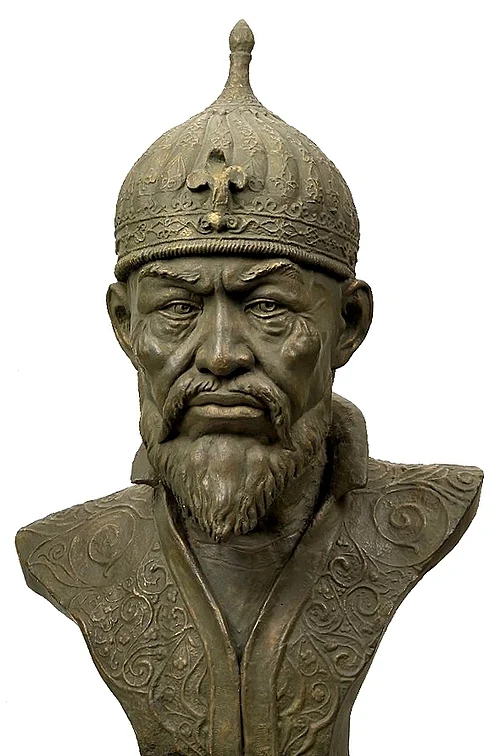
Facial reconstruction from Timur’s skull,
by Mikhail Mikhaylovich Gerasimov Photo By user:shakko – Own work, CC BY-SA 3.0, https://commons.wikimedia.org/w/index.php?curid=9494028
Adapted from Wikipedia and drafted for the Myanmar Muslim News Network
The Legacy of Amir Timur: The “Lord of Conjunction” Who Shaped the Islamic World
The history of the Islamic world is decorated with figures whose military genius and cultural patronage permanently redrew the global map. Among these giants, few loom larger than Amir Timur (historically known in the West as Tamerlane). As a Turco-Mongol conqueror and the founder of the Timurid Empire, Timur remains one of history’s most influential, complex, and undefeated military strategists.
For readers of the Myanmar Muslim News Network, understanding Timur requires looking beyond just his military campaigns; it means examining his deep devotion to Islamic scholarship, his self-proclaimed role as the “Sword of Islam,” and the magnificent Islamic golden age he left behind.
1. Rise to Power: From Transoxiana to Imperial Ruler
Born in the late 1320s near Kesh (modern-day Shahrisabz, Uzbekistan) into the Turkicized Mongol tribe of Barlas, Timur’s early life was defined by the chaotic fragmentation of the Chagatai Khanate.
Salient Features of His Rise
- The “Lame” Strategist: In his youth, while serving as a mercenary or defending his lands, Timur sustained severe arrow wounds to his right leg and right hand. Though physically disabled for life—earning him the Persian nickname Temūr-i Lang (Timur the Lame)—his physical limitations never hindered his absolute mastery over horse archery and battlefield tactics.
- The Path to Sovereignty (1370): Through brilliant political maneuvering and shifting alliances, Timur consolidated power among the local Turkic tribesmen. By 1370, he overthrew his rival Amir Husayn and was formally proclaimed sovereign in the ancient city of Balkh.
The Challenge of Legitimacy
Because Timur was not a direct patrilineal descendant of Genghis Khan, traditional steppe law forbade him from taking the supreme title of Khan. To legitimize his rule to both his Mongol and Muslim subjects, he adopted unique titles:
- Güregen (Royal Son-in-Law): He married Saray Mulk Khanum, a direct princess of the Chinggisid line.
- Amir and Sahib Qiran: He ruled under the title of Amir (General) and adopted the messianic title Sahib Qiran (“Lord of Conjunction”), signifying an auspicious astrological era ordained by God to establish justice and order.
2. The Unbeaten Military Genius: Major Invasions and Events
Timur spent 35 years in continuous military expeditions, remaining entirely undefeated in battle. His multi-ethnic armies shook the foundations of the world’s most powerful empires.
Key Historic Confrontations
- The Tokhtamysh-Timur War: Timur clashed repeatedly with his former protégé, Tokhtamysh, the leader of the Golden Horde. In massive clashes like the Battle of the Terek River (1395), Timur effectively dismantled the power of the Horde.
- The Sack of Delhi (1398): Turning his sights toward the wealthy Delhi Sultanate in India, Timur crossed the Indus River. Facing an army equipped with terrifying war elephants, Timur brilliantly used camels carrying burning straw to panic the elephants, leading to a swift victory.
- The Battle of Ankara (1402): In one of the most famous clashes in medieval history, Timur marched into Anatolia and faced the rising Ottoman Empire led by Sultan Bayezid I. Timur’s tactical superiority resulted in the total defeat and capture of the Ottoman Sultan, delaying the Ottoman expansion into Europe by decades.
3. The “Sword of Islam” and Patron of Scholars
While mainstream Western history often focuses exclusively on the immense destruction caused by his campaigns, Islamic history remembers Timur as a deeply religious ruler who deeply revered the family of the Prophet Muhammad (Peace Be Upon Him) and championed Islamic civilization.
“He referred to himself as the ‘Sword of Islam’ and styled himself a Ghazi (Holy Warrior) in his later years, heavily utilizing Islamic rhetoric to unify his vast, diverse empire.”
Dialogues with Islamic Giants
Timur was highly intelligent, fluent in Chagatai Turkic and Persian, and deeply enjoyed intellectual debates. He famously sought out the company of the greatest Muslim minds of his era:
- Ibn Khaldun: During the siege of Damascus in 1401, the legendary father of sociology and historiography, Ibn Khaldun, was lowered over the city walls to negotiate with Timur. The two spent weeks in deep philosophical and historical discourse, with Timur expressing immense respect for the scholar’s insights.
- Hafez and Hafiz-i Abru: He regularly interacted with Persia’s finest poets and court historians, ensuring that his conquests were documented and scrutinized by the era’s intellectual elite.
4. The Timurid Renaissance: Architecture and Culture
Perhaps Timur’s greatest living legacy is the Timurid Renaissance—a period of unparalleled cultural, scientific, and architectural brilliance that blossomed after he turned his capital, Samarkand, into the “Pearl of the World.”
Salient Cultural Features
- Architectural Wonders: Timur brought the finest craftsmen, architects, and artists from Persia, India, and Syria back to Samarkand. He commissioned breathtaking structures characterized by massive turquoise domes, intricate tilework, and grand geometry, such as the famous Gur-e-Amir (his final resting place).
- The Legacy of Science: Timur’s devotion to knowledge paved the way for his descendants. His grandson, Ulugh Beg, would become one of the world’s premier astronomers and mathematicians, building a historic observatory in Samarkand.
- Founding the Mughals: Centuries later, Timur’s great-great-great-grandfather descent line would lead to Babur, who founded the Mughal Empire in India, carrying the artistic, architectural, and administrative brilliance of the Timurids into South Asia.
Conclusion: A Complex Titan of History
Amir Timur passed away in February 1405 during an expedition toward China. He left behind an empire that spanned from the borders of Europe to the gates of India.
For the modern reader, Timur stands as a complex symbol of absolute power, brilliant military doctrine, and grand Islamic patronage. He proved that even from humble beginnings, strategic vision and intellectual curiosity can reshape the course of human civilization forever.