By U Aung Tin from Canada (translated and adapted)
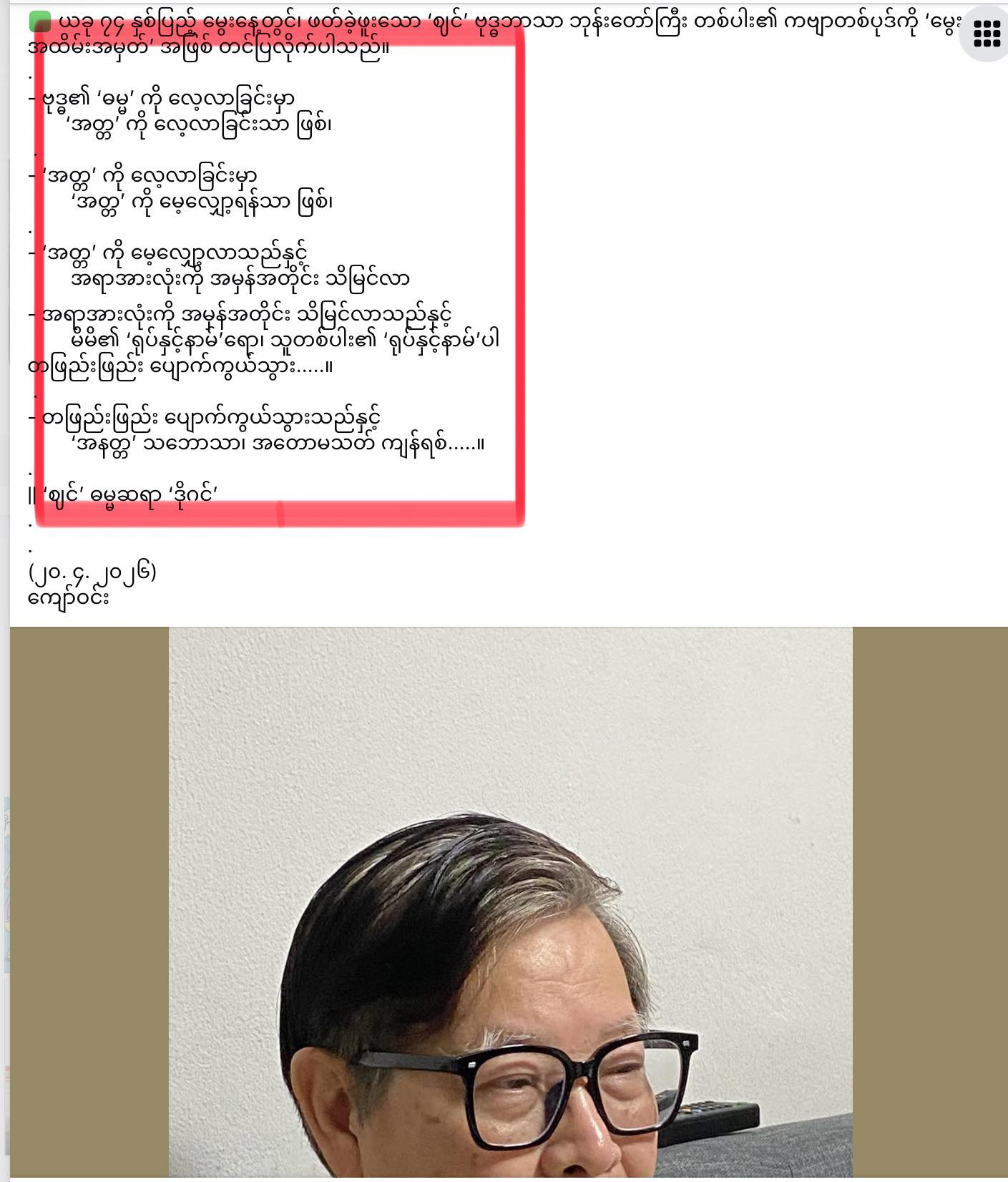
A respected Myanmar writer, Kyaw Win, on the occasion of his 74th birthday, shared a poem by the Zen Buddhist monk Dōgen—a meditation on the transformation from self (atta) to non-self (anatta).
I must confess: I do not fully understand these philosophical ideas of atta and anatta. Nor am I particularly eager to wrestle with them. This reflection is not about explaining such doctrines.
He is 74. I am 72.
At this stage of life, regardless of religion, we elders inevitably find ourselves thinking more about death. And when we think about death, we tend to do so within the frameworks we have lived in all our lives—the beliefs, disciplines, and boundaries that shaped us. We rarely wish to step outside them.
It is perhaps like the story of the young monk Sariputta, who urged his aged teacher Sañjaya Belatthiputta to listen to the Buddha’s teachings—but was refused.
Or like the story of the Prophet Muhammad, who lovingly pleaded with his uncle Abu Talib—the man who had protected and raised him—to accept Islam, yet was gently refused.
As we grow older, we become like people who have lived in the same house for sixty, seventy, or eighty years. We grow attached to that house. The old chair we always sit in feels most comfortable. Our environment becomes part of us.
We no longer long for a new house, a new place, or new possessions. Likewise, in matters of faith, we feel little desire to abandon the spiritual path we have long practiced and understood.
The Buddha taught about a good coming, a good living, and a good going.
No one owns the “good coming.” None of us chose our parents, birthplace, ethnicity, skin color, or religion at birth.
As for “good living” or “bad living”—that part of life has already passed. At this age, we cannot go back and live it again.
So whatever religion we follow, whatever community we belong to, what truly matters now is striving for a good ending—a good departure.
In Islam, the teaching is clear: from the moment of maturity until the final breath, the duties remain the same. There is no reduced obligation because one is old, nor extra burden because one is young.
Yet some people, not understanding this, tell me:
“You are old now. Just count prayer beads and focus on worship.”
But Islam is not a religion where one begins devotion only in old age or at the brink of death. It is a lifelong discipline—to do good and avoid wrong, consistently.
From what I have observed, all religions ultimately teach the same truth.
One of my favorite reflections, however, comes not from a religious figure, but from the well-known atheist-leaning communist writer Bhan Mo Tin Aung:
“The true value of a person is determined by how well they fulfilled their responsibilities in the human world.”
This piece gently bridges Buddhist, Islamic, and humanist thought, arriving at a shared moral conclusion:
- We do not control how we begin life.
- We cannot rewrite the past.
- But we remain responsible for how we complete our journey.
In a divided world—religious, political, and ethnic—this quiet wisdom offers something rare:
not argument, but convergence.