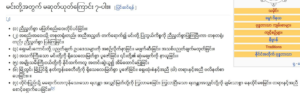
Adapted from Aung N Htwe’s post in Burmese on August 27, 2015
Introduction
Buddhists generally accept that the Buddha taught only those doctrines that were beneficial and worthy of adherence. Upon examining the teachings delivered across the Buddha’s 45 Vassa (rains retreats), through the lens of modern social science and political science, one finds that the Buddha’s teachings carry a remarkably deep and penetrating relevance that continues to resonate today.
Economic Decline as a Consequence of Corrupt Governance
Among the many sufferings endured by the people (veneyya) under the self-serving and tyrannical rule of wicked kings — as described in the Buddha’s teachings — one of the most consequential is economic deterioration and ruin, referred to in Pali as Bhoga Byasana (the destruction of wealth and prosperity).
The Buddha firmly taught the principle of cause and effect: that every consequence arises from a cause. In this context, the root cause is identified as Ñāti Byasana — the ruin or loss of noble kinsmen and worthy associates.
The Brain Drain: A National Catastrophe
As discussed in Part 1 of this series, the loss of virtuous and capable citizens represents an enormous national tragedy. Specifically, the four essential pillars required for a nation’s development — namely:
- Intellectuals and scholars
- Skilled professionals and artisans
- Business and economic experts
- Legal professionals and jurists
— have repeatedly been forced to flee, go into hiding, or perish under oppressive rule. This systematic elimination of a nation’s finest human capital results in a severe deficit of knowledge, expertise, and competitiveness. Without these pillars, a country loses its ability to engage meaningfully in economic activities on par with other nations.
Incompetence Fills the Vacuum
When genuine expertise is driven out, the void is filled by ignorant, incompetent, and unqualified rulers who, driven by arrogance and a belief that they alone know best, assume control of every institution and sector. The inevitable outcome is economic stagnation — a failure to produce meaningful results or sustainable growth — plunging the population into a deepening cycle of poverty from which there is no escape.
The Buddha clearly and emphatically taught that such conditions lead to widespread hunger, destitution, and helplessness among the people.
Myanmar: A Living Case Study
When the Buddha’s teachings on corrupt governance and economic ruin are measured against the historical trajectory of Myanmar, the parallels are striking and unmistakable.
Since the brutal and absolute military coup of 1962, a single self-serving military institution — clad in green — has controlled, directed, and dominated every aspect of the nation. The economic system that has persisted from that point to the present government is one defined not by innovation, production, or competitive industry, but by the exhaustion and sale of existing resources — a policy of stripping the nation bare.
Rather than creating new industries or producing goods competitive on the international stage, Myanmar’s economy has devolved into what can only be described as a “bare-bones, hollow economic policy” — akin to a famished dog licking the last remnants from a piece of hard palm sugar candy. The domestic economic situation has deteriorated to a state where the people are left scrambling over scraps, like starving dogs fighting over a worn-out shoe sole.
Conclusion
This is the condition of Bhoga Byasana — the poverty of livelihood, consumption, and sustenance — that the Buddha forewarned would befall any nation governed by corrupt and self-serving rulers. Myanmar’s modern history serves as a sobering testament to the enduring truth of these ancient teachings.
References:
- Cakkavatti-Sīhanāda Sutta, Dīgha Nikāya 26 — on the social and economic consequences of immoral governance.
- Kūṭadanta Sutta, Dīgha Nikāya 5 — on the Buddha’s economic philosophy and the root causes of poverty and crime.
- Aggañña Sutta, Dīgha Nikāya 27 — on the origin of kingship and the duties of rulers.
- Mahāparinibbāna Sutta, Dīgha Nikāya 16 — on the conditions for a nation’s welfare and non-decline.
- Lieberman, V. (2003). Strange Parallels: Southeast Asia in Global Context. Cambridge University Press.
- Steinberg, D. I. (2010). Burma/Myanmar: What Everyone Needs to Know. Oxford University Press.