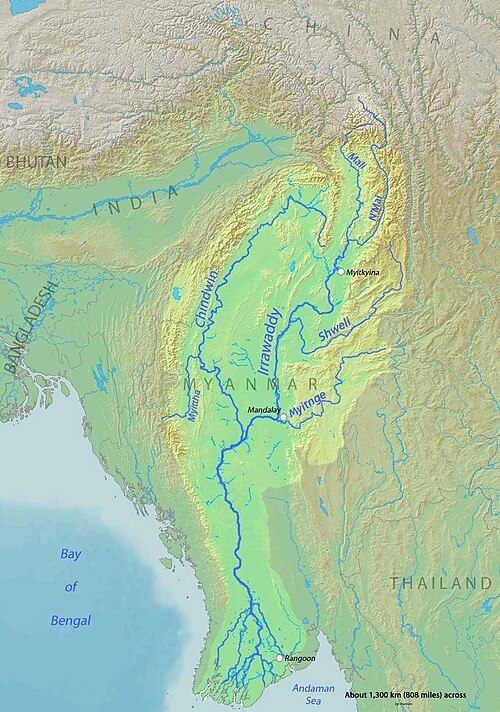
By Shannon – Background and river course data from http://www2.demis.nl/mapserver/mapper.asp, CC BY-SA 4.0, https://commons.wikimedia.org/w/index.php?curid=9633969
The First Footsteps
Imagine standing on the bank of the Ayeyarwady River thousands of years ago.
There were no cities.
No pagodas crowned the hills.
No monasteries echoed with the chanting of monks.
No kingdoms ruled the valleys.
The land that would one day become Burma was covered with dense forests, winding rivers, fertile plains, and rugged mountains. Elephants roamed freely. Tigers stalked the jungle. Great rivers carried fish in abundance, while the forests provided fruits, game, and timber.
Yet one thing was missing.
People.
Or rather, people had only just begun to arrive.
Modern science tells us that our earliest human ancestors originated in Africa before gradually spreading across the world over tens of thousands of years. Some moved westward into Europe, while others travelled east across Asia. Long before there was an India, a China, or a Burma, these early humans followed rivers, coastlines, and mountain passes in search of food and safety.
The region we now call Burma lay at the meeting point of these ancient journeys.
Some groups entered from the north through what is now China. Others crossed mountain ranges from the west through the Indian subcontinent. Some sailed across the Bay of Bengal, guided by seasonal monsoon winds that would later make Burma an important crossroads of maritime trade.
None of these early travellers knew they were entering a future nation. They were simply following the timeless human instinct to explore, survive, and build a better life.
Those first footsteps, almost forgotten by history, marked the beginning of a story that would continue for thousands of years.
In the chapters that follow, we shall meet the many peoples who travelled these ancient paths and discover how each contributed a thread to the rich tapestry that became Burma.
Continue to read: 3/ The Making of Myanmar: A History of Migrations, Civilizations and Peoples. Part Three