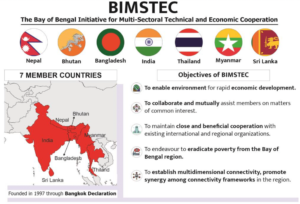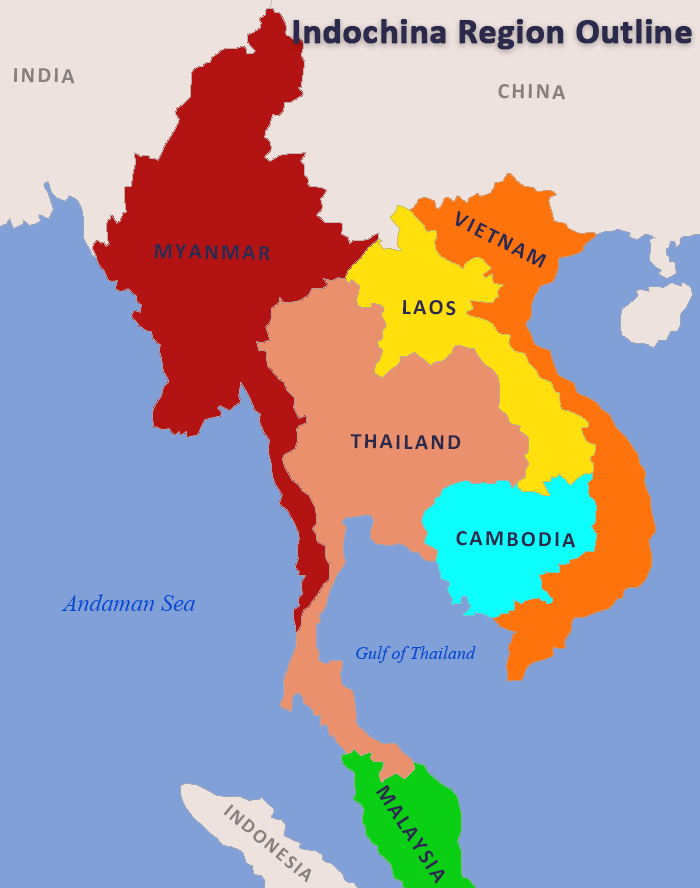
“When I studied geography at Kingswood High School, Kalaw, in the early 1960s, we learned about the countries of the Indo-Chinese Peninsula. The term has largely disappeared from modern textbooks, replaced by expressions such as Southeast Asia, ASEAN, BIMSTEC, and the Indo-Pacific. Yet the old concept contained an important truth: Burma stood at the crossroads of India, China, and Southeast Asia. More than sixty years later, that geographical reality continues to shape Myanmar’s opportunities and challenges.”
“Indo-China” or “Indo-Chinese Peninsula” was much more commonly used in geography textbooks from the colonial period through the 1960s.
When you were studying geography in the late 1950s and early 1960s, the Indo-Chinese Peninsula usually referred to:
- Myanmar (Burma)
- Thailand (Siam)
- Laos
- Cambodia
- Vietnam
- sometimes Malaya was discussed alongside them
The idea behind the name was geographical and cultural:
- “Indo” because Indian civilization strongly influenced the region through Buddhism, Hinduism, scripts, literature, law, and trade.
- “China” because Chinese civilization also exerted major influence through migration, commerce, administration, and diplomacy.
Myanmar sat almost exactly between those two great civilizations.
In fact, old geography teachers often described Burma as:
“The meeting place of Indian and Chinese civilizations.”
That description still has considerable truth today.
The reason the term has become less popular is partly political and partly academic.
After:
- the independence of Asian countries,
- the Vietnam War,
- the formation of ASEAN,
people increasingly preferred more neutral regional terms such as:
- Southeast Asia
- Mainland Southeast Asia
- The Mekong Region
- ASEAN Region
The word “Indo-China” also became associated with French colonial rule in:
- Vietnam,
- Laos,
- Cambodia,
because the colony was officially called French Indochina.
As a result, many modern scholars avoid the term even though the geographical concept remains valid.
Ironically, today’s geopolitical language is moving back toward similar concepts.
Consider modern terms such as:
- Indo-Pacific
- Act East Policy
- BIMSTEC
- Bay of Bengal Region
- Mekong-Ganga Cooperation
All of these recognize something that your old geography books already taught decades ago:
Myanmar is not merely a Southeast Asian country.
It is a bridge:
- between South Asia and Southeast Asia,
- between India and China,
- between the Bay of Bengal and the Mekong world,
- between the Indian Ocean and the Pacific Ocean.
In some ways, the old geography teachers at Kingswood and other schools may have given students a broader regional perspective than many modern textbooks. They encouraged students to see Burma not as an isolated nation but as part of a wider interconnected region stretching from India to Vietnam.
If we write about Myanmar in BIMSTEC, it would be incomplete without examining Myanmar’s position between India and China, and more broadly within what older geographers called Indo-China.
Historically, Myanmar has never been purely South Asian or purely East Asian. It has always been a crossroads.
Burma: The Meeting Point of Three Civilizations
Myanmar sits at the intersection of:
- The Indian civilization sphere from the west.
- The Chinese civilization sphere from the north.
- The Southeast Asian civilization sphere from the east and south.
This unique position influenced almost every aspect of Burmese history.
Indian Influence
For nearly two millennia, India profoundly influenced Myanmar through:
- Buddhism.
- Sanskrit and Pali literature.
- Law and administration.
- Trade and maritime commerce.
Ancient kingdoms such as Thaton and Bagan absorbed many Indian cultural and religious influences.
Muslim traders from Arabia and India also became part of this wider Bay of Bengal world.
Chinese Influence
China’s influence arrived through:
- Overland trade routes.
- Migration.
- Border commerce.
- Political and military interactions.
The Burmese kingdoms frequently dealt with Chinese dynasties through diplomacy, trade, and occasionally warfare.
Even today, northern Myanmar remains economically connected to China’s southwestern province of Yunnan.
Southeast Asian Influence
Myanmar also shares deep historical links with:
- Thailand
- Laos
- Cambodia
through Theravada Buddhism, royal traditions, architecture, and trade.
The Geopolitical Reality
Today, Myanmar remains strategically important because it offers:
- China’s shortest route to the Indian Ocean.
- India’s land bridge to Southeast Asia.
- ASEAN’s western gateway.
- Access to the Bay of Bengal.
As a result, both China and India view Myanmar as strategically significant.
Potential Advantages for Myanmar
If peace and stability emerge, Myanmar could benefit from:
- Transit trade.
- Manufacturing investment.
- Energy projects.
- Tourism.
- Educational exchanges.
- Regional infrastructure.
Instead of choosing one side, Myanmar could potentially benefit from engagement with both India and China.
Potential Risks
However, geography can be both a blessing and a burden.
Myanmar risks:
- Becoming an arena for great-power competition.
- Excessive dependence on one major power.
- Strategic debt or political leverage from external actors.
- Border instability spilling across frontiers.
A Historical Reflection
Throughout history, successful Burmese rulers often pursued a balancing strategy.
Leaders from the Bagan, Toungoo, and Konbaung periods generally sought relations with multiple neighboring powers rather than complete dependence on any single one.
In the modern era, a similar lesson may apply.
Myanmar’s greatest strength may lie not in becoming an extension of India, China, or any other power, but in serving as a bridge among them.
That idea might form the central theme of a future MMNN article:
“Myanmar in Indo-China: Bridge, Buffer, or Battleground?”
Such an article could trace the story from ancient Indian and Chinese influences, through colonial times, the Cold War, BIMSTEC, ASEAN, the Belt and Road Initiative, the Quad, and finally the current conflict and its implications for Myanmar’s future.
It would be a fascinating subject because Myanmar’s geography has remained constant, while the empires, governments, and ideologies around it have changed repeatedly. The challenge for every generation of Burmese leaders has been the same: how to turn that geography into an advantage rather than a vulnerability.