Xi’an was the starting point of the ancient Silk Road, which wound its way through Central Asia, Persia, and onward to the Mediterranean world. Isfahan, the magnificent Safavid capital of Iran, was one of the Silk Road’s greatest and most storied stops — a city so splendid that travellers called it “Half the World.” While historians generally identify Antioch (in modern Turkey) or Rome as the Silk Road’s western terminus, Isfahan’s central role in Persian trade and culture made it the heart of the route through Iran. For any traveller who has stood in both Xi’an and Isfahan, the sense of having touched two poles of that ancient civilisation is deeply meaningful.
Today, we find the idea of the Silk Road being powerfully revived.
After the US Navy launched a blockade on April 13 targeting all ships seeking to reach Iranian ports, more than 3,000 Iran-bound containers were stranded at Karachi. In response, Pakistan opened six overland transit routes for goods destined for Iran, formalising a road corridor through its territory. The Ministry of Commerce issued the Transit of Goods through Territory of Pakistan Order 2026 on April 25, bringing it into immediate effect. The order allows goods originating from third countries to be transported through Pakistan and delivered to Iran by road. The NationalAl Jazeera
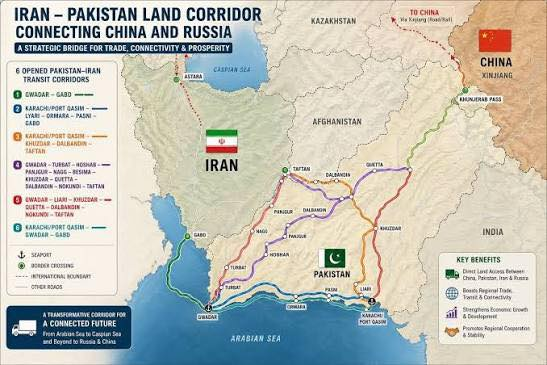
By activating Gwadar, Karachi, Port Qasim, Taftan, Gabd, Quetta, Khuzdar, and Ormara as integrated transit nodes, Islamabad is not merely facilitating commerce but redefining strategic access and geopolitical leverage. The shortest route, the Gwadar-Gabd corridor, reduces travel time to the Iranian border to between two and three hours, compared with the 16 to 18 hours it takes from Karachi, and could cut transport costs by 45 to 55 percent. Today, thousands of trucks are delivering much-needed goods and supplies to people in the region. Defence Security AsiaAl Jazeera
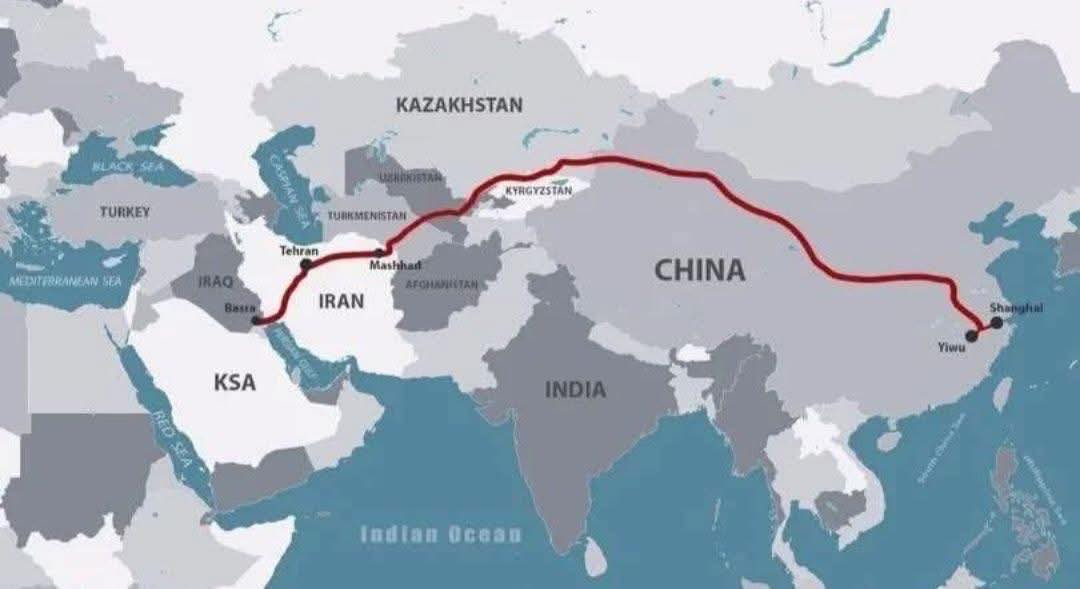
The revival of the ancient Silk Road finds expression also in a remarkable railway that China has built to connect itself, Central Asian nations, and Iran. The rail journey covers 10,399 km from eastern China to Tehran via Xinjiang, the Alataw Pass, Kazakhstan, and Turkmenistan — taking about 14 days, compared to 30 to 40 days by sea. On May 25, 2025, the first freight train from Xi’an arrived at the Aprin dry port in Iran, marking the official launch of this direct rail link. The corridor is now moving towards handling an estimated 300 trains annually, supported by unified tariffs among member nations, with Iran emerging as the “Golden Gateway” for Chinese goods heading to Europe. Trade between Eurasian countries is increasingly overland and no longer confined to the seas — though it should be noted that bulk crude oil still largely moves by ship, and the railway’s greatest strength is in non-oil goods. Business Today + 2
With all these overland trade routes, Iran will be far harder to strangle by naval blockade. Iran has land borders with Iraq, Turkey, Azerbaijan, Armenia, Turkmenistan, Afghanistan, and Pakistan — seven nations in total — and additional outlets through the Caspian Sea. In the long term, Pakistan’s action may signal a strategic pivot towards balancing US ties with regional partnerships involving Iran, China, and Russia. WikipediaMSN
With its varied topography, Iran is also largely self-sufficient in food, unlike many of its neighbours. Neither does it depend significantly on desalination plants for water — a stark contrast to the Gulf states.
Iran is a nation of immense potential. With a young and educated population of around 90 million, extraordinary history, diverse geography, and now a web of overland connections to China, Russia, Central Asia, and Europe, the conditions for a remarkable economic renaissance exist. I look forward to seeing Iran prosper once this war ends — and to visiting again to witness that potential realised.
Above is the fact checked, EDITED AND EXTENDED VERSION of part of the good post below.
Why Trump’s Naval Blockade Will Never Strangle Iran.
My first and only visit to Iran was in 2003, when I went to the country with my team to investigate a shipping casualty at the port of Bandar Iman Khomeini, in preparation for a London arbitration against the charterers.
Like so many who did not know Iran well, I had assumed the country was one big dessert as it was in the Middle East. Instead, I found a country of extraordinary beauty. Tehran is ringed by gorgeous mountains. Our plane took off from Dubai but was prevented from landing in Tehran because of a snow blizzard. After circling Tehran for several hours,the pilot had to fly back to Dubai. So 10 hours after we first took off from Dubai, we found ourselves back at our airport hotel. The next day, the weather was much kinder and we finally managed to land in Tehran.
The gorgeous views of the snow-capped mountains around Tehran are still etched in my mind. And I still remember the aroma of freshly baked naan bread emanating from the many small bakeries which dot the city. It was an experience to see long lines of people waiting to buy bread and the happy faces of many men and women carrying freshly baked bread home to their families.
After our work at Bandar Iman Khomeini, my team took off to Isfahan, an ancient capital of the Persian empire, to explore the history of this ancient civilisation. Don’t get me started on Isfahan, because it is one of the greatest wonders of the world I have visited. I will write about the glories of Isfahan another time.
But the visit to Isfahan was very personal and significant for me. In 1985, my late Father had first brought me to China. China then was still a very poor country- not the giant behemoth it is today. On that trip he took me to Xian ( also known as Changan in ancient times). Xian was the ancient capital of China, the seat of 11 dynasties. Its most famous attraction is of course the Terra Cotta warriors- the life size terra cotta army which protected China’s 1st emperor in his afterlife. But Xian was also the start of the ancient Silk Road, which wound its way through Central Asia. And that road ended in Isfahan. For me personally, it was very fulfilling to tell myself that I had been to both the beginning and the end of the Silk Road. Xian and Isfahan are twin cities.
Today, we find the idea of the Silk Road being revived.
After the Strait of Hormuz was closed, Pakistan opened up 6 land corridors to facilitate the movement of goods between Pakistan, China, Russia and other Central Asian countries with Iran. This happened on 26 April 2026. Today, 3000 containers which were previously held up because of the closure of the Strait of Hormuz are on the move because of these land corridors. Thousands of trucks are delivering much needed goods and supplies to people in the region.
The revival of the ancient Silk Road finds expression also in the amazing 10,400 km railway that China has built to connect itself, many of the Central Asian countries, and Iran ( see diagram below ). This railway is now operational. Trade between Eurasian countries will be overland and not confined to the seas.
With all these overland trade routes, Iran will never be strangled by Trump’s naval blockade. Iran is bordered by 7 countries and there are also other outlets through the Caspian Sea and other routes which I will not elaborate here.
With its varied topography, Iran is also largely self-sufficient in food, unlike its Arab neighbours. Neither does it have to depend significantly on desalination plants for water.
I am looking forward to seeing Iran becoming prosperous again once this war ends. I see the potential for Iran to be the China of the Middle-East. The potential for this nation with a very young population of 93 million are limitless. And I want to visit Iran again to see its potential realised.