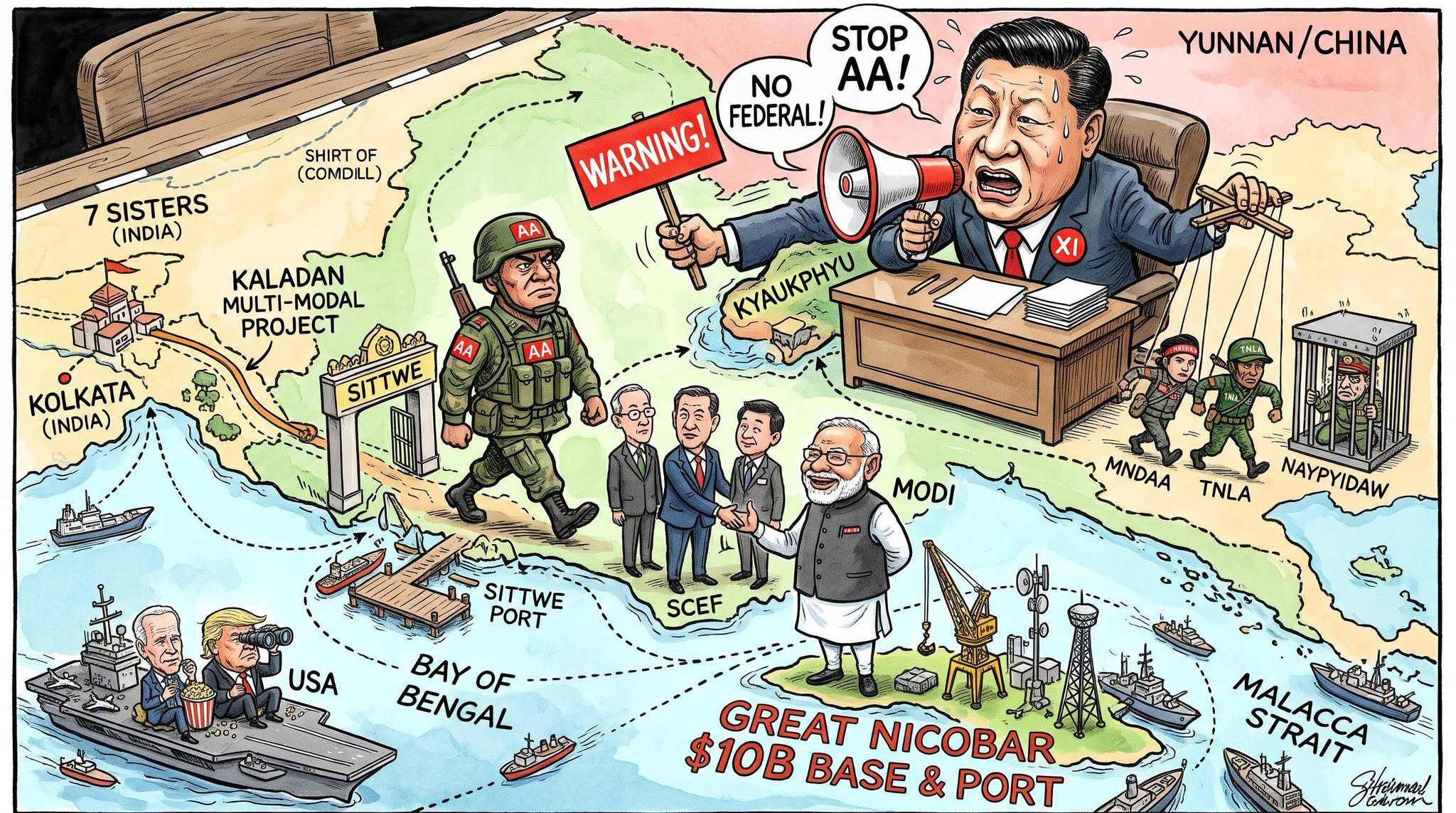
How the Arakan Army, China, India and Myanmar’s Federal Future Could Become Interconnected
Translated and edited for MMNN by Dr Ko Ko Gyi, based on a commentary by Zaw Tun Oo. The article distinguishes reported developments from geopolitical interpretation.
Introduction: Why Should Beijing Be Concerned About Sittwe?
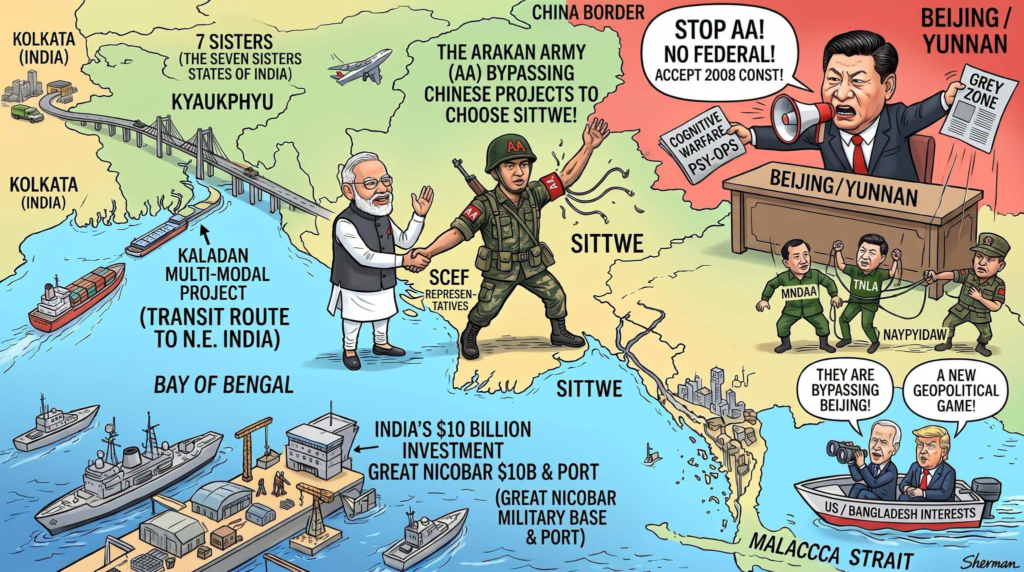
Why might China be concerned about the Arakan Army (AA) advancing towards Sittwe? Why did the Ta’ang National Liberation Army (TNLA) and the Myanmar National Democratic Alliance Army (MNDAA), both members of the Three Brotherhood Alliance, enter negotiations with Myanmar’s military authorities in Naypyidaw, while the AA held talks with the Steering Council for the Emergence of a Federal Democratic Union (SCEF)?
These questions point towards a wider geopolitical contest involving China, India, Myanmar’s ethnic resistance organizations and the future political structure of Myanmar.
There is, however, an important distinction between documented events and interpretations of Beijing’s intentions. Reports indicate that China has exerted pressure on ethnic armed organizations to negotiate with Myanmar’s military authorities. But claims that Chinese President Xi Jinping has personally warned the AA to halt its advance, or that Beijing is directing particular online propaganda campaigns against federalism, have not been independently established.
The central question remains: Could developments in Rakhine State alter the strategic calculations of both China and India, while strengthening the case for a federal democratic Myanmar?
1. Why Sittwe Matters Alongside Kyaukphyu
At first glance, the explanation appears straightforward. China has major strategic and economic interests in Kyaukphyu, while India has invested in the Kaladan Multi-Modal Transit Transport Project, which connects India’s northeastern region with the Bay of Bengal through Myanmar.
However, the strategic importance of Sittwe goes beyond its immediate military significance.
China’s interests in Myanmar include access to the Indian Ocean, energy infrastructure, cross-border commerce and the China–Myanmar Economic Corridor. Kyaukphyu is particularly important because it hosts a deep-sea port project and is connected to oil and natural gas pipelines running towards China’s Yunnan Province.
India, meanwhile, seeks to improve access to its northeastern states and strengthen its economic and strategic presence in the Bay of Bengal.
If the AA were to gain control of Sittwe, or if a future political settlement allowed it to exercise meaningful authority over the port and surrounding territory, India would have to assess how the new situation might affect its interests.
Would New Delhi be able to establish more direct and practical communication with the authorities exercising control over the territory through which the Kaladan project passes? Could this help resolve some of the project’s longstanding security and implementation difficulties?
These are reasonable questions, but the answers depend on future political and security arrangements. Control of Sittwe alone would not automatically guarantee India’s access or enable the project to operate without obstacles.
The larger point is that the authorities controlling Rakhine State could become increasingly important to the regional balance of power.
2. The Kaladan Project: More Than a Transport Route
India’s Kaladan Multi-Modal Transit Transport Project is designed to connect the Indian port of Kolkata with Sittwe by sea, continue along the Kaladan River to Paletwa in Chin State, and then use a road link to Mizoram in northeastern India.
The project is intended to improve connectivity between mainland India and its northeastern states, reducing dependence on routes through the narrow Siliguri Corridor.
It is important to correct one common misconception: the project does not itself connect all seven northeastern Indian states directly to Sittwe. Rather, it is a strategic transport corridor intended to improve access to India’s northeastern region, with potential wider economic benefits.
The project’s progress has been slow. In October 2026, Mizoram’s official government website reported that the 109.2-kilometre Paletwa–Zorinpui road section had achieved approximately 25 per cent physical progress and 30 per cent financial progress. This illustrates the practical challenges that remain.
Reference: Mizoram government update on the Kaladan road project, 5 October 2026.
The project’s future therefore depends not only on infrastructure investment, but also on security, cross-border cooperation and the political authorities governing the areas through which it passes.
For India, a workable relationship with the authorities in Rakhine State could be strategically valuable. For China, any development that changes the balance of influence around Myanmar’s western coastline deserves attention.
Nevertheless, it would be premature to conclude that the Kaladan project would necessarily threaten China’s interests. India and China have overlapping interests in regional trade and stability, alongside their strategic rivalry.
3. Great Nicobar and the Strait of Malacca: Connecting the Geopolitical Dots
India’s Great Nicobar Island development adds another dimension to this strategic picture.
The Indian government has outlined a major development programme for Great Nicobar, including an international container transshipment terminal, an international airport, a power plant and a planned township. The project is intended to strengthen India’s maritime and economic position near major east–west shipping routes.
Reference: Government of India, Great Nicobar Project, 1 May 2026.
Great Nicobar lies near the western approaches to the Strait of Malacca, one of the world’s most important maritime passages. The strait connects the Indian Ocean with the South China Sea and carries substantial volumes of international trade and energy shipments.
Sittwe and the Strait of Malacca are separated by a considerable distance. Yet geography alone does not determine strategic relevance. Ports, shipping lanes, energy corridors, military capabilities and diplomatic relationships can link places that are far apart.
A more connected regional network involving Kolkata, Sittwe, India’s Andaman and Nicobar Islands, and the Strait of Malacca could create new commercial opportunities and alter strategic calculations over the long term.
For India, such connectivity could support trade diversification, economic development and a stronger maritime presence. For China, which relies heavily on maritime trade and energy imports, changes in India’s regional capabilities are naturally relevant to its strategic planning.
However, this should not be interpreted as proof that the Kaladan project and Great Nicobar development form a single coordinated military strategy. The two projects have distinct stated purposes, and any broader strategic connection remains an analytical possibility rather than an established fact.
The important lesson is that Rakhine State’s future cannot be understood solely through the lens of Myanmar’s internal conflict. It must also be considered within the wider geopolitics of the Bay of Bengal and the Indo-Pacific.
4. Why Did the TNLA and MNDAA Go to Naypyidaw While the AA Engaged SCEF?
The political developments of July to October 2026 provide an important context.
On 19 July, the TNLA held talks in Naypyidaw with the military authorities’ National Solidarity and Peacemaking Negotiation Committee (NSPNC). Reports indicated that the TNLA sought recognition of a Ta’ang State covering territories under its control.
The meeting occurred amid reports of Chinese pressure on ethnic armed organizations to enter negotiations. Analysts have also pointed to the TNLA’s territorial losses, the need to consolidate its remaining areas and the absence of a strong common political framework among resistance organizations.
Reference: The Irrawaddy, “TNLA Becomes First Ethnic Rebel Army to Join Regime Peace Talks,” 21 July 2026.
The MNDAA subsequently sent a delegation to Naypyidaw, where discussions began on 24 September. Reporting by the Shan Herald Agency, published through Burma News International, said Chinese intervention helped ensure the delegation proceeded to the talks. The reopening of China–Myanmar border trade routes was a key issue.
These developments demonstrate that Beijing has considerable influence over some armed organizations operating near its border. They also illustrate the practical pressures that can lead an organization to negotiate even while the broader conflict remains unresolved.
The AA followed a different publicly visible political track. On 23 July, its leadership held a formal meeting with SCEF, a coalition associated with the struggle for a federal democratic union.
Reference: DVB, “Myanmar Resistance Coalition SCEF Holds First Formal Talks with Arakan Army Leadership,” 27 July 2026.
The significance of this meeting lies in the possibility of greater political coordination between a powerful ethnic armed organization and a wider federal-democratic coalition.
It does not, by itself, prove that the AA has committed to every SCEF objective or that a comprehensive political agreement has been reached. Nor does the available evidence establish that Beijing views the meeting as a direct challenge to its authority.
Nevertheless, the contrast is politically significant: while some organizations were negotiating with the military authorities, the AA was also engaging with a coalition advocating a different political future for Myanmar.
5. Is Beijing Trying to Prevent a Federal Democratic Settlement?
The original commentary suggests that China is concerned about the AA joining a federal-democratic political framework and that online messages advocating “high-level autonomy” instead of federalism may be intended to discourage the AA from pursuing that course.
This is a hypothesis that deserves examination, but it must not be confused with a proven Chinese directive.
China has strong reasons to prioritize stability along its border, cross-border trade, infrastructure security and agreements that reduce the risks to its economic interests. Its reported pressure on the TNLA and MNDAA to negotiate provides evidence of an active role in Myanmar’s conflict.
It does not follow automatically that every criticism of federalism, every argument for autonomy, or every social-media campaign originates with the Chinese government.
There is also a genuine constitutional question here. What is the difference between meaningful federalism and high-level autonomy?
Federalism generally involves a constitutionally defined division of powers between a federal government and constituent states or regions. Depending on the constitutional design, states may have protected legislative, administrative and fiscal authority, together with representation in federal institutions.
Autonomy can provide substantial self-government, but its extent may depend on the central constitution, legislation or political agreements. If its protections are weak, it may be more vulnerable to unilateral changes by the central government.
The distinction is not merely a matter of terminology. It concerns who exercises power, how that power is distributed, and whether the rights of constituent states can be protected against arbitrary interference.
The 2008 Constitution of Myanmar established a system of self-administered zones and divisions and recognized certain forms of subnational administration. However, it did not establish a comprehensive federal system based on an agreed division of sovereign constitutional powers between equal constituent states. It also entrenched a powerful military role in national politics.
Therefore, the central question for Myanmar’s future should not be whether the word federalism is politically convenient. It should be whether the constitutional arrangement provides genuine self-government, democratic accountability, equality among citizens and effective protection for ethnic nationalities.
A federal system need not mean the breakup of the Union. Properly designed, it can be a framework for preserving the Union by accommodating diversity and resolving disputes through agreed constitutional institutions.
6. Can the Experience of the Wa and Kokang Areas Settle the Federalism Debate?
The original commentary asks why the establishment of a federal or highly autonomous arrangement for Kokang should necessarily be regarded as a problem.
This is a legitimate question, although the situation requires careful explanation.
The Wa Self-Administered Division and the Kokang Self-Administered Zone are examples of territorially concentrated ethnic administration recognized within Myanmar’s existing constitutional framework. Their existence shows that the country has already experimented with forms of territorial self-administration.
But neither arrangement, by itself, establishes what a future federal Myanmar should look like.
The Wa and Kokang cases differ in their history, demographic circumstances, military capabilities, external relationships and administrative arrangements. Their experiences cannot simply be copied and applied to every other state or nationality.
The stronger argument is that Myanmar should allow its people to debate a range of constitutional options, including federalism, asymmetrical federal arrangements and confederal proposals, without treating the discussion itself as a threat to national unity.
Any settlement should be negotiated with the participation of the communities concerned and should protect the rights of people living within each territory, including ethnic and religious minorities.
A system that grants autonomy to one community while denying equal citizenship to others would reproduce the very problem it was intended to solve.
7. The 2020 Election, the 2008 Constitution and the Federal Question
The original commentary argues that the 2020 general election demonstrated strong public support for political change and that the demand for federalism had become increasingly prominent.
The results of the 2020 election are documented. The National League for Democracy won an overwhelming parliamentary majority, and the election was followed by the military coup of February 2021.
However, it would be too strong to claim that every vote for the NLD represented an explicit vote for federalism or the formal rejection of the 2008 Constitution. Voters had different priorities, and the election was conducted under the constitutional framework then in force.
The broader political argument nevertheless has merit: Myanmar’s constitutional future cannot be settled merely by restoring the pre-coup political order.
The military’s seizure of power, the subsequent nationwide resistance and the growing participation of ethnic and other political forces have transformed the constitutional debate. A durable settlement will require negotiations that address the distribution of power, the military’s political role, the rights of ethnic nationalities and the democratic aspirations of the population.
Federalism should therefore be assessed as a possible means of addressing Myanmar’s longstanding political conflicts, not dismissed as an inherently separatist project.
8. Can Ethnic Division Continue to Be Used Against Myanmar’s Democratic Movement?
The commentary also argues that political narratives dividing the Bamar majority from other ethnic nationalities have become less effective since the opening of the Nationwide Ceasefire Agreement and peace-process period, and especially during the political developments following 2015.
There is a real basis for discussing changes in interethnic political relationships. Aung San Suu Kyi’s government convened the 21st Century Panglong Union Peace Conference, which sought to advance dialogue on a negotiated settlement.
However, the peace process did not resolve Myanmar’s constitutional conflicts, and ethnic mistrust did not disappear. The military coup of 2021 created new forms of cooperation among sections of the Bamar population, ethnic resistance organizations and other pro-democracy forces, but these relationships remain complex.
Nor is it accurate to assume that all ethnic armed organizations share identical goals or that they can be expected to follow one common strategy.
The more constructive lesson is that Myanmar’s political future depends on building institutions that make cooperation worthwhile for all communities.
A durable federal democratic union would require:
- Equal citizenship: No community should be denied fundamental rights because of ethnicity, religion or language.
- Constitutionally protected self-government: States and constituent units should have clearly defined powers.
- Shared decision-making: Ethnic nationalities must have meaningful participation in federal institutions.
- Protection for minorities within every state: Local majorities must not be allowed to dominate smaller communities.
- Peaceful dispute resolution: Constitutional courts, negotiated procedures and representative institutions should replace coercion wherever possible.
Such principles would make it more difficult for political actors to exploit communal divisions and would offer a more credible foundation for national reconciliation.
9. What Might Happen Next?
Three possible developments deserve attention.
First, the AA could deepen its engagement with federal-democratic forces. If the AA and SCEF can develop a workable political framework, this could improve coordination among resistance organizations. The extent of such cooperation will depend on their respective objectives, mutual trust and willingness to negotiate.
Second, China could continue to encourage bilateral negotiations with the military authorities. Beijing has clear interests in border security, trade routes and infrastructure. The TNLA and MNDAA negotiations demonstrate that these interests can influence the calculations of armed organizations. They do not establish that every group will ultimately accept the same political arrangement.
Third, India could seek practical engagement with whichever authorities can help secure the Kaladan corridor. India has invested in a project that remains incomplete, and the security environment in Rakhine State is central to its future. Any expanded engagement would depend on India’s policy choices, the security situation and the willingness of the relevant authorities to cooperate.
None of these outcomes is inevitable. The situation will be shaped by military developments, local public opinion, diplomacy and the political choices made by Myanmar’s many stakeholders.
Conclusion: Myanmar’s Future Must Be Decided by Its People
The advance of the Arakan Army towards Sittwe, the negotiations involving the TNLA and MNDAA, and the AA’s engagement with SCEF are developments worth examining together. They reveal different approaches to survival, political negotiation and the search for a future settlement.
They also underline the importance of Myanmar’s geography. Rakhine State lies at the intersection of domestic conflict, Indian connectivity ambitions, Chinese economic interests and the strategic environment of the Bay of Bengal.
Yet geography should not obscure the fundamental political question.
Myanmar’s future cannot be secured merely by preserving the interests of powerful states, nor can national unity be achieved by denying the aspirations of ethnic nationalities. A durable settlement must reconcile territorial integrity with genuine self-government, democratic participation and equal citizenship.
The appropriate goal is neither domination by a central authority nor the exclusion of one community by another. It is a federal democratic union in which all communities can participate in shaping their common future.
Equal Rights for All, with Additional Safeguards for Ethnic Nationalities.
That principle offers a more sustainable basis for Myanmar’s unity than coercion, communal division or the assumption that any external power should determine the country’s constitutional future.
Zaw Tun Oo
AA ကို ရှေ့ဆက်မတိုးဖို့ ရှီကျင့်ဖင် လှမ်းသတိပေး
++++++++++ ++++++++++ ++++++++++
စစ်တွေ နဲ့ ကျောက်ဖြူမှာ ဘာလို့ စစ်တွေကို ရွေးလိုက်တာလဲ
MNDAA နဲ့ TNLA ကို နေပြည်တော် လှမ်းခေါ် တဲ့ အချိန်မှာ AA က ဘာလို့ SCEF နဲ့ သွားတွေ့ရတာလဲ
အဲဒီ မေးခွန်း ၂ ခု ဟာ ရှီကျင့်ဖင် အတွက် အခံရခက်နေတဲ့ မေးခွန်းတွေ ဖြစ်နေပါတယ်။
ဘိုင်ဒင် လက်ထက် ကတည်းက ဘင်္ဂလားဒေ့ရှ် နဲ့ ချိတ်ဆက်ပြောဆိုတာတွေ ရှိနေခဲ့တာ ထွမ့် လက်ထက်မှာလည်း ဘိုင်ဒင် တုန်းကထက် အသံတိုးသွား သလို ရှိပေမဲ့ တကယ်တမ်း နင်လားငါလား ဆိုတာတွေ ဖြစ်လာရင် ပိုပြီး ရှေ့တိုးလာမှာ အသေအချာပါပဲ။
တကယ်တမ်း နင်လားငါလား ဆိုတာ နတ်မြစ်ဝ နဲ မလက်ကာ ရေလက်ကြား နဲ့ ဆက်နွယ်နေတဲ့ ပထဝီနိုင်ငံရေး ဖြစ်နေပါတယ်။ နတ်မြစ်ဝ နဲ့ မလက်ကာရေလက်ကြားက မိုင်ထောင့်ငါးရာလောက် ဝေးတာကွာ ဘာဆိုင်လို့လဲ မေးလာရင် စောင့်ကြည့်လိုက်ပါ မကြာပါဘူးလို့ပဲ ပြောရပါမယ်။
++++++++++ ++++++++++ ++++++++++
စစ်တွေ နဲ့ ကျောက်ဖြူမှာ ဘာလို့ စစ်တွေကို ရွေးလိုက်တာလဲ
ကျောက်ဖြူမှာ ရှီကျင့်ဖင် ရဲ့ စီမံကိန်းတွေ ရှိနေလို့ စစ်တွေကို အရင်သိမ်းဖို့ လုပ်တာဆိုတဲ့ အတွေးက ဖြစ်နိုင်တယ် လို့ လတ်တလော တွေးမိကြပေမဲ့ AA က စစ်တွေကို အရင်သိမ်းလိုက်နိုင်ရင် မိုဒီ နဲ့ အခုထက်ပို ပွင့်ပွင့်လင်းလင်း စကားပြောလို့ ရလာမယ် အဆက်အသွယ်လုပ်လို့ ရလာမယ် မိုဒီ အလော တကြီး ဖြစ်ချင်နေတဲ့ ကုလားတန် ဘက်စုံ သယ်ယူပို့ဆောင်ရေး စီမံကိန်း (Kaladan Multi-Modal Transit Transport Project) ကိုလည်း အမြန်စတင်လို့ ရလာမယ် ဆိုတာတွေ ဆက်လာမယ် ဆိုတဲ့ သတင်းထွက်လာရင်တော့ ရှီကျင့်ဖင် အိပ်ပျော်နိုင်မှာ မဟုတ်တော့ပါဘူး။
ကုလားတန် ဘက်စုံ သယ်ယူပို့ဆောင်ရေး စီမံကိန်း (Kaladan Multi-Modal Transit Transport Project) ဆိုတာ ကာလကတ္တား စစ်တွေ ပလက်ဝ ကနေ The Seven Sister States ညီမခုနှစ်ဖော် လို့ တင်စားကြတဲ့ အရှေ့အိန္ဒိယ ပြည်နယ် ခုနစ် ခု ဆက်ကြောင်းကြီး ဖြစ်ပါတယ်။ အဲဒါလား ဆိုရင် အဲဒီထက် ပိုတာ ရှိပါသေးတယ်။
Great Nicobar ဂရိတ်နီကိုဘာ ဆိုတဲ့ မလက်ကာ ရေလက် ကြားထိပ်က ကျွန်းကြီးပေါ်မှာ ၁၀ ဘီလီယံ ရင်းနှီးမြုတ်နှံပြီး အဆင့်မြင့် ကင်းစခန်း နဲ့ မြို့ပြ ဆိပ်ကမ်း စီမံကိန်း လုပ်မယ်လို့ ကြေညာထားတဲ့ မိုဒီအတွက် ကာလကတ္တားဆိပ်ကမ်း စစ်တွေဆိပ်ကမ်း ပို့ဘလဲဆိက်ကမ်း ဂရိတ်နီကိုဘာဆိပ်ကမ်း မလက်ကာရေလက်ကြား ဆိုတဲ့ ကမ္ဘာလုံးဆိုင်ရာ နှလုံးသည်းပွတ် ပထဝီနိုင်ငံရေး ချိတ်ဆက်မှု နဲ့ သန်း တထောင့်ငါးရာ ဆိုတဲ့ အိန္ဒိယ လူဦးရေ ပေါင်းစပ်လိုက်နိုင်မှုက ရာစုနှစ်များစွာ ကြာအောင် အခွင့်အလမ်းတွေ ဖြစ်တည်လာစေမှာ သေချာနေပါတယ်။
ဒီလိုတွေ သဘောပေါက်သွားပြီ ဆိုရင်တော့ နတ်မြစ်ဝ နဲ့ မလက်ကာရေလက်ကြား ဆိုတာ ဘယ်လောက်ဝေးဝေး အနီးလေး ဆိုတာမျိုး ဖြစ်သွားပါပြီ။
++++++++++ ++++++++++ ++++++++++
MNDAA နဲ့ TNLA ကို နေပြည်တော် လှမ်းခေါ် တဲ့ အချိန်မှာ AA က ဘာလို့ SCEF နဲ့ သွားတွေ့ရတာလဲ
ညီနောင်သုံးဖော်မဟာမိတ်အဖွဲ့ (Three Brotherhood Alliance) အထဲက TNLA ကို ၂၀၂၆ ခုနစ် ဇူလိုင် ၁၉ မှာ MNDAA ကို စက်တင်ဘာ ၂၄ မှာ ရှီကျင့်ဖင် ဖိအား နဲ့ နေပြည်တော်ကို အတင်းခေါ်ခဲ့တာ တွေ့ရပါတယ်။
အဲဒီမှာ ထူးခြားတာက TNLA နေပြည်တော် သွားပြီး ရက်ပိုင်း အတွင်း ဇူလိုင် ၂၃ မှာ AA က SCEF နဲ့ တရားဝင် ဆွေးနွေးပွဲ လုပ်ခဲ့တယ် ဆိုတဲ့ သတင်းတွေ ထွက်လာတာပါပဲ။ နောက်ထပ် စိတ်ဝင်စားစရာ ကောင်းတဲ့ သတင်းက MNDAA ကိုယ်စား လှယ်အဖွဲ့ နေပြည်တော်သွားတွေ့တဲ့ ၂၀၂၆ စက်တင်ဘာ ၂၄ ရဲ့ နောက်တရက် စက်တင်ဘာ ၂၅ မှာ ညီနောင်သုံးဖော်မဟာမိတ်အဖွဲ့ (Three Brotherhood Alliance) ထိပ်ပိုင်းခေါင်းဆောင်တွေ လောက်ကိုင်မြို့မှာ တွေ့ဆုံခဲ့တယ် ဆိုတဲ့ သတင်းပဲ ဖြစ်ပါတယ်။
AA နဲ့ SCEF ဟာ ၂၀၂၆ အောက်တိုဘာ ၈ ရက်မှာ နောက် တကြိမ် တွေ့ဆုံဆွေးနွေးခဲ့တယ် ဆိုတဲ့ သတင်းလည်း ထွက်လာခဲ့ပါတယ်။ AA နဲ့ SCEF တွေ့ဆုံတယ် ဆိုတဲ့ သတင်းဟာ သာမန် သတင်းလို့ မှတ်ယူနိုင်ပေမဲ့ အဲဒီတွေ့ဆုံမှုအပေါ် မြန်မာပြည်သူအားလုံးနီးပါး အားရဝမ်းသာ တုန့်ပြန်မှုကတော့ ရှီကျင့်ဖင် ကို ကိုင်လှုပ်ပစ်လိုက်တာ ထင်ရှားလှပါတယ်။
++++++++++ ++++++++++ ++++++++++
AA ကို ရှေ့ဆက်မတိုးဖို့ ရှီကျင့်ဖင် လှမ်းသတိပေး
စစ်တွေမြို့နဲ့ မလှမ်းမကမ်း အထိ AA တပ်ဖွဲ့ဝင်တွေ နေရာယူလာနိုင်ပြီဆိုတဲ့ ဒီရက်ပိုင်း သတင်းတွေ ထွက်လာအပြီးမှာ ရှီကျင့်ဖင် ရဲ့ ကွန်ဆိုက်ဝါး Cognitive Warfare and Grey Zone Components တွေဆီက သွယ်ဝိုက် သတိပေးတာတွေ လိုင်းပေါ် ပွထ လာပါတယ်။ သိသာတဲ့ နမူနာ တခုကတော့ ဖက်ဒရယ် ဆိုတာ မကောင်းဘူး အဆင့်မြင့် ကိုယ်ပိုင်အုပ်ချုပ် ရေး ဆိုတာပဲ ကောင်းတယ် ဆိုတဲ့ အရေးအသားတွေပါပဲ။
အရင်တုန်းက ဝ ဒေသ ကို အားကျခဲ့တာမဟုတ်လား
ဒါဆို ဖက်ဒရယ်တွေ ကွန်ဖက်ဒရိတ်တွေ လုပ်မနေနဲ့ အဆင့်မြင့် ကိုယ်ပိုင်အုပ်ချုပ်ရေးပဲ လုပ်
မအလ လက်အောက်မှာပဲ ၂၀၀၈ ခြေဥက ပေးနဲ့ အဆင့်မြင့် ကိုယ်ပိုင်အုပ်ချုပ်ရေး ဆိုတာနဲ့ပဲ ဆက်နေ
ဒီ အရေးအသားတွေက AA ကို တဖက်လှည့် လှမ်းသတိပေးတာ သိသာလွန်းနေပါတယ်။
++++++++++ ++++++++++ ++++++++++
တကယ်တော့ ရှီကျင့်ဖင် စိုးရိမ်နေတာ SCEF က AA ရဲ့ ရည်မှန်းချက် တွေကို သဘောတူ လက်ခံ လိုက်မှာကိုပါ။
နိုင်ငံရေးအရ ရခိုင်ဒေသခံတွေရဲ့ ထောက်ခံမှု ရပြီး စစ်ရေးမှာလည်း စစ်တွေနားအထိ ချည်းကပ်လာနိုင်တဲ့ AA ကို SCEF ကသာ လက်တွဲပြီး နိုင်ငံတကာ မျက်နှာစာမှာ ရပ်တည်ပေး လိုက်မယ် ဆိုရင် AA ဟာ ရှီကျင့်ဖင် စိတ်ကူးထားတဲ့ ရုပ်သေး ရုပ် ဖြစ်လာတော့မှာ မဟုတ်ပါဘူး။
ဒါဆိုရင် လက်ရှိအခြေအနေအရ ရှီကျင့်ဖင် ဖိအားပေးလို့ နေပြည်တော် သွားတွေ့နေရတဲ့ MNDAA နဲ့ TNLA တို့လည်း နောက်တခါ အခြေအနေ ပေးတာနဲ့ AA လမ်းကြောင်းပေါ် ဆက်လိုက်ကြတော့မှာပါ။
တကယ်က ၁၉၈၈ နောက်ပိုင်းကတည်းက ဗမာ နဲ့ အခြား တိုင်းရင်သားများ ဆိုတဲ့ ရန်လှည့်တိုက်ထားတဲ့ လူမျိုးရေး ကွန်ဆိုက်ဝါး Cognitive Warfare and Grey Zone Components က အလုပ်မဖြစ်တော့ပါဘူး။
၂၀၁၆ အမေစု လုပ်ပိုင်ခွင့် ရလာတဲ့ အချိန်မှာ ပထမဆုံး လုပ်တာက ၂၁ ရာစု ပင်လုံညီလာခံ ခေါ်ကာ တိုင်းရင်းသား ခေါင်းဆောင်တွေကို ကမ္ဘာသိ မိန့်ခွန်းပြော စေခဲ့တာပါပဲ။
အမေစု ကိုယ်တိုင်လည်း တိုင်းရင်းသား ခေါင်းဆောင်တွေနဲ့ ကမ္ဘာသိ ညီအကိုမောင်နှမ ဆွေးမျိုးအရင်းအခြာ လို ဆက်ဆံပြောဆိုခဲ့ပါတယ်။ အဲဒီအချိန်ကတည်းက ဗမာ နဲ့ အခြား တိုင်းရင်သားများ ဆိုတဲ့ ရန်လှည့်တိုက်ထားတဲ့ လူမျိုးရေး ကွန်ဆိုက်ဝါး Cognitive Warfare and Grey Zone Components က ပြိုကျသွားခဲ့တာ ဖြစ်ပါတယ်။
++++++++++ ++++++++++ ++++++++++
တိုင်းရင်းသားတွေ ဖက်ဒရယ်ရသင့်တာ ကြာပေါ့ ဆိုတဲ့ နွေဦးပြည်သူတွေရဲ့ ခိုင်မာတဲ့ စိတ်ပိုင်းဖြတ်မှုဟာ ၂၀၂၀ ရွေးကောက်ပွဲ ရလာဒ်မှာ အထင်အရှားပြသနေခဲ့ပါတယ်။
၂၀၂၀ ရွေးကောက်ပွဲမှာ ပြည်သူအားလုံး တခဲနက် မဲပေးခဲ့ကြတယ်ဆိုတာ ၂၀၀၈ ခြေဥကို ဇာတ်သိမ်းလိုက်တာပဲ ဖြစ်ပါတယ်။ ၂၀၀၈ ခြေဥထဲ ဖက်ဒရယ် ဆိုနဲ့ စကားလုံး ဘယ်နေရာမှာမှ ထည့်ရေးခဲ့တာ မတွေ့ရပါဘူး။
ကိုးကန့်နယ်မြေ ဖက်ဒရယ် ဖြစ်သွားတော့ ဘာဖြစ်လဲ ပို မကောင်းဘူးလား မေးရင် ရှီကျင့်ဖင် ရဲ့ ကွန်ဆိုက်ဝါး Cognitive Warfare and Grey Zone Components တွေက စပ်စပ်ထိ ခါ သွားပါလိမ့်မယ်။
ကိုးကန့်ဆိုတာ မြန်မာနယ်မြေထဲမှာ လူဦးရေ သိန်းဂဏန်းလောက်သာ ရှိတာဖြစ်ပြီး ယူနန်ထဲမှာ သန်းကျော် ရှိနေပါတယ်။ သမိုင်းမှာ တထီးတနန်း နဲ့ နေခဲ့တဲ့ ယူနန်သားတွေ ယူနန်က တိုင်းရင်းသားတွေ AA ရဲ့ အောင်မြင်မှုတွေကို အားကျပြီး ဖက်ဒရယ် ကွန်ဖက်ဒရိတ် တောင်းလာခဲ့ရင်တော့ ဆိုတဲ့ ဆိုတဲ့ စိတ်ကူးအတွေးက တားလို့မရတော့တာ သိသာလာပါပြီ။