Separating Facts, Allegations, and Strategic Fears
The recent testimony attributed to a former Arakan Army (AA) officer regarding the Myanmar National Democratic Alliance Army has attracted attention because it combines firsthand battlefield observations, historical interpretation, geopolitical speculation, and deep mistrust toward the Kokang Chinese armed group.
For international readers — including diplomats, researchers, journalists, ASEAN observers, and Western policymakers — it is important to distinguish between:
- verified facts,
- plausible but unverified claims,
- wartime perceptions,
- and emotionally charged political fears.
The following assessment attempts to separate those layers carefully.
1. VERIFIED OR WIDELY ACCEPTED FACTS
A. The MNDAA Has Expanded Dramatically Since Operation 1027
This is undeniable.
Following Operation 1027, the MNDAA and its allies captured:
- Laukkai,
- Chinshwehaw,
- Kunlong,
- Theinni,
- and later Lashio-related strategic zones.
The operation fundamentally changed the balance of power in northern Shan State.
The MNDAA today controls far more territory, military resources, and economic infrastructure than before 2023.
B. China Has Significant Influence Over Northern Myanmar
Also widely accepted.
China:
- is Myanmar’s largest neighbor,
- dominates border trade,
- maintains relations with both the Myanmar military and multiple EAOs,
- and has repeatedly mediated ceasefires in northern Shan State.
China’s priorities are generally understood to include:
- border stability,
- protection of trade routes,
- suppression of cyber-scam operations targeting Chinese citizens,
- and safeguarding the Belt and Road Initiative (BRI).
C. Northern Myanmar Has Long Been Linked to Illicit Economies
This is historically documented.
Parts of northern Shan State and border regions have long been associated with:
- narcotics production,
- casinos,
- cross-border smuggling,
- arms trafficking,
- and more recently cyber scam syndicates.
These activities have involved multiple actors over decades:
- militia groups,
- criminal syndicates,
- corrupt officials,
- business networks,
- and some armed organizations.
The issue is not unique to the MNDAA alone.
D. The MNDAA Relied Heavily on Alliance Cooperation
The author is likely correct that the MNDAA could not have achieved its battlefield successes alone.
Operation 1027 involved cooperation among:
- MNDAA,
- TNLA,
- AA,
- and later broader revolutionary networks.
AA, TNLA, PDFs, and other forces all contributed manpower, logistics, and battlefield pressure.
2. PLAUSIBLE BUT UNVERIFIED CLAIMS
Several important claims in the article are plausible but difficult to independently verify.
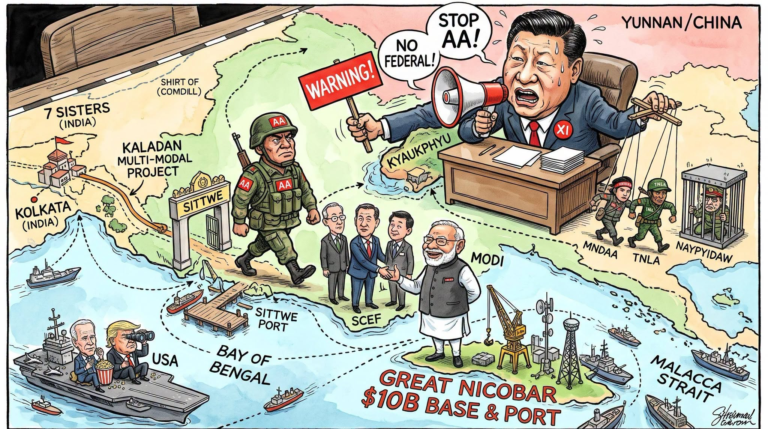
A. Alleged Long-Term Plan for a “Chinese Proxy State”
The author claims the MNDAA aims to build:
- a Chinese-dominated confederate entity,
- or a long-term proxy state in northern Myanmar.
There is currently no public evidence proving an official MNDAA separatist blueprint.
However:
- the expansion of territorial control,
- increasing economic autonomy,
- direct Chinese economic integration,
- and stronger local governance structures
have created fears among some ethnic groups that northern Shan State could gradually drift outside meaningful Myanmar state control.
This concern is strategic speculation rather than established fact.
B. Large-Scale Chinese Demographic Engineering
The testimony alleges deliberate settlement of Chinese workers, technicians, administrators, and recruits into MNDAA-controlled territory.
Some increase in Chinese economic presence is observable in border regions. However:
- reliable demographic data is scarce,
- wartime migration patterns are chaotic,
- and many claims remain anecdotal.
Still, demographic anxiety is genuine among several ethnic communities in northern Myanmar.
C. Systematic Betrayal of Allies
The author portrays the MNDAA as using allies temporarily before sidelining them.
There have indeed been growing reports of:
- territorial friction,
- administrative disputes,
- and tensions between northern EAOs.
However, wartime alliances are often fluid and transactional. Similar accusations have historically existed among many Myanmar armed actors, including:
- the military junta,
- ethnic organizations,
- and Bamar resistance groups.
At present, the full extent of MNDAA-TNLA-AA tensions remains unclear.
3. CLAIMS THAT REQUIRE STRONGER EVIDENCE
Some accusations in the article are serious but presently lack reliable public confirmation.
A. Direct Chinese State Sponsorship of a Future Proxy Entity
While China clearly has influence, there is no verified evidence that Beijing officially seeks:
- annexation,
- partition,
- or the formal creation of a Chinese-controlled state inside Myanmar.
China’s behavior historically suggests preference for:
- leverage,
- buffer zones,
- economic access,
- and stability,
rather than overt territorial absorption.
China usually avoids openly supporting separatism abroad because of its own sensitivities regarding:
- Tibet,
- Xinjiang,
- and Taiwan.
B. Exact Levels of Drug and Scam-Control Ownership
The article provides detailed percentages and operational claims about:
- narcotics production,
- cyber scam control,
- and financial networks.
These figures are difficult to verify independently.
Multiple organizations and criminal networks operate across the region, and responsibility is often diffuse.
C. Claims of Executions, Forced Recruitment, or Internal Corruption
The testimony contains anecdotal allegations involving:
- executions,
- looting,
- coercive recruitment,
- and corruption inside the MNDAA.
Such incidents may occur in wartime environments, but they require independent investigation before being treated as established fact.
4. WHY THIS ARTICLE MATTERS ANYWAY
Even if parts are exaggerated, the article remains important because it reflects several real underlying trends.
A. Post-Junta Myanmar Could Face New Power Struggles
International observers sometimes assume all anti-junta groups share long-term political goals.
In reality:
- many alliances are tactical,
- territorial interests overlap,
- and future disputes are likely.
The article reflects emerging fears about what happens after military rule weakens.
B. Ethnic Anxiety About Chinese Influence Is Growing
Many communities in northern Myanmar increasingly worry about:
- economic dependency,
- demographic shifts,
- loss of local identity,
- and erosion of sovereignty.
These fears are not limited to anti-China nationalism. They also involve concerns about survival, autonomy, and political representation.
C. The Collapse of Central Authority Creates New Realities
Myanmar’s fragmentation has allowed armed groups to evolve from insurgencies into quasi-state actors.
Some now:
- collect taxes,
- control trade,
- run courts,
- manage border crossings,
- operate industries,
- and conduct foreign relations.
This transformation raises long-term questions about:
- federalism,
- sovereignty,
- and the future shape of the Myanmar state.
5. KEY TAKEAWAYS FOR INTERNATIONAL POLICYMAKERS
For ASEAN, Western governments, NGOs, and analysts, the article highlights several important realities:
1. Myanmar’s conflict is no longer simply “junta vs democracy.”
It is becoming:
- multi-layered,
- fragmented,
- and geopolitically entangled.
2. Ethnic armed organizations are not politically identical.
Different EAOs have:
- different goals,
- different foreign relationships,
- and different visions of federalism.
3. China’s influence will remain decisive.
No future Myanmar settlement can realistically ignore China’s:
- economic power,
- border leverage,
- and relationships with northern armed groups.
4. Illicit economies remain central to conflict dynamics.
Drugs, casinos, cyber scams, smuggling, and weapons trading continue to finance armed actors across multiple sides.
5. Post-war competition may become as dangerous as the current war.
Territorial disputes, demographic fears, resource competition, and foreign influence may intensify even if the junta weakens.
Final Assessment
The former AA officer’s testimony should not be read as pure truth, nor dismissed as mere propaganda.
It is better understood as:
- a warning document,
- a battlefield perspective,
- and a reflection of rising mistrust inside Myanmar’s revolutionary landscape.
Some claims are verifiable.
Some are plausible.
Some remain speculative.
Some may reflect wartime resentment and ethnic fear.
Yet together, they reveal a deeper reality:
Myanmar’s conflict is evolving into a struggle not only over democracy and military rule, but also over territory, identity, foreign influence, economics, and the future political map of the country itself.