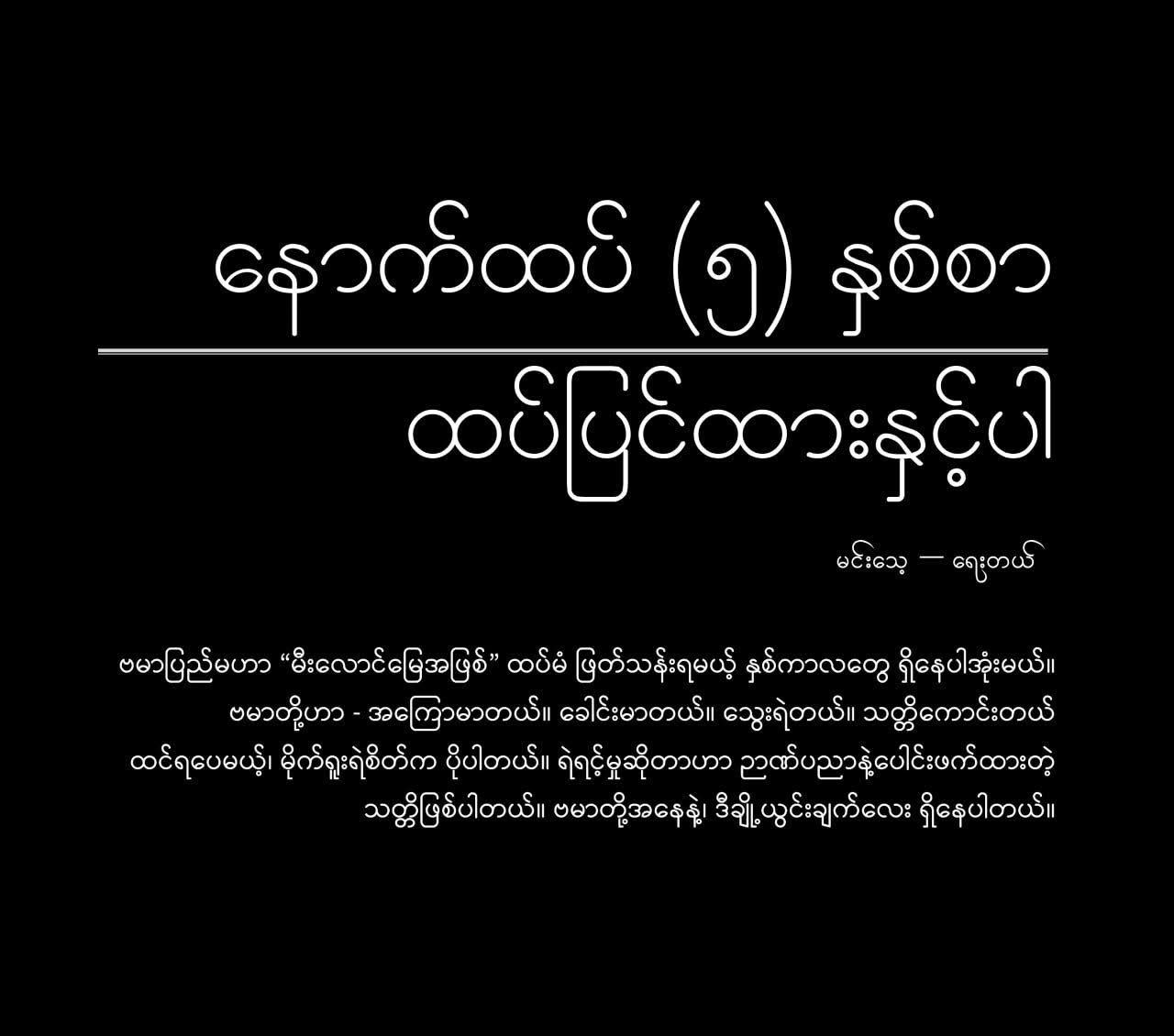
(Adapted and translated from an article by Min Thet, 11 July 2026)
Over the past several years, I have written extensively about what I called “Myanmar’s Five-Year Season” (2021–2025). Perhaps I wrote enough; perhaps I wrote even more than necessary. Now, however, I wish to reflect on what may lie ahead during the next five years—2026 to 2030.
Back in 2023, I wrote an article entitled “Prepare for the Next Ten Years.” It was met with harsh criticism, personal attacks, and strong condemnation. Yet I understood why. The article contained uncomfortable truths rather than comforting words. It was never intended to please readers but to encourage them to confront realities they might prefer to ignore.
Similarly, I wrote numerous articles analysing the National League for Democracy (NLD), Daw Aung San Suu Kyi, and the political atmosphere surrounding Myanmar. Many of my friends were NLD members or loyal supporters, but I believed that honest criticism was necessary regardless of political affiliation. If, on occasion, my language was sharp, it was because I hoped to awaken reflection rather than to insult.
Beyond party politics, I repeatedly warned about deeper problems within Myanmar’s political culture. I cautioned against factionalism, personality cults, and the tendency to place loyalty to individuals above institutions and national interests. I also wrote about the dangerous combination of political power, armed conflict, and human nature. When political ambition becomes intertwined with weapons, fear, and hatred, the consequences can be devastating for any society.
Today, Myanmar’s conflict economy has expanded significantly. Entire sectors now depend upon the continuation of war. At the same time, old patterns associated with ceasefires and conflict-related economic interests appear to be re-emerging. These developments raise the concern that Myanmar may once again become trapped in a recurring cycle of violence rather than moving toward lasting peace.
I also wrote consistently about China’s influence on Myanmar. Geography cannot be changed. Myanmar’s future will inevitably be affected by the interests and policies of its neighbours, especially China. Whether people welcome or dislike this reality, it remains a fact of geopolitics that Myanmar cannot isolate itself from regional powers.
For that reason, I urged readers to understand geopolitics rather than ignore it. Nations do not exist in isolation. Geography, economics, regional security, and international diplomacy all shape the choices available to political leaders. Many of today’s developments were foreseeable years ago, which is why I expressed concern long before they unfolded.
Looking ahead, I fear that Myanmar may continue to experience years marked by destruction and hardship. The greatest danger is not merely the continuation of armed conflict, but the gradual normalization of violence itself. When societies become accustomed to solving political disagreements through force, future generations inherit a dangerous legacy.
One of the saddest consequences of prolonged civil war is that killing gradually becomes accepted as routine rather than exceptional. Hatred deepens, trust disappears, and reconciliation becomes increasingly difficult.
As someone who belongs to this society, I write not as an outsider but as a person reflecting upon my own people and my own country’s shortcomings. Self-criticism is never easy, but genuine national renewal requires honest reflection.
For some time, I have deliberately refrained from making detailed predictions about Myanmar’s future because I felt I had already expressed my concerns. Yet today I feel compelled to offer one final warning.
The years between 2026 and 2030 may become even more painful than those that have already passed. Without meaningful political dialogue, many more lives may be lost. Communities that once lived together peacefully may continue to be divided by fear, suspicion, and violence.
Perhaps the greatest tragedy is that many of those bearing the burden of war are ordinary young men and women rather than those who make the political decisions.
If Myanmar continues to rely primarily on military solutions while postponing political compromise, the country risks prolonging a conflict from which everyone ultimately loses.
This warning is offered not out of pessimism, but out of hope that it may still be possible to change course before more irreversible damage is done.
My remarks and thoughts:
The author’s reflections highlight an uncomfortable reality shared by many observers: prolonged civil wars often become self-perpetuating. Over time, armed conflict develops its own political, economic, and social momentum. Trust diminishes, compromise becomes more difficult, and successive generations inherit grievances that make reconciliation increasingly challenging.
While opinions differ regarding responsibility for Myanmar’s current crisis, there is growing recognition that a sustainable peace cannot be achieved solely through military means. Even where military gains occur, they rarely resolve the underlying political questions that have fuelled conflict for decades.
This is why Myanmar urgently needs a genuine nationwide ceasefire, followed by credible and inclusive peace negotiations, supported by impartial international observers acceptable to all parties. The objective should not be to produce winners and losers, but to create the conditions necessary for a Transitional National Consensus Government (TNCG) that can guide the country through constitutional reform, humanitarian recovery, reconstruction, and eventually free and fair elections.
In any successful peace process, the courage to negotiate should never be mistaken for weakness. On the contrary, choosing dialogue over perpetual warfare often requires greater political courage than continuing to fight.
“Every bullet fired today narrows the space for dialogue tomorrow. Every successful negotiation widens the space for peace.”
“No army can rebuild a school while fighting a war. No battlefield can replace a negotiating table. Myanmar’s future will ultimately be secured not by weapons alone, but by wisdom, compromise, and the shared determination of its people to end decades of conflict.”
“Even if one side were eventually to gain a decisive military advantage, the long-term stability of Myanmar would still require political reconciliation, constitutional legitimacy, and broad public acceptance. Sustainable peace cannot rest solely upon military outcomes.”
The proposed peace framework. Since we renamed it the Transitional National Consensus Government (TNCG), we might define its guiding principles in a simple and memorable way:
Those “Five Cs” are easy for readers, diplomats, and journalists to remember.
The Five Cs Peace Framework
1. Ceasefire
A real, nationwide, independently monitored ceasefire by all parties to stop the bloodshed and allow humanitarian assistance to reach civilians.
2. Conciliation
An impartial process, facilitated by trusted national and international partners, to rebuild confidence, narrow differences, identify common ground, and help the parties move toward mutually acceptable solutions. Conciliation goes beyond simply bringing parties together; it actively assists them in overcoming deadlocks and finding practical compromises.
3. Consensus
Building broad political agreement among all principal stakeholders—including the SAC, NUG, EROs, PDFs, political parties, civil society, religious leaders, women, and youth—on the fundamental principles for Myanmar’s future.
4. Constitution
Negotiating and adopting constitutional and federal reforms that guarantee democracy, equal citizenship, the rule of law, protection of minority rights, an independent judiciary, and an appropriate balance of powers between the Union and the States and Regions.
5. Confidence
Restoring public confidence through humanitarian assistance, reconstruction, economic recovery, security sector reform, the safe return of displaced persons, and eventually free and fair elections under independent domestic and international observation.
Note: “The implementation of the Five Cs should promote national reconciliation among Myanmar’s diverse ethnic, religious, and political communities.”
To continue tomorrow:
Part III will present Kyaw Gyi (Mandalay)’s heartfelt appeal to Myanmar’s young people, followed by a concluding editorial calling upon all stakeholders to place the lives and future of the Myanmar people above continued armed confrontation.