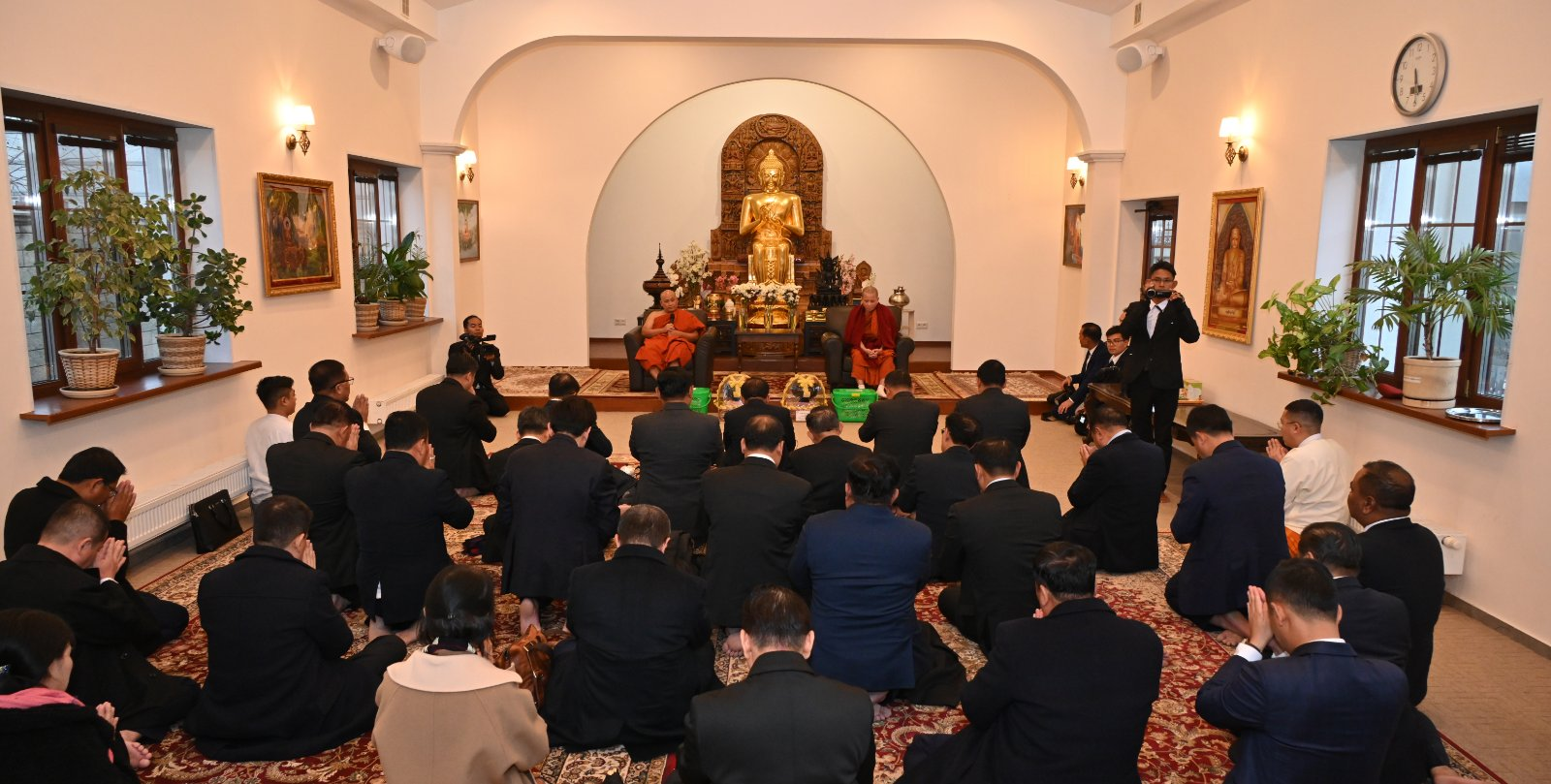
Photo: Senior General Min Aung Hlaing pays homage to Abbot of Myanmar Theravada Buddhist Centre in Moscow
(Adapted from a post by Lee Min Soo)
There are many Theravāda Buddhist countries in the world.
But Myanmar, undeniably, is… special.
In most countries, respect for religion coexists with reason.
In Myanmar, however, the boundaries are more creatively drawn.
Ask a question to a monk? Risky.
Print a Buddha image incorrectly on a coffee cup? Dangerous.
Play a remix with Buddhist references in a nightclub? Potentially criminal.
But preach violence in saffron robes?
Pose with weapons?
Encourage war in the name of protection?
That, strangely, remains within the acceptable spectrum of devotion.
Figures like Ashin Wirathu—who openly deliver threatening rhetoric—continue to command reverence.
Narratives invoking kings like Dutugamunu are retold, not as history, but as moral justification.
And so, the paradox deepens.
A respected monk such as Ashin Wayaminda reminds us of a simple karmic principle:
good causes bring good results; bad causes bring bad results.
Yet in today’s Myanmar, one cannot help but wonder:
what kind of results are expected when wealth derived from suffering is transformed—not into schools, hospitals, or reconstruction—but into towering pagodas?
Senior General Min Aung Hlaing, often portrayed as a devout donor, may indeed go down in history as one of the country’s greatest religious benefactors—at least in terms of concrete and height.
But history has a long memory.
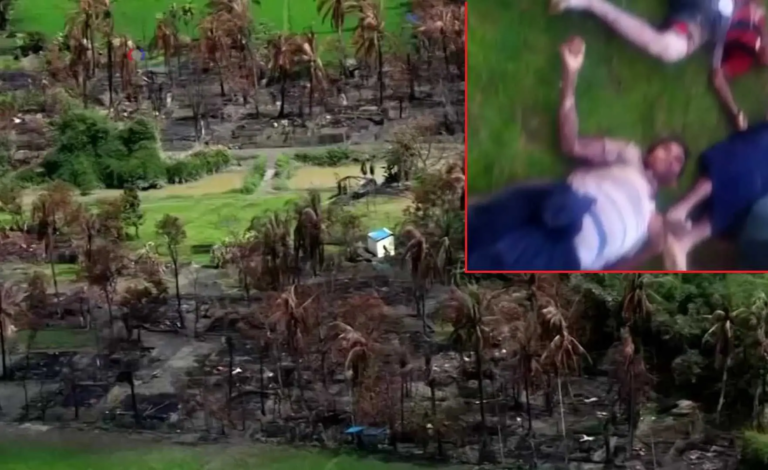
When bombs fall on villages, when homes are burned, when entire communities are displaced—
and later, grand religious monuments rise from the same soil—
the question is no longer about devotion.
It becomes a question of moral arithmetic.
Even more curious is the role of the public.
Those who suffer the consequences of conflict
are often the same individuals seen bowing in prayer at these newly built pagodas.
Faith?
Resignation?
Or simply survival?
Perhaps all three.
And just when one thinks the contradictions have reached their limit,
a new proposal emerges:
education in Myanmar should be led by monks, as suggested by Ashin Revata.
One hesitates to respond.
Not because there is nothing to say—
but because, in Myanmar, silence is sometimes the safer form of wisdom.
Globally, even graduates of institutions like University of Oxford, University of Cambridge, and Harvard University readily admit the limits of their knowledge.
In Myanmar, however, a different confidence prevails.
Graduates of insular systems—whether military academies or narrowly framed religious institutions—often speak with absolute certainty on every subject: politics, economics, science, and education.
It is, in its own way, impressive.
But then again, who would challenge them?
One carries a gun.
The other wears a robe.
And between the two,
the space for truth becomes very, very small.