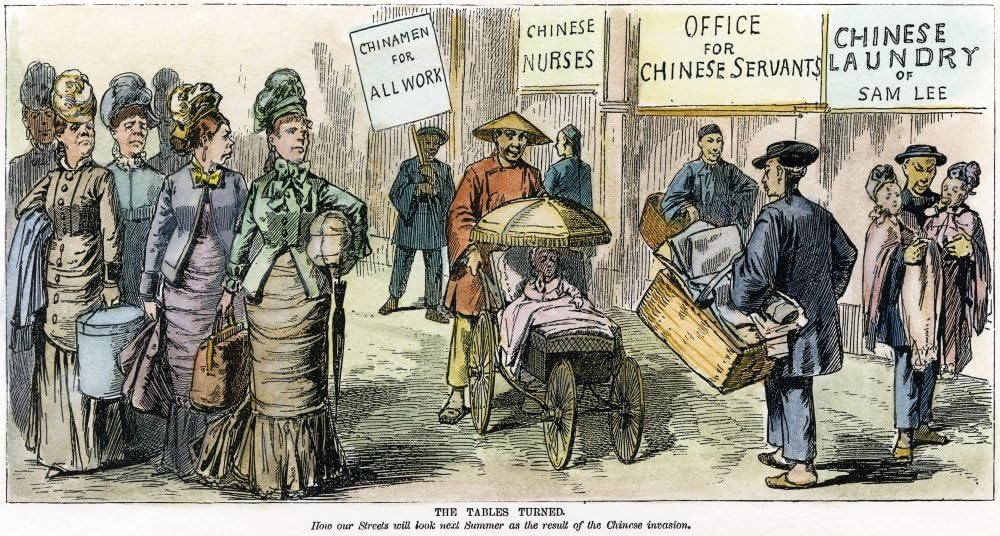
Cartoon Chinese Immigrants 1880 NThe Tables Turned American Cartoon Suggesting What City Streets Might Look Like To Irish-Americans As A Result Of Increased Chinese Immigration Cartoon 1880.
Rohingya, Migrants, and Our Selective Memory
A Selangor assemblyman recently warned of a “Rohingya influx” in Pandan Perdana as a public safety concern. Similar sentiments surfaced in Melaka, where Rohingya and other foreign nationals were discouraged from holding public gatherings.
Fine. Raise concerns.
But let us not lose historical memory in the process.
Malaysia did not just tolerate Rohingyas—it helped build their future.
In 1988, at ABIM headquarters in Wangsa Maju, its president Ahmad Azam Abdul Rahman told me they had a Rohingya-run Burmese department.
Under Anwar Ibrahim as Education Minister, Rohingya students entered IIUM. Many graduated, some with MScs and PhDs, and later migrated onward to the US, Canada, Europe, and Australia.
Malaysian leaders across the political spectrum spoke up:
- Mahathir Mohamad and Abdullah Ahmad Badawi supported international advocacy
- Najib Razak and Ahmad Zahid Hamidi backed public demonstrations
- Wan Azizah Wan Ismail lobbied through ASEAN parliamentary channels
- Charles Santiago and others raised refugee concerns, including Myanmar Christians
Malaysia once stood tall on humanitarian grounds.
During COVID, sentiment shifted.
Provocative social media behaviour by individuals like “Long Tiger,” combined with risky boat arrivals during strict quarantine, ignited widespread anger.
On the ground, real issues surfaced:
- Overcrowding
- Poor sanitation
- Cultural friction
These are legitimate concerns. But they are management problems—not justification for collective blame.
Let us be blunt.
Every migrant wave—including those now settled and prosperous—came with baggage.
Early Chinese migration into Malaya:
- Built the tin mining economy
- But also brought secret societies, opium dens, prostitution, and gang conflicts—under colonial structures
Yet today, those descendants are pillars of the nation.
So what changed?
Time, opportunity, and acceptance.
The Hypocrisy of Migrants Against Migrants
This is not unique to Malaysia.
- Mainland Chinese face discrimination in Hong Kong and Singapore
- Earlier migrants often look down on later arrivals
- Even Donald Trump—a product of migrant lineage—rose on anti-migrant rhetoric
History repeats itself—with different actors.
When Burma Was the “Heaven”
Once upon a time, Rangoon was the dream.
Aw Chu Kin, father of the Tiger Balm founders, described Singapore and Penang as muddy, unsafe, and full of vice—while Burma was “heaven on earth.”
Today?
- Myanmar is a place people flee
- Malaysia and Singapore are destinations
Fortunes reverse. Memory fades.
If History Had Turned Slightly…
During the Japanese occupation, Lee Kuan Yew once queued, thinking he would receive ration coupons.
It was actually recruitment for the Burma Railway.
A friend pulled him away.
Had that not happened, history might have taken a different turn.
Singapore’s founding father could have ended up a war victim—or even a refugee in Burma.
History is fragile. Fate is unpredictable.
Migration is not a one-way story.
Due to centuries of Siamese pressure in northern Malaya, many Malays migrated into Burma.
Their descendants became recognized as the Pashu, an ethnic minority within Myanmar.
They were accepted. Absorbed. Given identity.
Today, their descendants exist quietly as part of Myanmar’s complex ethnic fabric.
I once shared a scanned cartoon from a Malaysian Chinese newspaper—depicting young Chinese women arriving at immigration, portrayed as “Chinese dolls.”
It was later removed.
Why?
Because even satire exposes an uncomfortable truth:
Every community has, at some point, been stereotyped, objectified, or feared as “the other.”
Migration is not a crime. It is the human story.
- Gautama Buddha walked across regions
- Moses led an exodus
- Jesus Christ lived under displacement
- Prophet Muhammad (pbuh) migrated in the Hijrah
Migration is survival. Migration is dignity. Migration is destiny.
The Real Question Nobody Wants to Ask
Why do people flee Myanmar?
Not just Rohingya.
All races. All religions.
Even educated citizens choose illegality abroad over dignity at home.
That is not a migration problem.
That is a state failure problem.
Yes, there are problems.
Yes, there are tensions.
But let us not pretend:
- Today’s critics were yesterday’s migrants
- Today’s stability was built by outsiders
- Today’s “others” may be tomorrow’s citizens
To forget this is not just unfair.
It is dangerous.
Because when memory is erased,
the pot will always call the kettle black.
READ ALSO:
1/ Rohingya influx in Pandan Perdana a public safety concern, says rep
4/ Migration is a natural phenomena even practiced by Prophets and “gods” .
7/ All Myanmar citizens are migrants but they discriminate on Muslims and later migrants from Indian subcontinent and China. Read in Early history of Burma in Wikipedia
8/ Read here about the Muslims response on oppression by their rulers and obligation of Muslim rulers to accept them. Q/A No 22. How should Muslims response to unjust laws of Muslim or non-Muslim rulers?
9/ Refugees, asylum seekers deserve access to education, says Fadhlina
10/ Isolating Rohingya may deepen social risks, group warns
11/ Refugee children can be valuable assets to Malaysia, says NGO