Myanmar Animal Kingdom (Updated for MMNN)
Adapted from “Shwe Ba” (Burma Digest), revised and updated
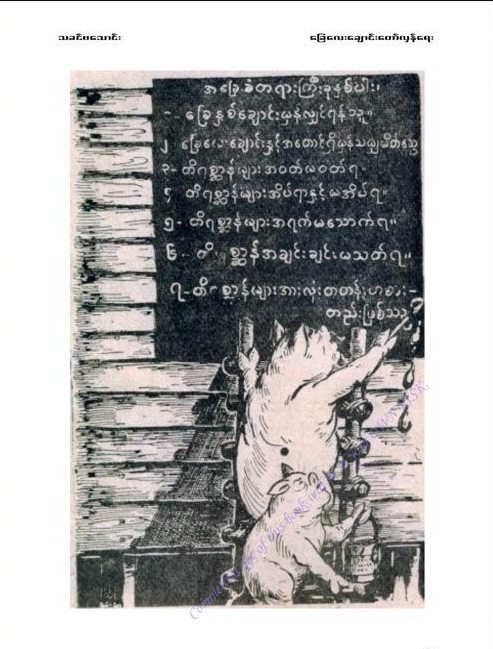
One of my favourite “fairy stories” is Animal Farm by George Orwell. It is not merely a story, but a political education wrapped in satire. For many of us from Myanmar, it feels less like fiction and more like a mirror.
Orwell himself had deep ties to Burma. Born in Bengal and educated at Eton, he served five years in colonial Burma as a British Imperial Police officer. Disillusioned by injustice, he later opposed both capitalism and communism, and also wrote Burmese Days.
Long ago, there was a farm called Burma, filled with many kinds of animals. Their instincts were strong—and even today, one may feel that some habits have not changed.
The farm was ruled by a master known as “The Empire.” He was not the original owner, but had taken control by force. To maintain power, he practiced the classic tactic: divide and rule.
He told the Bama animals they were the true natives, while others were outsiders—“Kalars” or “wild hill animals.” He imported labouring animals from neighbouring lands and kept them separated, ensuring distrust instead of unity.
Ironically, “The Empire” also educated a select group of animals—teaching them language, administration, and governance. But this backfired. The animals became aware.
“Why not run the farm ourselves?” they asked.
The animals revolted. Nationalist “Thakin” animals declared themselves masters. With help from eastern “Rising Sun” animals, they briefly pushed out “The Empire”—only to discover that new masters could be just as cruel.
Eventually, after the great global war, “The Empire” withdrew. The animals finally owned the farm.
But freedom did not bring equality.
The most respected leader, the White Elephant King (General Aung San), was assassinated before his vision could be realised. Power struggles followed.
Then came the Boars.
Led by the cunning Wild Boar (Ne Win), they seized control, claiming to “save the farm.” They introduced the “Burmese Way of Socialism”—nationalising everything, concentrating wealth into the hooves of the military pigs.
The result?
- Economic collapse
- Hunger and poverty
- Fear and repression
The animals revolted again in 1988—but the Boars returned in new forms: SLORC, SPDC, and later other disguises.
The Boars became more sophisticated. They learned from global powers—colonial, communist, and authoritarian systems alike.
They controlled:
- Business permits
- Trade routes (legal and illegal)
- Intelligence networks
- The courts and prisons
Animals who protested were imprisoned under ever-changing laws. Unlike the old “Empire,” which at least maintained a façade of justice, the Boars ruled through fear.
Even journalists became parrots—like Squealer in Animal Farm—spinning lies to justify oppression.
“All Animals Are Equal…”
The famous rule remained:
All animals are equal, but some are more equal than others.
The military animals and their associates became a privileged class. Ordinary animals—farmers, workers, minorities—struggled to survive.
Discrimination persisted:
- Based on race
- Religion
- Origin
Some animals, though living on the farm for generations, were denied basic rights.
From 1988 to the recent Spring Revolution, the animals repeatedly resisted.
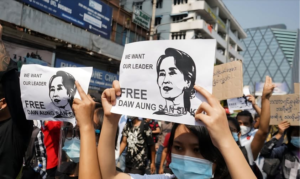
- The Peacock Princess (Daw Aung San Suu Kyi) rose—and was repeatedly caged
- Reform hopes emerged—and were crushed
- New resistance forces (PDFs, EROs) united across species
Yet even among the cracks appeared—corruption, mistrust, and power struggles.
Today, the farm is no longer controlled by a single master.
Instead, it is a battlefield:
- The Boar-Crow alliance clings to power
- Resistance animals fight for a new system
- External powers—Northern Dragon and Western Eagle—pull strings from afar
The suffering, however, remains with the ordinary animals.
The story of Myanmar’s Animal Kingdom is not yet over.
The greatest lesson from Animal Farm is not simply that power corrupts—but that unchecked power repeats itself, regardless of who holds it.
If the animals of Burma Farm truly want a different ending, they must learn what they failed to learn before:
- Unity beyond race and religion
- Accountability for all leaders, not blind loyalty
- Institutions stronger than individuals
- Justice that applies equally to every animal
Otherwise, the cycle will continue:
New masters will replace old ones.
New slogans will replace old lies.
But the farm will remain the same.
The hope lies not in replacing one group of rulers with another—but in transforming the very rules of the farm.
Only then can the animals finally say—not as a slogan, but as reality:
All animals are equal.