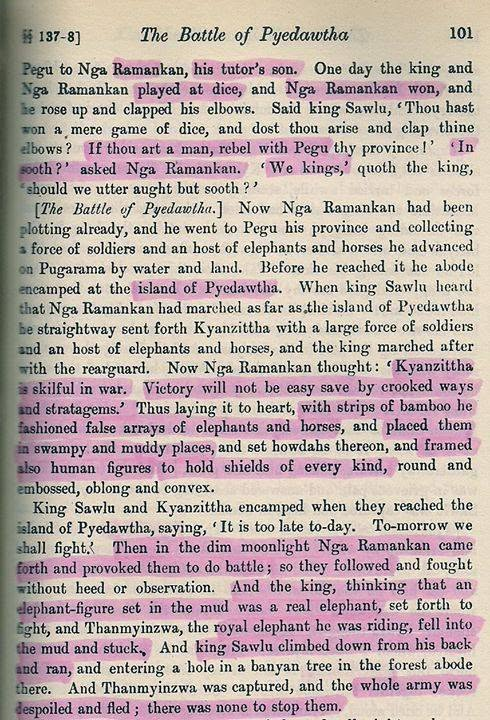
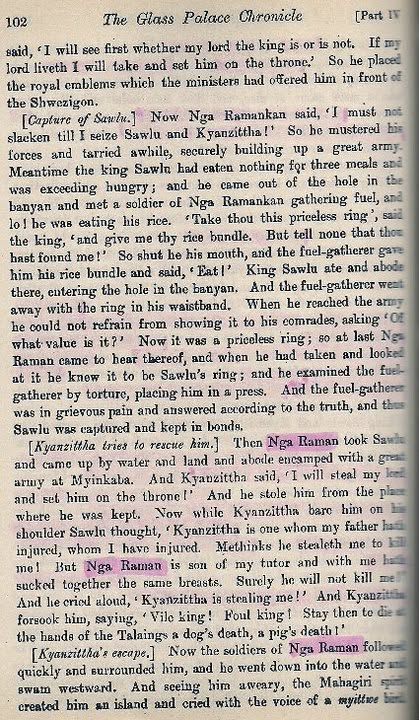
I hereby scanned “The Glass Palace Chronicle of the Kings of Burma“, translated by Pe Maung Tin and G. H. Luce and published.
The relevant section of the Glass Palace Chronicle appears between pages 100 and 103. The chronicle refers to a figure named “Nga Ramankan” or “Nga Raman Kan.”
In Burmese usage, the prefix “Nga” was commonly attached to the names of non-royal male commoners. Therefore, “Nga Raman Kan” was not a royal title but the name of an individual.
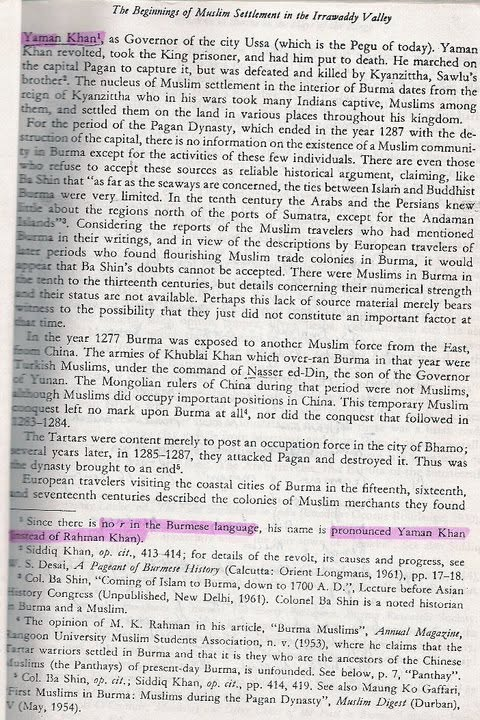
In The Muslims of Burma, Yegar noted that King Sawlu was educated by a Muslim Arab and referred to Yaman Khan as Governor of Ussa (Pegu). He further explained that the Burmese language historically lacked the “r” sound in certain contexts, leading to variations such as Raman, Yaman, or Rahman.
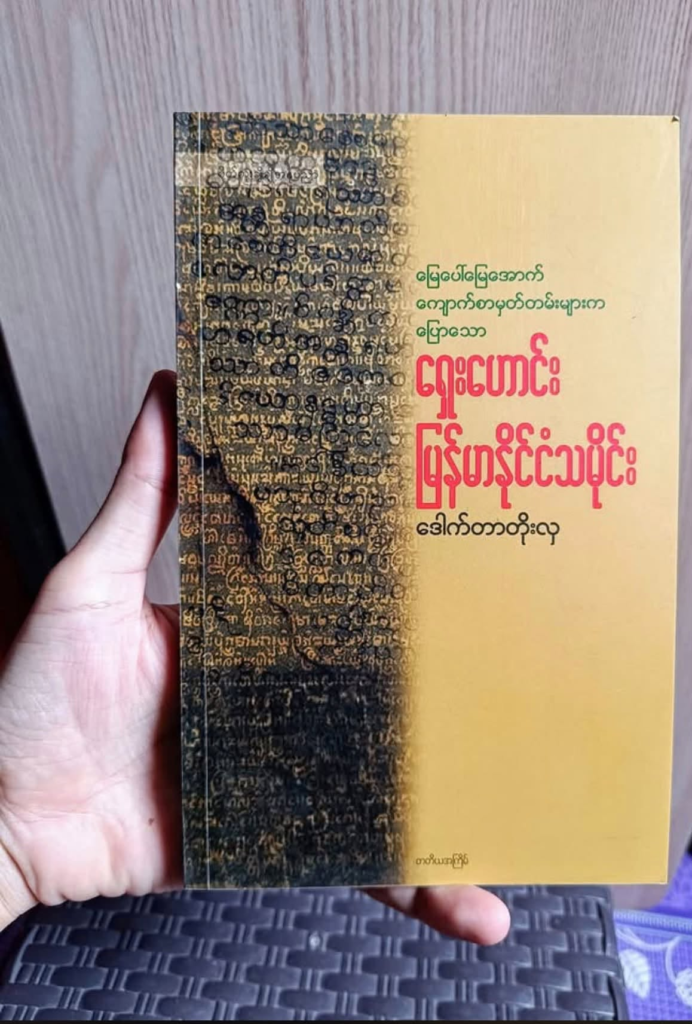
Myanmar historian Dr. Toe Hla, former Vice-Chairman of the Myanmar Historical Commission, examined contemporary stone inscriptions rather than later royal chronicles. In his work Ancient Myanmar History Told by Inscriptions Above and Below Ground, confirmed that First, the evidence comes directly from contemporary inscriptions rather than later chronicles. Historians generally regard inscriptions as among the most reliable primary sources because they were created during the period they describe.
Second, Dr. Toe Hla explicitly identifies the name “Raman” as a Burmese rendering of the Muslim name “Rahman.” This independently supports the interpretation that I had advanced years earlier.
Third, the inscriptions demonstrate that Muslims were not merely transient traders visiting Myanmar’s ports. They were sufficiently integrated into local society to appear in official records, land grants, witness lists, and other administrative documents.