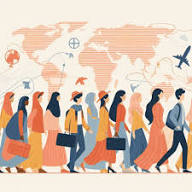
Beyond Labels: Rethinking Generations, Migration, and Identity
By Dr. Ko Ko Gyi @ Abdul Rahman Zafrudin
In today’s globalised world, the language of “generations” is often used to define identity, belonging, and social position. Terms such as first generation, second generation, and even Generation X, Y, or Z are widely used. Yet, behind these labels lies a deeper and more complex human story—especially for migrants and displaced communities.
This article reflects on how generational labels are defined, how they evolve across time and place, and how, in some cases, they are unjustly applied.
Understanding Migrant Generations
The term first-generation migrant usually refers to a person who is foreign-born and has migrated to a new country. These individuals often carry with them the full cultural, linguistic, and social imprint of their homeland.
Between the first and second generations lies a unique group known as the “1.5 generation.” These are individuals who migrated as children or early teenagers. They grow up balancing two identities—rooted in their country of origin, yet shaped by the society in which they are raised.
Most 1.5 generation individuals are:
- Bilingual
- Culturally adaptive
- Able to bridge two worlds
Their identity is not divided, but rather enriched—formed by both inheritance and experience.
The second generation refers to those born in the host country to immigrant parents. By the third generation, the grandchildren of migrants are usually fully integrated into society and are no longer seen as migrants at all.
Work Ethic and Generational Change
A commonly observed pattern among migrant communities is the shift in work ethic across generations.
The first generation often demonstrates extraordinary resilience. Many take on multiple jobs, including difficult and low-paying work, live frugally, and prioritise the education of their children. Fully aware of their migrant status, they rarely demand social or political rights.
The second generation, having grown up with greater stability, may not face the same hardships. By the third generation, the sense of struggle often fades further, while expectations of full citizenship rights naturally increase.
This is not a criticism, but a reflection of changing circumstances. Each generation lives under different conditions, and their attitudes evolve accordingly.
A Personal Perspective
My wife and I belong to the first generation.
Our children who were born in Burma (before it was renamed Myanmar), but migrated at a young age and began schooling in Malaysia, may be considered 1.5 generation.
Those born abroad are second generation, while our grandchildren represent the third generation.
In Malaysia, our grandchildren are no longer regarded as migrants. They are recognised as part of the nation itself—children of the soil (Bumiputra) under the Malaysian Constitution.
Generations in the Myanmar Context
In Myanmar, generational identity is not only shaped by migration, but also by political and historical eras. One might describe generations as:
- The Colonial Generation
- The Democracy Generation under U Nu
- The BSPP Era under Ne Win
- The 8888 Uprising and SLORC/SPDC Generation
- The NLD Generation under Aung San Suu Kyi
- The so-called “hybrid” civilian–military period
- And today, the Spring Revolution era under Min Aung Hlaing
Among Muslims, the generational experience has been even more painful. We may speak of:
- The 969 ultra-nationalist and Islamophobic era
- The Refugee Generation
- The Rohingya Genocide Generation
Technology and Social Generations
Generations can also be understood through the lens of technological change:
From the pre-TV and pre-computer eras, to the internet age, and now to the AI era, each generation is shaped by the tools and technologies it inherits.
We have witnessed:
- The MTV generation
- The pre- and post-internet divide
- The Facebook and social media generation
- The era of Twitter (X), TikTok, YouTube, and Zoom
Each of these has reshaped how people think, communicate, and organise their lives.
A Painful Contradiction
Despite these frameworks, one harsh reality remains.
Many Muslims in Myanmar are not recent migrants, but communities that have lived there for generations—often more than ten. Yet they are still treated as outsiders.
The Rohingya, in particular, have endured extreme injustice. Despite centuries of presence, they have been:
- Denied citizenship
- Stripped of identity
- Even forbidden from using their own ethnic name
What they face has been widely described as a slow and systematic genocide.
Labels Beyond Borders
Even after leaving Myanmar, migrants continue to be classified:
Legal migrants, undocumented migrants, overstayers, UNHCR refugees, permanent residents, and resettled individuals—all carry different labels depending on their legal and social status.
These classifications may serve administrative purposes, but they often fail to capture the human dignity and lived experiences behind them.
Modern Generational Categories
In popular global discourse, generations are also labelled as:
- Generation X (1966–1976)
- Generation Y (Millennials) (1977–1994)
- Generation Z (1995–2012)
While useful in certain contexts, these labels can sometimes oversimplify complex identities—especially for migrants and displaced populations.
Conclusion: Beyond Generations
Generational labels—whether based on migration, politics, or technology—can help us understand society. But they can also limit our understanding if applied without sensitivity.
For migrants, identity is not fixed by labels. It is shaped by struggle, adaptation, resilience, and hope.
Above all, no generation—whether first, second, or tenth—should be denied dignity, recognition, or belonging.