Anwar’s invitation, Dhaka’s appeal, and a genocide case still under deliberation at The Hague
Editorial gist and analysis — 16 September 2026
I. The Gist: Three Stories, One Question
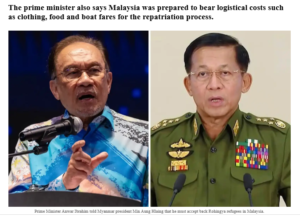
1. Kuala Lumpur — 16 September 2026. Prime Minister Anwar Ibrahim announced he will invite Myanmar’s President Min Aung Hlaing for an official visit to Malaysia, to accelerate the return of what he put at roughly 200,000 Rohingya. Myanmar has agreed to take back 5,000 in stages; the first group of about 1,500 is due to sail within weeks. Malaysia has offered to pay for clothing, food and passage, arguing this is cheaper than detention at RM50–RM200 per person per day. Anwar framed it bluntly: trade and friendship are available, but Myanmar must take its people back. He also placed blame for the influx on previous governments that welcomed the arrivals.
2. Dhaka — 7 September 2026. Prime Minister Tarique Rahman urged Japan’s Special Envoy for National Reconciliation in Myanmar, Yohei Sasakawa, to push for safe, voluntary and dignified return. Sasakawa said he had raised the matter directly with Myanmar’s president and believed Naypyidaw was sincere, while cautioning that conditions in Rakhine will delay any real movement. Both sides agreed that bilateral channels alone are insufficient and that multilateral engagement is essential. Bangladesh, hosting close to a million refugees, says it is ready to help with rehabilitation inside Myanmar.
3. Washington — the analytical frame. Dr Azeem Ibrahim’s argument, that genocide does not end when the killing stops, supplies the missing lens. His thesis: state responsibility survives regime change; naming the crime is not the remedy; and the passage of time, combined with hollow repatriation plans and indefinite camp funding, risks converting a violently altered demographic map into a permanent legal fact.
The question all three raise is the same one: is a return to Myanmar in late 2026 a solution, or the final stage of the erasure?
II. Fact-Check and Corrections
Several details circulating in commentary need tightening before any argument is built on them.
The ICJ has issued no merits judgment. Public hearings in The Gambia v. Myanmar ran from 12 to 29 January 2026 — two rounds of oral argument, three witnesses and one expert for The Gambia, one witness for Myanmar. On 29 January the Court announced it had begun deliberations. The date of the decision has not been fixed. What is in force are the provisional measures of 23 January 2020 — ordering Myanmar to prevent acts of genocide, preserve evidence and report periodically — and the 22 July 2022 ruling rejecting Myanmar’s preliminary objections, which confirmed jurisdiction by fifteen votes to one. Eleven states have intervened. Writing as though a verdict exists weakens an otherwise strong case; writing that a verdict is imminent while the ships are being loaded is far stronger, and accurate.
Min Aung Hlaing is now, formally, President. He was sworn in on 10 April 2026 following the indirect presidential vote of 3 April, itself following the general election staged from December 2025 to January 2026 from which the NLD and most opposition parties were absent. The International Crisis Group’s assessment of the new administration is consolidation, not transition, and it advises governments to calibrate their engagement so as not to confer unwarranted legitimacy. The title changed; the command responsibility for the 2016–2017 clearance operations did not.
The numbers are being conflated. UNHCR registers around 126,000 Rohingya in Malaysia out of roughly 193,800–215,000 refugees and asylum seekers from Myanmar overall. Anwar’s “200,000 Rohingya” appears to fold in unregistered arrivals. The first phase is precisely 1,476 people, scheduled for 29 September 2026, aboard two Myanmar Navy warships and a hospital ship.
Most importantly — Naypyidaw is not saying what Kuala Lumpur is saying. Malaysia announced the return of “5,000 Rohingya.” Myanmar’s foreign ministry countered that the programme concerns verified Myanmar nationals held in Malaysian detention, and rejected the characterisation that it had agreed to accept Rohingya. Malaysia’s own Home Ministry statement on the 1,476 declined to disclose their ethnicity. This is not a drafting discrepancy. It is the 1982 Citizenship Law operating in real time.
Ground control. The Arakan Army holds the overwhelming majority of Rakhine State — by its own account most of the seventeen townships, with the junta reduced to Sittwe, Kyaukphyu and a handful of garrisons. Whoever signs the diplomatic note in Naypyidaw does not control the villages to which these people would be returning.
III. Commentary: The Case For, and the Case Against
The case for Anwar’s approach
Only Myanmar can end the statelessness. No amount of resettlement, documentation or humanitarian funding fixes a legal void created by Myanmar law. Any process that ends with Naypyidaw formally receiving Rohingya-origin people as its own is, at minimum, a crack in the position that they were never Myanmar’s to begin with.
Refusal to engage has produced nine years of nothing. Bangladesh has hosted roughly a million people since 2017 with no meaningful return. Two aborted repatriation attempts, endless verification lists, an aid pipeline in decline. Anwar’s implicit charge — that principled non-engagement has delivered permanent camps — is not frivolous.
Domestic politics are real and deteriorating. Refugee schools have closed under harassment, settlements in Penang have been cleared, and online hate campaigns have hardened public opinion. A government that ignores this does not stay a government; and what replaces managed diplomacy is rarely gentler. Anwar is at least proposing an orderly process rather than pushbacks at sea.
Cost and leverage. Detention is expensive and legally exposed. And Malaysia — which chaired ASEAN in 2025 and has hosted the region’s largest Rohingya population — has more standing than most to demand something in return for normalisation.
The case against
Non-refoulement binds Malaysia whether or not it signed anything. Malaysia is not a party to the 1951 Refugee Convention, but the prohibition on returning people to a place where their life or liberty is at risk is customary international law and binds every state. UNHCR put this on the record on 1 September 2026: it is not involved in the programme, ongoing armed conflict means the conditions for safe, dignified and sustainable return do not exist, and no one should be sent to a country where their rights or freedoms may be at risk.
“Voluntary” consent obtained inside a detention depot is not consent. More than 10,000 Myanmar nationals were held in immigration depots by mid-August. When the alternative to signing is indefinite detention, the word voluntary collapses. Fortify Rights has called the disregard for refugee lives unacceptable and a breach of Malaysia’s obligations; Human Rights Watch says the conditions for safe and dignified return simply do not exist.
No UNHCR role means no verification and no monitoring. Nobody independent is confirming that departure is voluntary; nobody will be present on the other side to see where these people go. There is no reintegration framework, no monitoring mandate, no readmission guarantee if it fails.
The receiving authority does not hold the ground. Returns negotiated with a government that controls perhaps a fifth of Rakhine, into townships administered by an armed group that is not party to the arrangement, is not repatriation. It is transfer into a live conflict — with exposure to the junta’s conscription law, to Arakan Army pressure, and to recruitment by RSO and ARA factions.
Two navy warships and a hospital ship. The optics are not humanitarian. They are of a security transfer conducted by the armed force whose 2017 operations the ICJ is currently adjudicating.
The verification trap. If Myanmar “verifies” returnees as nationals but issues NVCs or equivalent provisional documents, the outcome is people relocated from Malaysian detention into Rakhine containment — the Sittwe and Kyaukphyu IDP camp model — holding papers that confirm rather than cure their statelessness. That is not return. That is transfer of custody.
Legitimacy, at the worst possible moment. A state visit is the highest-value currency a middle power can spend. Spending it on a man who was Commander-in-Chief during the clearance operations, while the ICJ deliberates on whether his state committed genocide, is a transfer of political capital that cannot be recovered if the Court rules against Myanmar.
IV. The ICJ Backdrop: Why the Deliberation Changes the Calculation
Three points follow from the case’s actual posture.
Myanmar is currently under binding provisional measures. The January 2020 Order requires it to prevent acts falling under Article II of the Genocide Convention against the Rohingya and to preserve evidence. Those measures remain in force during deliberation. Returning Rohingya into a jurisdiction that is under a standing order of the World Court to refrain from genocidal acts — on the strength of a diplomatic note from that same government — is, at best, an uncomfortable position for any sending state to explain later.
Malaysia has its own obligation, not merely a choice. Malaysia is a party to the Genocide Convention. Under the ICJ’s 2007 Bosnia v. Serbia judgment, the Article I duty to prevent is not territorial: it binds a state that has a capacity to influence events, and it is breached by failure to employ the means reasonably available. A sending state with direct diplomatic leverage over the receiving state is precisely such a state. Malaysia’s exposure here is not only under refugee law.
Dr Ibrahim’s central point is the operative one. State responsibility does not evaporate with a change of leadership — and it equally does not arrive with a change of title. Min Aung Hlaing’s move from Senior General to President alters nothing about what the state owes. Which means the question to put to him on a Malaysian state visit is not how many will you take, but under what legal status, to which locations, with whose monitoring. If the answer is silence on all three, the invitation is not diplomacy. It is a logistics contract.
V. Benchmarks: What Would Make This Legitimate
Any programme worth defending should be able to answer these before the ships sail:
- Status on arrival. Full citizenship under a repealed or amended 1982 Law — not NVCs, not white cards, not “verified national” listings.
- Destination. Return to place of origin, with property restitution. Not IDP camps, not relocation sites, not transit centres of indefinite duration.
- Freedom of movement, without township permits.
- Independent monitoring — UNHCR and a UN presence with access, before, during and after.
- Genuine voluntariness, assessed outside detention, with a documented right to decline and no consequence for declining.
- A counterparty that controls the ground — meaning some engagement with the de facto authority in Rakhine, however uncomfortable.
- A readmission guarantee, so that those returned who face persecution can come back.
- Transparency on ethnicity and numbers of each cohort, published in advance.
Zero of eight are currently satisfied.
VI. Conclusion
Anwar is right that nine years of principled refusal to negotiate has left a million people in camps and 126,000 in legal limbo. Dhaka is right that the burden is unsustainable and that multilateral pressure beats bilateral bargaining. Sasakawa is right that Rakhine’s realities will delay everything.
But Dr Ibrahim is right about the thing that matters most: the danger is no longer the killing. It is the quiet, administrative, well-intentioned normalisation of its result. A repatriation that returns people without citizenship, to camps rather than villages, under naval escort, unmonitored, negotiated with a government that does not hold the territory and does not call them Rohingya — that is not the reversal of the genocide. It is its paperwork.
The Court is deliberating. The ships are scheduled for 29 September. Malaysia should wait for the judgment. If it will not wait, it should at least be able to answer the eight questions above.
References
Malaysia’s repatriation programme
- Free Malaysia Today, “Anwar to invite Myanmar president to expedite Rohingya repatriation,” 16 September 2026 — https://www.freemalaysiatoday.com/category/nation/2026/09/16/anwar-to-invite-myanmar-president-to-expedite-rohingya-repatriation
- Malaysiakini, “Rohingya: Anwar points fingers at Najib and Hadi,” 16 September 2026 — https://www.malaysiakini.com/news/885145
- Al Jazeera, “Malaysia to return 1,500 Rohingya refugees next month, despite safety fears,” 28 August 2026 — https://www.aljazeera.com/news/2026/8/28/malaysia-to-return-1500-rohingya-refugees-next-month-despite-safety-fears
- Reuters / BusinessWorld, “UNHCR says it has no role in Malaysia’s planned repatriation,” 1 September 2026 — https://bworldonline.com/world/2026/09/01/773767/
- The Diplomat, “UNHCR Says It Is Not Involved in Malaysia’s Planned Repatriation of Refugees to Myanmar,” September 2026 — https://thediplomat.com/2026/09/unhcr-says-it-is-not-involved-in-malaysias-planned-repatriation-of-refugees-to-myanmar/
- Rohingya Khobor, “Malaysia Sets September Return for 1,476 Myanmar Nationals but Does Not Say Whether Rohingya Are Included,” 28 August 2026 — https://rohingyakhobor.com/malaysia-sets-september-return-for-1476-myanmar-nationals-but-does-not-say-whether-rohingya-are-included/
- Myanmar Now, “Malaysia to repatriate first group of Myanmar nationals in September,” August 2026 — https://myanmar-now.org/en/news/malaysia-to-repatriate-first-group-of-myanmar-nationals-in-september/
- MoeMaKa, “Malaysia Moves Ahead with Plan to Repatriate Myanmar Refugees,” 30 August 2026 — https://moemaka.net/eng/2026/08/malaysia-moves-ahead-with-plan-to-repatriate-myanmar-refugees/
Bangladesh and Japan
- The Daily Star, “Tarique urges Japan envoy to help ensure safe Rohingya repatriation,” 7 September 2026 — https://www.thedailystar.net/news/bangladesh/diplomacy/news/tarique-urges-japan-envoy-help-ensure-safe-rohingya-repatriation-4267011
- DVB, “Bangladesh urges Japanese envoy on Myanmar to facilitate safe Rohingya repatriation,” September 2026 — https://english.dvb.no/bangladesh-urges-japanese-envoy-on-myanmar-to-facilitate-safe-rohingya-repatriation/
- Dhaka Tribune, “PM urges Japan envoy to help ensure safe, dignified Rohingya repatriation” — https://www.dhakatribune.com/bangladesh/419271/pm-urges-japanese-envoy-to-help-ensure-safe
The ICJ case — The Gambia v. Myanmar
- Independent Investigative Mechanism for Myanmar, case tracker (procedural history; deliberations opened 29 January 2026) — https://iimm.un.org/en/icj-gambia-v-myanmar
- ICJ, Case 178, oral proceedings — https://www.icj-cij.org/case/178/oral-proceedings
- Verfassungsblog, “The Rohingya Case Gets a Hearing,” 9 January 2026 — https://verfassungsblog.de/the-rohingya-case-gets-a-hearing/
- Opinio Juris, “From Fact-Finding to Fact-Proving at the ICJ,” 11 May 2026 — https://opiniojuris.org/2026/05/11/from-fact-finding-to-fact-proving-at-the-icj-the-gambia-v-myanmar-and-the-courts-coming-reckoning-on-evidence-interventions-and-intent/
- Opinio Juris, “The Gambia v. Myanmar and the Nature of Genocidal ‘Intent to Destroy,'” 11 February 2026 — https://opiniojuris.org/2026/02/11/
- East Asia Forum, “The ICJ Rohingya case reshapes human rights litigation,” 17 March 2026 — https://eastasiaforum.org/2026/03/17/the-icj-rohingya-case-reshapes-human-rights-litigation/
- ASIL Insights, “The Gambia v. Myanmar: An Analysis of the ICJ’s Decision on Jurisdiction” (2022 ruling) — https://www.asil.org/insights/volume/26/issue/9
- ICJ, Bosnia and Herzegovina v. Serbia and Montenegro, Judgment of 26 February 2007 — on the Article I duty to prevent and its extraterritorial reach.
Myanmar’s political and territorial situation
- International Crisis Group, Briefing 188, “Myanmar’s New Administration: Military Consolidation, Not Transition,” 3 June 2026 — https://www.crisisgroup.org/brf/asia-pacific/myanmar-china/b188-myanmars-new-administration-military-consolidation-not-transition
- Asia Times, “Myanmar’s political makeover unmasked by revolutionary reality,” May 2026 — https://asiatimes.com/2026/05/myanmars-political-makeover-unmasked-by-revolutionary-reality/
- Associated Press / NBC News, “Myanmar military-backed party declared election winner,” 5 February 2026
Further reading
- Azeem Ibrahim, The Rohingyas: Inside Myanmar’s Hidden Genocide (Hurst / Oxford University Press)
- New Lines Institute for Strategy and Policy, expert profile — https://newlinesinstitute.org