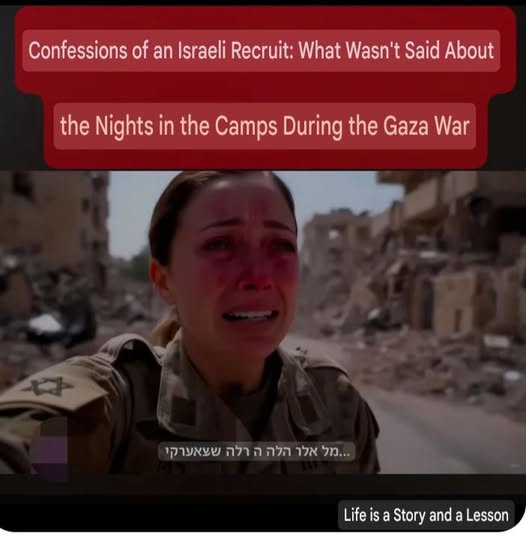
What Wasn’t Said About Camp Nights in the Gaza War. I’m in Gaza, and I don’t know if I’ll truly be a martyr, or just a forgotten corpse. Unfortunately, that’s how it is at night in the camp. They pass the time with these trivial things and escape their fear. The nights of fighting were exhausting, but the nights inside the base were filthier than any battlefield. When I joined the army, they told me, “We are protecting Israel.” I didn’t believe in war, but I believed that we would enter Gaza, restore order, and leave.
No one told me that I would leave it a different person. I entered the camp in a clean uniform, with a composed face, with an inner voice saying everything was under control. But in war, no one remains the same.
A shell doesn’t just change the land; it changes the person who sees it explode. On my first night inside Gaza, I didn’t hear the sound of gunfire, but I heard a woman screaming from behind the wall. I didn’t understand her words, but I understood that a mother was calling out. My reaction wasn’t what I expected. I didn’t feel proud; instead, a chill ran down my spine. It was something Inside, I refused to celebrate.
The next day, we began the “combing,” as they call it.
We moved between houses, breaking through walls, forcing people out.
But I was searching for something else.
I was searching for meaning.
Every time I stood before a Palestinian woman, she looked at me silently.
I felt as though she was asking me: Why are you here? And I had no answer.
In the evening, we’d return to base.
And there, inside, another war would begin.
A war that didn’t appear in the reports.
Alcohol.
Music.
Vulgar talk.
Fast-paced relationships.
At first, I resisted.
Then I grew tired.
Then, in a moment, I succumbed.
I realized that it wasn’t just the guns that wounded.
There was something else.
Slower. More insidious.
And it gnawed silently inside me.
I thought the war would end when we returned.
But the truth is, the real war began after we came back.
The war that no one sees.
When you find yourself a stranger even to yourself.
No one talked about the war after returning to base.
They talked about decommissioning.
Relaxing. The reward after the mission.
And all I saw wasn’t relaxation.
It was moral decay.
Yes.
Moral decay.
The base at night was another world.
Orders vanished.
Discipline evaporated.
Tents became communal sleeping quarters.
Music swelled.
Clothes fell off.
And boundaries were forgotten.
There were officers who entered the female recruits’ tents as if they were their own.
There Female soldiers offering their bodies as a means of survival
Or perhaps to escape loneliness
I saw a girl crying in the morning
Then, in the same evening, laughing in the arms of the one she had cried for
I didn’t understand what was breaking us
But I felt that something was being ripped from us every night
Rumors began to spread
So-and-so was transferred to a private hospital
So-and-so was sent back for internal investigation
We were told the reason was psychological pressure
But we learned the truth from the nurses
Unexplainable blood tests
A decline in immunity
Cases suspected to be linked to HIV
One of the doctors couldn’t sleep
He told me:
It’s not just the disease that scares me
But the silence
This wall of silence
And the army had decided to cover up the disease
Just as it covered up its crimes
The moment of realization was harsher than any explosion
We weren’t soldiers
We were tools
We were allowed to be strong during the day
And to collapse at night
On the condition that we didn’t show anything in front of the cameras
And every night I forced myself
To remember who I was before this war
But even my old image began to fade
We didn’t enter Gaza We simply allowed Gaza to enter us, to expose our fragility, to strip us bare. Sometimes I wake up in the middle of the night, not from a nightmare, but because the silence itself has become painful. I used to think pain came from outside, from the sirens, from the images, from the explosions, but I discovered that the most dangerous thing about war is what it leaves inside you after it’s over. I can’t say I was a hero, nor that I wasn’t a victim. I was something in between, something without a name, without an identity, without any honor to keep for itself. My life today is a series of failed attempts to escape the past. I wash my hands many times every day, even though I never shot anyone directly. But my soul is stuck in a moment when I saw a child emerge from under the rubble, looking at me, unaware that I am part of everything that collapsed on top of him. I tried to become a normal person again. I went to psychiatrists, read books about inner healing, attended self-help sessions. All of it seemed trivial compared to one sentence I kept repeating to myself: Why? Why didn’t I leave from the beginning?
Why did I stay?
The answer: Because I wanted to be meaningful. I was searching for a role, for meaning, for an identity within the uniform. But I left it, ashamed to even look at my name. Many in Israel today speak of deterrence, of dignity, of the right to defend ourselves. And I ask: Where was our dignity when we exchanged cheap jokes on our camp beds?
Where was our right when we let diseases spread in silence, simply because talking about them embarrassed the establishment?
Who are we to call ourselves a “moral army” when inside we live in nameless moral decay? I didn’t leave Gaza with a tale of victory.
I left with a silent illness.
Not in my blood,
but in my conscience.
Something that bleeds every time I look in the mirror.
Something that makes me change my clothes quickly,
So I won’t remember my camp uniform.
I write this testimony today,
Not because I’m brave,
But because I’m tired.
Because I’m fed up with the lies,
And the justifications,
And the empty rhetoric of patriotism.
While the truth is,
We lost ourselves before we won any war.
I say this now,
Because I no longer want anything from this country.
Not a promotion,
Not protection,
Not even a thank you.
I only want my voice to be heard, for people to know
That within this army,
There were nights
When the darkness was more intense than any shell,
And the pain
Wasn’t cured with painkillers,
But with confession.