In criminal law, two elements elevate an act from a mere incident to a grave crime: motive and pre-planning. Without them, wrongdoing may be dismissed as accidental, spontaneous, or the unintended consequence of chaos. With them, the same act becomes deliberate, systematic, and punishable at the highest level.
This principle applies universally. A death caused by negligence becomes murder when motive is established. A street fight becomes a serious felony when pre-planning is proven. In international law, the same logic governs crimes against humanity and genocide. The difference between “communal violence” and state crime lies precisely here.
Myanmar’s treatment of the Rohingya and wider Muslim population must be understood through this legal lens.
Motive: Political Survival and Strategic Diversion
Myanmar’s modern political history provides a clear motive.
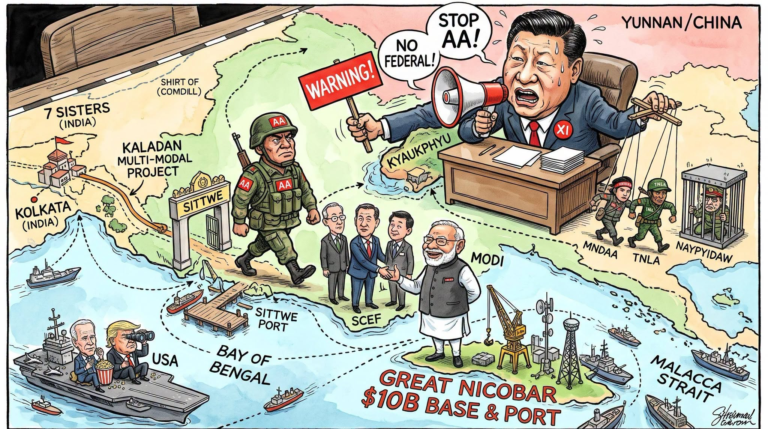
When nationwide online campaigns successfully pressured the government to halt the Chinese-backed Myitsone Dam project, the military-aligned establishment learned a dangerous lesson: public attention could derail strategic economic interests, including other Chinese projects—especially those in Rakhine State.
Soon after, an aggressive anti-Rohingya and anti-Muslim campaign exploded across Facebook and state-tolerated media ecosystems. This was not accidental timing. Hate became a tool of diversion, redirecting public anger away from opaque mega-projects and toward a manufactured internal enemy.
At the same time, electoral politics intensified this motive. After the USDP’s humiliating defeat in the by-elections, fear of Daw Aung San Suu Kyi’s rising popularity set in. Instead of political reform or genuine coalition-building, elements within the state apparatus chose a darker route: weaponising religious identity to retain power.
This was warned against publicly at the time. Anti-Muslim mobilisation was not a social reflex—it was a political strategy.
A Revealed Objective: Demographic Engineering
Perhaps the most damning evidence of motive surfaced unintentionally.
Junta-aligned lobbyists later argued—openly—that losing the international case would force Myanmar to grant citizenship to Rohingyas and other Muslims. Their fear was not legal; it was demographic and political. Citizenship would mean population growth acknowledged by law, followed by demands for representation, administration, and rights.
This admission exposes the real aim: reducing Muslim presence to prevent future political influence.
When a state fears citizens not for crimes but for their existence and numbers, the crime is no longer discrimination—it is persecution by design.
Pre-Planning: A Scripted Political Stage
Genocide does not begin with bullets. It begins with scripts.
Myanmar’s Muslim-eradication campaign followed a recognisable pattern:
- Dehumanisation through hate speech
- Normalisation of exclusion
- Legal erasure of citizenship
- Security “clearance operations”
- Forced displacement
- Denial and narrative control
This was not spontaneous mob violence. It was carefully executed according to Tatmadaw playbooks, coordinated across institutions, media, extremist groups, and administrative mechanisms—a wider political staged-show, not random chaos.
The evidence of this planning has now crossed domestic boundaries and entered the jurisdiction of international law.
Proof and the ICJ
At the International Court of Justice, the debate is no longer about isolated incidents. It is about intent, pattern, and state responsibility.
The convergence of motive (political survival, demographic control, diversion from economic scrutiny) and pre-planning (coordinated hate campaigns, administrative exclusion, military operations) forms the backbone of the case. This is why denial has become frantic—and contradictory.
The Final Act: Coercion and Performance
Today, the pattern continues.
On one hand, Ma Ba Tha-linked demonstrations and threats of “revenge” are allowed to loom over Muslim communities. On the other, the same authorities theatrically urge the public to avoid hate speech and refrain from criticising ICJ judges—performing moderation for international observers.
Behind the scenes, Muslims and civil organisations are coerced into issuing statements in state-owned media—statements written under fear, not free will.
This duality is not confusion. It is control.
Conclusion: From Chaos to Crime
Once motive and pre-planning are established, Myanmar’s actions can no longer be framed as unfortunate history or communal breakdown. They constitute a deliberate state crime, executed over years, refined through propaganda, and sustained through coercion.
The tragedy is not only what was done to the Rohingya and Muslims of Myanmar—but how long the world was persuaded to see it as something else.
History will not.
International law will not.
And denial, as history teaches us, is often the final stage of the crime itself.
READ ALSO:
How Ne Win’s Private Fears and a Secret BSPP Report Shaped Decades of Islamophobia in Myanmar
The roots of General Ne Win’s Islamophobia have long been debated. Historians usually point to colonial-era anti-Indian sentiment, the 1978 Operation Nagamin, or the 1982 Citizenship Law.
But rarely discussed—because it was never made public—is the internal, top-secret demographic report produced under the Burma Socialist Programme Party (BSPP) around 1972. Combined with several personal incidents inside his family and inner circle, this report helped transform Ne Win’s private insecurities into national policy.
This article reconstructs those connections through credible testimonies from retired civil servants, military insiders, and the lived experiences of families who were close to the Ne Win household.

The 1972 BSPP “30-Copy” Demographic Report
Around 1972, Ne Win ordered a highly restricted study on the ethnic and religious composition of Burma. It was printed in only about 30 copies, each numbered and marked “Top Secret.” One of the few who saw it was a senior professional officer from the Ministry of Finance—a man known for integrity and accuracy, who shared his findings with his relatives decades later.
The report’s conclusions were explosive:
1. Muslim population vastly undercounted
Official statistics claimed Muslims were 3–4%.
The secret estimate placed the figure at around 12%.
2. Demographic projection of rapid Muslim growth
The report projected that, if fertility and migration trends continued,
Muslims might reach 25–30% of Burma’s population within 30 years.
3. Border migration concerns
It cited movement across the Burma–East Pakistan/Bangladesh frontier,
which BSPP intelligence interpreted—rightly or wrongly—as a strategic threat.
4. Economic presence in towns
It noted the strong role of Muslims in trade and urban finance.
To an increasingly paranoid Ne Win, this report did not remain a quiet analysis. It became a justification—almost a prophecy—for systematic political action.