By Myo Win
Dr. Martin Luther King Jr. (MLK) (1929–1968) remains one of the most influential leaders of the twentieth-century civil rights movement in the United States. A Baptist minister and advocate of nonviolent resistance, King sought racial justice, human dignity, and equality under U.S. law. His philosophy of nonviolent direct action helped dismantle segregation and inspired subsequent movements for justice across cultural and religious lines. 
Religious Foundations and Interfaith Resonance
King’s Christian faith profoundly shaped his worldview. He rooted his philosophy of justice and love in the teachings of Jesus and the Black church tradition. Yet, his themes of equality, love of neighbor, and resistance to injustice find echoes in other faith traditions—including Islam, which also places moral emphasis on human dignity and equity. Scholars and commentators have pointed out that many of King’s moral assertions on the universality of justice reflect ethical principles found in the Qur’an, such as respect for diversity and the moral imperative to oppose oppression. 
For many American Muslims today, King’s message resonates with Islamic teachings on equality. Muslim leaders and writers have highlighted parallels between King’s insistence that “injustice anywhere is a threat to justice everywhere” and Islamic moral imperatives urging fairness, compassion, and solidarity among all people. 
King and Black Muslim Movements
During the civil rights era, the most visible Islam-associated community in the United States was the Nation of Islam (NOI), a Black nationalist religious movement that blended Islamic language with a distinct theology and organizational structure centered on figures like Elijah Muhammad. 
King’s relationship with Black Muslim movements was complex. In 1965, a reporter asked him about the “Black Muslim religion,” and King clarified that he distinguished the Nation of Islam from orthodox Islam and refrained from dismissing the socio-political conditions that gave rise to Black Muslim movements. His comments reflected caution about equating the Nation of Islam’s theology with mainstream Islam while acknowledging broader ferment within Black America. 
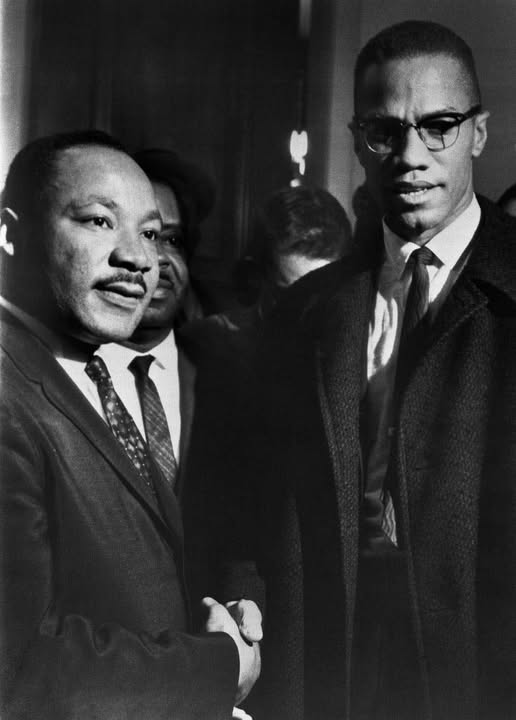
The broader Islamic world intersected with American civil rights through figures like Malcolm X, a vocal leader associated initially with the Nation of Islam and later with Sunni Islam after his pilgrimage to Mecca. While King and Malcolm X epitomized different philosophical approaches—nonviolence vs. self-defense and differing emphases on integration—historical records show they met once in 1964 during Senate debates on civil rights legislation. The meeting symbolized mutual recognition despite divergent methods and religious affiliations. 
Legacy in Muslim American Communities
Although King himself was not embedded within Muslim communities, his moral legacy has been embraced and extended by American Muslims confronting prejudice and seeking full inclusion in U.S. civic life. Muslims in America have drawn inspiration from King’s advocacy for universal human rights, applying his nonviolent philosophy and rhetoric of equality to struggles against discrimination—including anti-Muslim bias in politics, media, and law. 
In commemorations such as Martin Luther King Jr. Day, Muslim organizations often reflect on both the shared ethical priorities and distinct religious teachings that align with King’s vision of justice. These reflections help bridge interfaith understanding, underscoring that movements against inequality and exclusion transcend any single tradition. 
Conclusion
Dr. Martin Luther King Jr.’s work in the struggle for civil rights and human dignity did not directly focus on Muslim communities, but his message has profound relevance for them. His principles of justice, equality, and nonviolent resistance resonate with Islamic ethical themes and continue to inspire American Muslims’ engagement with issues of equity, pluralism, and civic participation. By drawing ethical parallels and fostering interfaith dialogue, King’s legacy contributes to a broader American narrative in which African American Christians and Muslim Americans find common cause in the enduring pursuit of justice.
References
Biography.com Editors. (2023). Martin Luther King Jr. and Malcolm X meeting. Biography.
https://www.biography.com/activists/martin-luther-king-jr-malcolm-x-meeting
Berkley Center for Religion, Peace & World Affairs. (n.d.). Reflecting on diversity in Islam through Martin Luther King Jr. Georgetown University.
https://berkleycenter.georgetown.edu/posts/reflecting-on-diversity-in-islam-through-martin-luther-king-jr
King, M. L., Jr. (1965). The dilemma and challenge facing the Negro today. The Martin Luther King Jr. Research and Education Institute, Stanford University.
https://kinginstitute.stanford.edu/king-papers/documents/dilemma-and-challenge-facing-negro-today-address-delivered-zion-hill-baptist
Medium. (2018). Muslim Americans drawing inspiration from Martin Luther King Jr.
https://medium.com/counterarts/muslim-americans-drawing-inspiration-from-martin-luther-king-jr-277f2bee2d03
Patheos. (2019). MLK Day 2019: A reminder of Islamic teachings on racism and diversity.
https://www.patheos.com/blogs/askamuslim/2019/01/mlk-day-2019-a-reminder-of-islamic-teachings-on-racism-and-diversity/
Wikipedia contributors. (2025). Martin Luther King Jr. Wikipedia.
https://en.wikipedia.org/wiki/Martin_Luther_King_Jr.
Wikipedia contributors. (2025). Nation of Islam. Wikipedia.
https://en.wikipedia.org/wiki/Nation_of_Islam