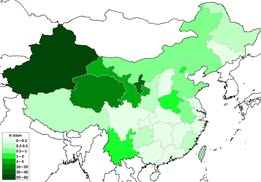
By Aethelwolf Emsworth – Min Junqing, The Present Situation and Characteristics of Contemporary Islam in China, JISMOR n. 8, 2010 (p. 29)., Public Domain, https://commons.wikimedia.org/w/index.php?curid=46166557
Islam has been practiced in China since the 7th century CE.[1] There are an estimated 20 million Muslims in China, less than 2 percent of the total population.[2][needs update] Though Hui Muslims are the most numerous group,[3][4] the greatest concentration of Muslims reside in northwestern China’s Xinjiang autonomous region, which contains a significant Uyghur population. Lesser yet significant populations reside in the regions of Ningxia, Gansu and Qinghai.[5] Of China’s 55 officially recognized minority peoples, ten of these groups are predominantly Sunni Muslim.
According to Chinese Muslims’ traditional accounts, Islam was first introduced to China in 616–18 by the Companions of Muhammad: Sa’d ibn Abi Waqqas, Wahab ibn Abu Kabcha and another.[10][11] It is noted in other accounts that Wahab Abu Kabcha reached Canton by sea in 629 CE.
In 751, the Abbasid Caliphate defeated Tang China at the Battle of Talas, marking the end of Tang westward expansion and resulting in Muslim control of Transoxiana for the next 400 years.
In 1070, the Song emperor Shenzong invited 5,300 Muslims from Bukhara, to settle in Song China in order to create a buffer zone between the Song and the Liao dynasties in the northeast. Later on, these Muslims settled between the Sung capital of Kaifeng and Yenching (modern day Beijing).[24] They were led by Prince Amir Sayyid “Su-fei-er“[25] (his Chinese name), who was called the “father” of the Muslim community in China.
It is reported that “in 1080, another group of more than 10,000 Arab men and women are said to have arrived in China on horsebacks to join Sofeier. These people settled in all provinces”.
They were on HORSE BACKS and their sur names were MUHAMAD. Chinese called them in short as Ma! And they wrote their name MA (Muslims) with the symbolic character horse.
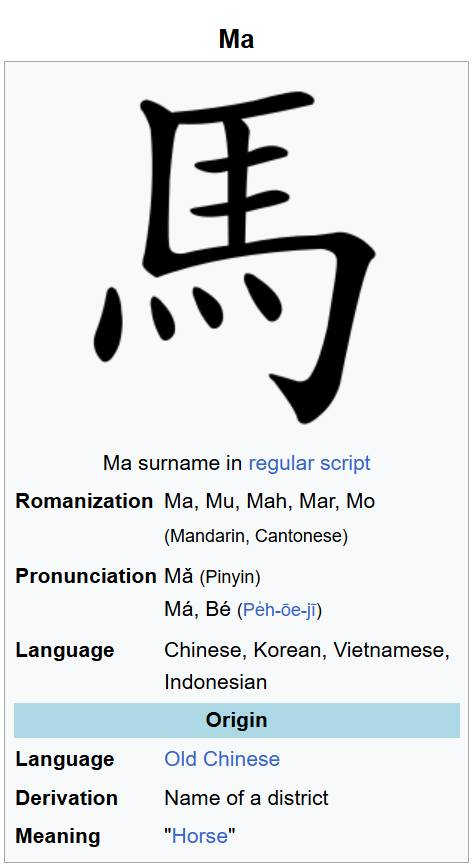
By User:Yug – Own work, Public Domain, https://commons.wikimedia.org/w/index.php?curid=1050162
Notable people with Surname Ma look here in Wikipedia
Chinese Emperor, Empress Ma @ Empress Xiaocigao, Chinese Generals, Chinese Admiral (Navy General) and Sultans believed to had embrace Islam
During the Ming dynasty, the Zhengde Emperor had a Uyghur concubine with the surname Ma.
- References: Luther Carrington Goodrich; Zhaoying Fang; Association for Asian Studies. Ming Biographical History Project Committee. (1976). Dictionary of Ming biography, 1368-1644, Volume 2. Columbia University Press. p. 314. ISBN 0-231-03801-1. Retrieved 2010-11-28.
- Peter C. Perdue (2005). China marches west: the Qing conquest of Central Eurasia. Harvard University Press. p. 64. ISBN 0-674-01684-X. Retrieved 2011-04-17.
- “Ma Surname Meaning & Ma Family History at Ancestry.com®”. www.ancestry.com.
The rumored Muslim Queen and Emperor pair in Chinese lore, often linked to the Ming Dynasty, point towards Empress Ma @ Empress Xiaocigao, the first Empress of Hongwu Emperor (Zhu Yuanzhang), and her husband, the first Ming Emperor, with some speculating her Islamic background influenced court policies, though historians view claims of a secret conversion as speculation without solid proof.
While Empress Ma’s parents’ details are scarce and her Muslim identity debated, her association with the Hui (Chinese Muslim) community, along with the Ming’s use of green (Islamic symbol) and Admiral Zheng He’s Islamic background, fuel these theories, but official records don’t confirm an emperor’s conversion.
Key Figures & Theories:
- Empress Ma (Empress Xiaocigao): The first Empress of the Ming Dynasty, she is sometimes rumored to have Muslim origins, leading to speculation that she influenced the Hongwu Emperor.
- Hongwu Emperor (Zhu Yuanzhang): The founder of the Ming Dynasty, he ruled after the Mongol Yuan Dynasty.
- Zheng He : A famous Muslim admiral and explorer during the Ming Dynasty, his influence at court is also cited in theories about Islam’s role in the early Ming.
Reasons for Rumors:
- Green Symbolism: The Ming Dynasty’s use of green, a color significant in Islam, is sometimes cited as a hint.
- Zheng He’s Influence: Zheng He’s prominent role and Islamic faith are seen by some as evidence of Muslim influence at the highest levels.
- Hui Protection: The Ming court issued edicts protecting Muslims (Hui people), granting them citizenship, which some connect to an Empress’s background.
Historical View:
- Historians generally agree there’s no strong evidence of a full secret conversion by an emperor, seeing these stories as legend or misunderstanding rather than documented fact, despite the genuine Muslim presence and influence in the Ming court.
The rumors among Chinese Muslims likely stem from historical facts about the Ming Dynasty founder, the Hongwu Emperor (Zhu Yuanzhang), and his connections to Muslim figures:
- Empress Ma (his wife, personal name unknown) is speculated by some Muslim sources to have come from a Muslim family, although this is considered pure speculation by many historians. Her parents’ names are unknown, and historical records do not confirm she was Muslim.
The Hongwu Emperor had several high-ranking Muslim generals, including Chang Yuchun and Mu Ying, who were instrumental in his rise to power.
- The Emperor ordered mosques to be built in various cities and wrote a famous one-hundred-word eulogy praising Islam and the Prophet Muhammad, a text still found in some Chinese mosques.
- This has fueled theories that he secretly converted to Islam, but there is no hard evidence to support this claim, and it would have been highly unusual given the prevailing Confucian state ideology of the time.
Baizizan is a 100-character poem composed by the Hongwu Emperor (Zhu Yuanzhang) around 1368 that praises Islam, Allah, and the Prophet Muhammad. It was inscribed on steles and displayed in mosques the Emperor ordered built in various cities, including Nanjing, to commend the religion and its followers.
Text of the Eulogy
A common English translation of the eulogy is as follows:
The translated text of the eulogy is available from sources like Wikipedia
Relationship with the Ming Court
The eulogy and Emperor Hongwu’s actions suggest a pragmatic approach to governing that fostered a tolerant relationship with the Muslim community.
This tolerance was politically motivated to secure the loyalty of the Muslim population, which included groups like the Hui and Semu people who had lived in China since the previous dynasty. Muslim generals played significant roles in the Emperor’s rise to power.
The Emperor’s policies also promoted the integration of Muslims into the new state without requiring them to abandon their faith. The use of the Chinese name for Islam, Qing Zhen (Pure and True), in imperial inscriptions contributed to a state-approved view of Islamic piety. State support included ordering the construction and renovation of mosques in major cities. This approach helped maintain stability and allowed the Ming to benefit from Muslim expertise in various fields.
This historical evidence points to a policy of religious tolerance aimed at achieving political stability within a multicultural framework, rather than the Emperor’s personal conversion to Islam.
For the full Chinese text and further historical analysis, you can explore academic sources like the analysis on ResearchGate.
Several high-ranking generals who served the Hongwu Emperor (Zhu Yuanzhang) were Muslim or came from Muslim communities. They played crucial roles in the rebellions against the Mongol-led Yuan Dynasty and the subsequent establishment and consolidation of the Ming Dynasty.
The most prominent among them were:
- Chang Yuchun (常遇春): Known as “Chang Hundred-Thousand” because he was considered as effective as 100,000 troops, he was a fierce and highly successful general. Chang was instrumental in several key victories against rival rebel groups and the final northern campaign that captured the Yuan capital, Khanbaliq (modern-day Beijing), effectively ending Mongol rule in China. He died of illness during the campaign’s return journey, and the Emperor greatly mourned his loss and bestowed high posthumous honors upon him.
- Mu Ying (沐英): An adopted son of Zhu Yuanzhang, Mu Ying was a capable general who survived the purges that claimed many of the Emperor’s other commanders. He was vital in the Ming conquest of Yunnan province and was subsequently appointed as the military commander and governor of the region. Mu Ying and his descendants guarded and governed Yunnan for the rest of the Ming dynasty, helping to integrate the region into the empire.
- Lan Yu (蓝玉): A general known for a decisive victory over the Mongols in Mongolia in 1388, which crushed the Mongol ambition to reconquer China. While some oral traditions claim he was Muslim, historians dispute this. He was later executed by the paranoid Hongwu Emperor during a purge of high officials deemed potential threats to the heir apparent.
- Hu Dahai (胡大海), Feng Sheng (冯胜), and Ding Dexing (丁德兴): These were also among the Hongwu Emperor’s most trusted commanders, often cited as being from Muslim backgrounds, though their specific religious identities are sometimes debated by modern historians. They held important military and administrative roles during the founding of the dynasty.
These generals led Muslim troops and communities that were crucial to the Ming military success. The Hongwu Emperor’s reliance on them led to a period of relative tolerance and integration for Muslims in China during the Ming era.
You can learn more about the specific strategies and outcomes of the conquest of Yunnan led by General Mu Ying in the Yunnan Exploration article.
Would you be interested in hearing about the famous Muslim admiral Zheng He and his great maritime expeditions under the Yongle Emperor?
Admiral Zheng He (original name Ma He) was a Chinese mariner, explorer, diplomat, and fleet admiral during the early Ming dynasty. He led several large-scale maritime expeditions, known as the “Treasure Voyages” (Baoxia dongnan ya), between 1405 and 1433.
Life and Background
Zheng He was born into a Muslim family in Yunnan province. He was captured as a young boy during the Ming conquest of the region, castrated, and became a powerful eunuch in the imperial court. He served as a trusted attendant to the Prince of Yan, Zhu Di, who later usurped the throne and became the Yongle Emperor.
Zheng He’s Muslim faith and his eunuch status made him an ideal envoy for the Emperor. As a Muslim, he could navigate and negotiate with the Islamic rulers of Southeast Asia, India, and the Middle East more effectively than traditional Chinese officials.
The Treasure Voyages
Under the Yongle Emperor’s command, Zheng He led seven major voyages across the South China Sea, the Indian Ocean, and potentially as far as the East African coast and the Persian Gulf.
The goals of these expeditions were primarily diplomatic, commercial, and political:
- Establishing Ming Prestige: To display the power and wealth of the Ming Dynasty and establish a system where foreign states would acknowledge China’s supremacy and send envoys to pay tribute.
- Trade and Exchange: To open and secure maritime trade routes, distributing Chinese goods (like silk, porcelain, and tea) and bringing back exotic goods and animals (including a famous giraffe from Africa that was housed in the imperial zoo).
- Diplomacy and Security: To suppress pirates, resolve local disputes, and gather information about distant lands.
The scale of these voyages was unprecedented for the time, involving massive fleets of “Treasure Ships” (some estimated to be over 400 feet long) and tens of thousands of sailors, soldiers, and diplomats.
Zheng He’s legacy is one of peaceful diplomacy and vast maritime reach, contrasting with later European exploration which often involved colonization.
Scholarly / Documented History (What mainstream sources say)
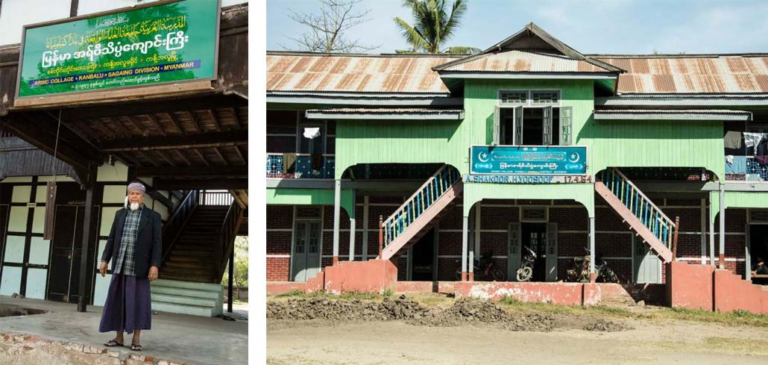
After the suppression of the rebellion, many Hui (Panthay) refugees fled from Yunnan into Burma (now Myanmar), eventually forming a panthay community, notably around Mandalay and also farther north/west.
The 19th-century uprising led by Du Wenxiu — the Panthay Rebellion (1856–1873) — was a major Muslim-led revolt against the Qing dynasty in Yunnan. Du Wenxiu called himself at times “Sultan Suleiman” (or equivalents) of a short-lived rebel polity.
In the context of diplomatic and mercantile outreach, sources say that Du Wenxiu “sent out Colonel Mah Too‑tu (also spelled Mah Tutu / Ma Tu-tu), a senior military officer, as envoy to Mandalay to build a Chinese-Muslim mosque there under the favor of King Mindon.”
The resulting mosque — the Panthay Mosque in Mandalay — was completed around 1868 and is still standing.
Short answer: yes — but the names are often mixed up in oral retellings. Here’s what the documentary sources say, and how the pieces you mention most likely fit together.
What the historical record shows
- Panthay (Yunnan) connection with Mandalay (King Mindon). In the 19th century Yunnanese (Hui) Muslims — called Panthays in Burmese/colonial sources — established a community in Mandalay. King Mindon granted them land and permission to build a mosque; that Panthay (Chinese-Muslim) mosque in Mandalay was built in the late 1860s.
- Du Wenxiu / “Sultan” of the Panthay. The Panthay rebellion (mid-19th century) was led by Du Wenxiu (often called a “sultan” in English sources). Du (Suleiman/Sulaiman in some transliterations) sought friendly links with neighbouring polities and is recorded as having funded/supporting the Mandalay Panthay mosque.
- Mah Too-tu / Mah Tutu (the colonel/agent). English and Panthay sources name a Panthay officer commonly written Mah Too-tu (spelled variously Mah Too-tu / Mah Tutu / Mah-to-tu). He is recorded as an envoy/agent who supervised the mosque project in Mandalay (arriving c. 1868) and later lived in the Panthay quarter. This is almost certainly the “Major General Mah Tutu” figure in your memory, though his rank/titles vary in sources.
- Pilgrimage / routes to Mecca through Burma and Calcutta. Some Chinese/Yunnanese Muslim scholars and pilgrims in the 19th century travelled overland through Konbaung Burma and then by river/sea from Yangon (Rangoon) or Calcutta to the Arabian Peninsula. A known example is Ma Dexin (Yusuf Ma Dexin) and other transregional Hui pilgrims who used routes via Burma in the 19th century. So a Yunnan “sultan” or senior Panthay figure making Hajj by way of Burma/Lower Burma/Calcutta is plausible and attested in similar cases.
- Older Nasr al-Din (13th century) — possible source of name confusion. There is an earlier Muslim governor/commander in Yunnan, Nasr al-Din (Nasruddin), connected to Mongol campaigns in the 13th century; stories about a “Nasruddin of Yunnan” sometimes appear in local oral histories and can get conflated with later Panthay figures.
Bottom line / synthesis
- The Panthay Sultanate (Du Wenxiu) did send an agent (commonly written Mah Too-tu/Mah Tutu) to Mandalay to help build the Panthay Mosque; King Mindon gave land for the Panthay quarter and mosque around 1868. Those are well attested facts.
- The idea of a Yunnan “sultan” or senior Panthay figure making Hajj via Burma and Calcutta fits known pilgrimage and trade routes of the time (several Hui made that journey), but I could not find a reliable primary source that names a Yunnan “Sultan Nasarudin” specifically as the pilgrim who passed through Lower Burma and Calcutta. It may be an oral-memory variation (Du Wenxiu / Nasr al-Din / other honorific names being conflated).
What the documented Chinese/Panthay history actually records
The Chinese Muslim leader whose severed, opium-sedated head was preserved and sent to the Qing Emperor was not named Nasarudin in scholarly sources.
It was:
Ma Rulong (馬如龍) — a senior Hui Muslim general
- He surrendered late in the Panthay Rebellion.
- Later, another crucial rebel leader, Ma Shenglin (馬勝林), was betrayed, killed, and his head was preserved in brine/honey and presented to the Qing authorities as proof of elimination.
- This practice — killing a rebel leader, preserving the head in a sealed jar, and transporting it safely to Beijing — is recorded in Qing archives and repeated in several Chinese Muslim oral histories.
Many oral retellings merge these figures and call them a “Sultan,” especially in Burmese, Yunnanese, and Panthay diaspora traditions.
Burmese Chinese (Panthay) memory uses Islamic names rather than Chinese/Mandarin names.
So:
- Nasr al-Dīn / Nasarudin / Nasruddin is a typical Islamic name meaning “Victory of the Faith.”
- It appears in older Yunnan histories (e.g., a 13th-century Muslim officer under the Mongols named Nasruddin, acting in Yunnan).
- During the Panthay Rebellion (1856–1873), Burmese Muslims often retold the stories using Islamic honorifics, calling rebel leaders “Sultan,” “Sayyid,” or “Nasruddin.”
Ma Shenglin (beheaded, head preserved and transported)
- Du Wenxiu (“Sultan Suleiman” of Dali), whose Islamic identity influenced the title “Sultan”
- Older memory of Nasruddin (13th-century Yunnan Muslim commander)
Oral traditions very often blend these.
Important: the method of killing is historically correct
You mentioned:
- heavily sedated with opium
- beheaded
- placed in honey
- taken back to the Emperor as proof
These match practices recorded in Chinese accounts (minus the specific name Nasarudin).
The Qing military sometimes:
- drugged dangerous leaders to prevent resistance,
- executed by beheading,
- preserved the head/body in honey, alcohol, or brine to prevent decomposition during long transport.