As there are a lot of Right wing Facist extremists around the whole world, Islamophobia, Antisemitism, Anti-Chinese, Anti-Asian, White suprimism especially against coloured people, ASIANS, Mexicans, Latin Americans etc.
Last night I was very sad or RATHER SCARE after watching this Hindi movie, while slow bicyclining infront of TV., New York (2009) is a Hindi-language thriller-drama available on Netflix that follows three friends whose lives are overturned by the post-9/11 fallout, I even wrote this on my FB..(dangerous) ICE/FBI officers, please watch this Netflix Bollywood movie, if U love USA. Peace be upon all of you, including ALL Americans. Even my Myanmar Muslim friend’s couple’s FB although I am scared but I just believed that just because of their son’s fight in school, arrestest as ‘terrorists’ by ICE/FBI. like this…
I am thinking about writing a short series of post starting from-
1/ A Balanced Path for Migrants and Host Societies
2/ Shared Ethical Teachings Across Religions
3/ Majority–Minority Relations
4/ Greetings and farewell words in different cultures often carry a similar prayer
5/ etc etc etc
So let’s start with the FIRST POST.
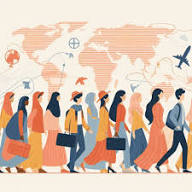
A Balanced Path for Migrants and Host Societies
Toward Peaceful Coexistence in a Troubled World
In today’s world, we see rising fears—extremism, racism, Islamophobia, antisemitism, and many forms of distrust. These fears affect both migrants and host communities. But fear should not guide policy or human relationships. Wisdom, justice, and compassion must.
1. Beyond Assimilation vs Separation
- Total assimilation asks migrants to erase their identity. This creates silent resentment and loss of dignity.
- Total separation leads to ghettos, misunderstanding, and suspicion.
- The better path is integration with dignity:
- Migrants respect the laws, language, and core values of the host nation.
- Host societies allow migrants to preserve culture, religion, and identity.
2. From Tolerance to Mutual Respect
Tolerance is not enough. It can feel like “putting up with” others.
What we need is mutual respect and understanding:
- See each other as human beings, not stereotypes.
- Encourage dialogue, not labeling.
- Replace suspicion with curiosity.
3. Shared Responsibilities
- Migrants should:
- Obey laws and contribute positively to society.
- Learn the language and engage with the community.
- Reject extremism in all forms.
- Host societies should:
- Ensure fairness and equal opportunities.
- Avoid collective blame or profiling.
- Recognize migrants’ contributions—economic, cultural, and social.
4. Justice is the Foundation of Peace
Fear grows when people feel unfairly treated.
- Fair law enforcement builds trust.
- Transparent systems reduce resentment.
- Justice must be seen and felt by all communities.
5. Humanizing Each Other
Films, media, and politics sometimes amplify fear.
But real life is different:
- Most migrants seek safety, dignity, and a better future.
- Most citizens want peace, stability, and security.
These goals are not in conflict—they are the same.
6. A Shared Future
Instead of “us vs them,” we must think:
We rise or fall together.
My Message
Peace is not built by fear, but by fairness.
Security is not achieved by suspicion, but by trust.
And unity is not created by force, but by understanding.
Peace be upon all—migrants and citizens alike.
Gist of the New York (2009 film) movie plot-
New York is a 2009 Indian Hindi-language drama film directed by Kabir Khan, written by Sandeep Shrivastava, and produced by Aditya Chopra under the banner of Yash Raj Films.[2] The film stars John Abraham, Katrina Kaif, Neil Nitin Mukesh, and Irrfan Khan. Set against the backdrop of post-9/11 America, the narrative follows three friends studying at the fictional New York State University whose lives are drastically altered in the aftermath of the September 11 attacks and the resulting socio-political fallout.

Sometime in 2008, Omar Aijaz, a young Indian man living in the United States, is arrested by the FBI after weapons are found in the trunk of a taxi registered to him. He is interrogated by Agent Roshan, a South Asian origin officer who has lived in the U.S. for two decades. Roshan suspects Omar’s involvement with Samir “Sam” Sheikh, a former college friend believed to be connected to terrorist activities. Omar, unaware of Sam’s current life, is pressured into cooperating with the FBI to spy on him.
The narrative shifts to a flashback from 1999, when Omar arrived in the U.S. to attend New York State University. There, he befriends Sam and Maya, a fellow student and counselor. The three form a close bond, though Omar secretly harbours feelings for Maya. Over time, Maya and Sam fall in love, prompting Omar to distance himself. Their lives are disrupted by the September 11 attacks.
Back to the present, Omar reconnects with Sam and Maya—now married with a son, Danyal—under the guise of rekindling old friendships, while secretly reporting to Roshan. He learns Maya is involved in civil rights activism, helping Sam’s employee and former detainee Zilgai cope with trauma from his post-9/11 arrest. Initially, Omar finds no incriminating evidence against Sam, but gradually uncovers deeper layers of Sam’s past. Sam had been detained at Guantánamo Bay for nine months due to circumstantial evidence and was tortured. Though later exonerated, the experience left him emotionally scarred and radicalised.
A turning point arrives when Zilgai, unable to reintegrate into society, kills a police officer and leads the police on a long chase ultimately ending in his death by suicide; in the aftermath, Sam appears to abandon his plans for a terrorist attack. However, Omar later discovers the plan is still active. He alerts Roshan, and in the final act, Sam is persuaded to surrender. As he complies, he is shot dead by FBI snipers. Maya, rushing to stop him, is also killed in stray crossfire.
The film concludes six months later with Omar adopting Danyal. Roshan, now recognised for his service, comforts Omar, explaining that while everyone believed they were doing the right thing, timing and choices shaped their fates. The story ends with a reflection on friendship, trauma, and the long-lasting consequences of 9/11.