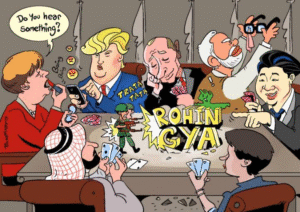
When U.S. lawmakers recently dissected the Myanmar crisis, one uncomfortable fact stood out: Beijing is the only major power benefitting from the bloodshed.
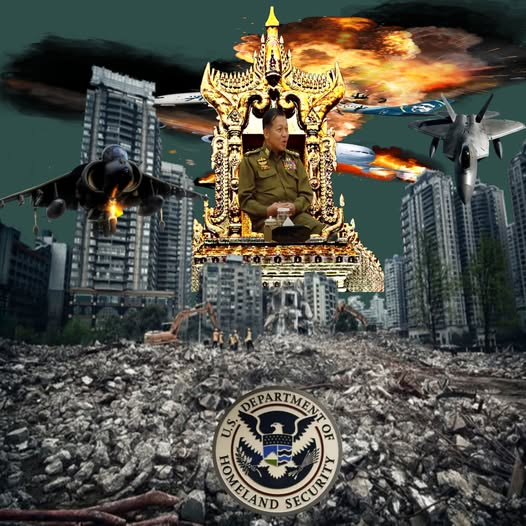
China doesn’t even like Min Aung Hlaing—yet it props him up because chaos gives Beijing a free hand to secure pipelines, ports, and a pliant satellite state on India’s doorstep.
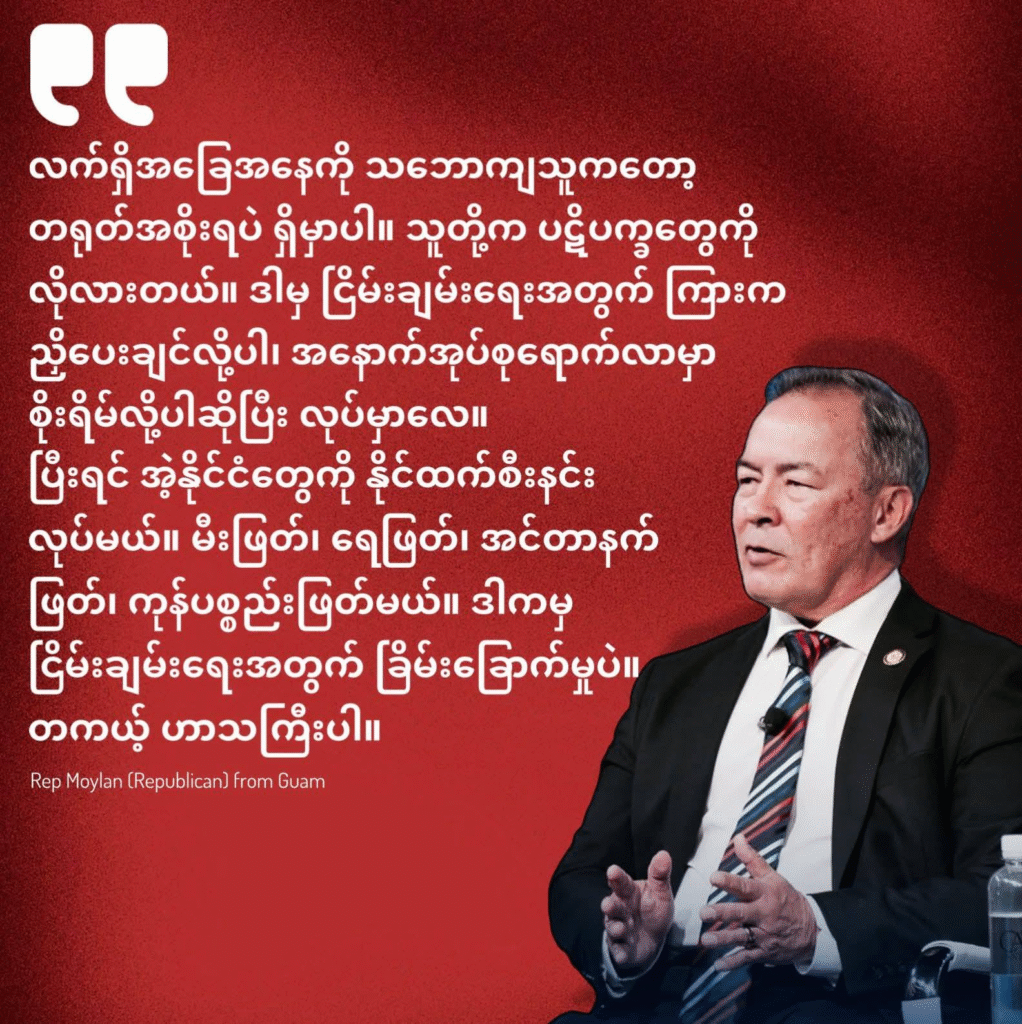
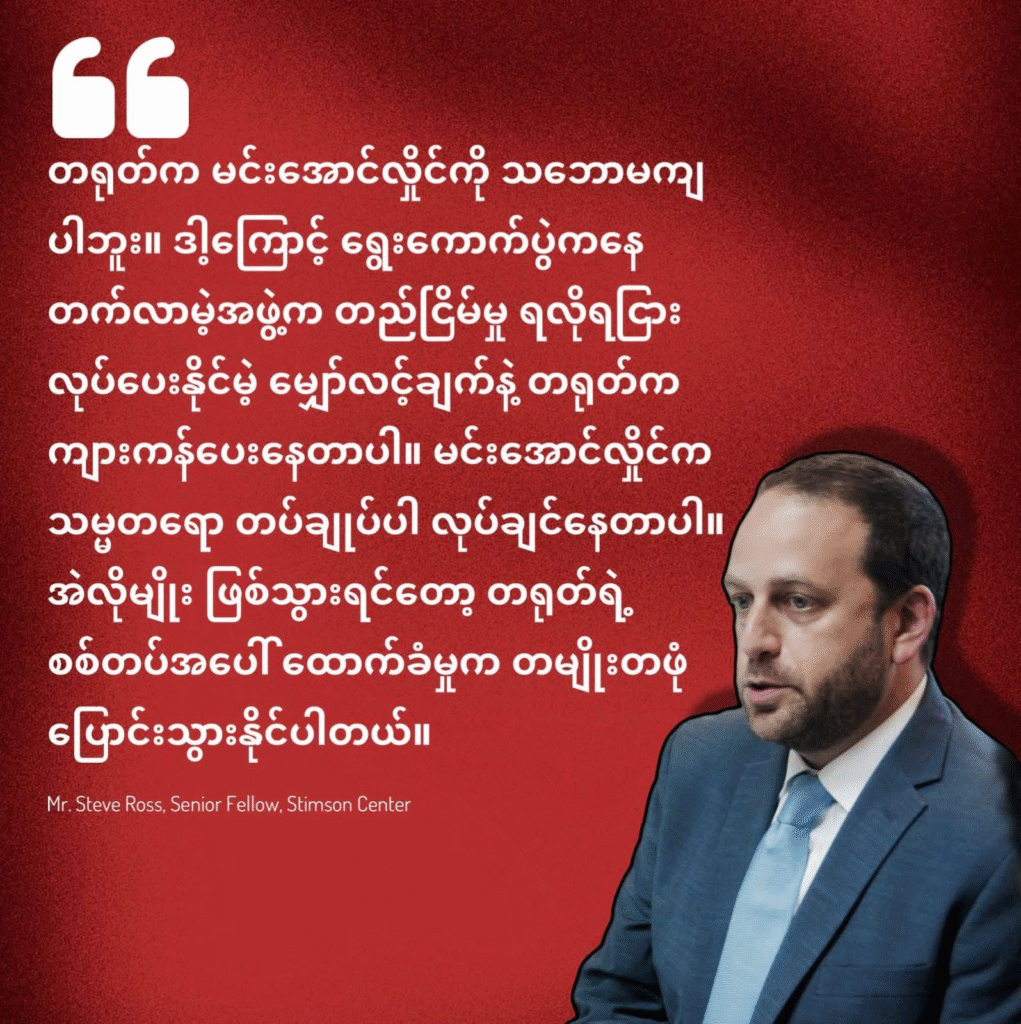
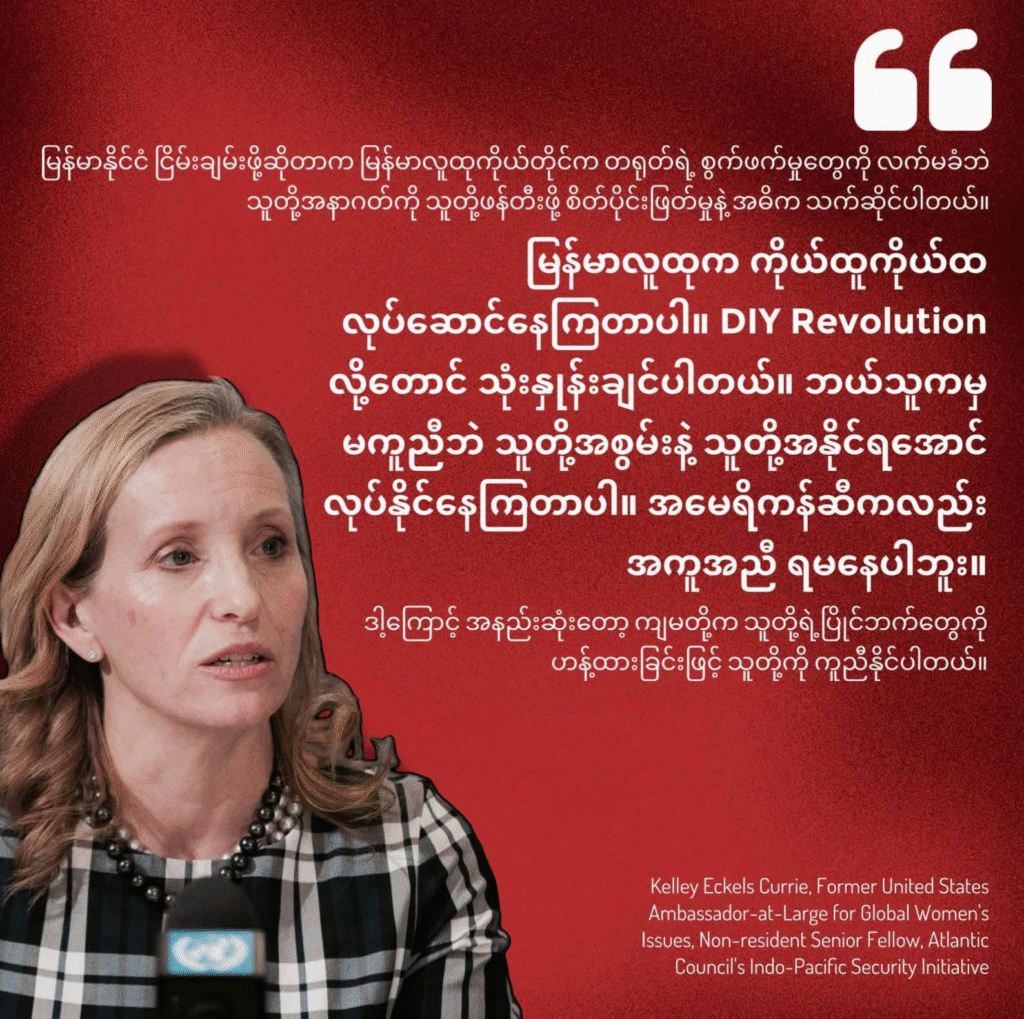
These posters credited to Wailin Aung and Naung Naung
The United Wa State Army, long treated as China’s loyal proxy, has now grown into one of the world’s most powerful narcotics syndicates. Yet Singapore shelters its leaders, Thailand hands out legal documents, and China integrates the Wa economy directly into Yunnan. U.S. experts openly call the UWSA “Asia’s Mexican cartel”—untouchable, violent, and indispensable to China’s geopolitical toolkit.
Meanwhile the Myanmar public, abandoned by nearly everyone, is carrying out what U.S. officials admiringly call a DIY Revolution—a self-funded, self-organized struggle against a foreign-backed dictatorship. Congress passed the BURMA Act, but its implementation remains toothless. Western allies hedge; Asian partners play both sides; and Beijing tightens its grip.
And Washington?
Washington is watching Myanmar burn from a very safe distance.
Why the Apathy? Trump’s America Has Other Wars—And Other Fears
If the Trump administration looks disinterested—or worse, clueless—there are reasons that go beyond ideology.
1. Exhausted coffers, overstretched war machine
Years of pouring money, weapons, and political capital into Gaza and Ukraine have drained U.S. attention and ammunition. Myanmar simply does not register as a priority when Washington’s military-industrial complex is already running hot.
2. PTSD from decades of disastrous wars
The U.S. still carries deep political trauma from Korea, Vietnam, Iraq, and Afghanistan.
Any scenario that risks confrontation with China—especially in China’s own backyard—triggers a bipartisan fear response:
“Not again. Not another long war with no clear victory.”
Myanmar is thus seen as a geopolitical minefield with huge risks and zero economic benefit. No oil, no strategic bases, no vote-winning headlines. Only moral responsibility—which Washington has never been good at carrying alone.
3. A cynical calculation: ignoring Myanmar is the easiest option
With no strategic dividends and high potential costs, Trump’s team seems to be choosing the simplest path:
pretend the Spring Revolution does not exist.
Pretend the Myanmar people are not suffering.
Pretend China is not constructing a client state right across the Bay of Bengal.
Convenient ignorance, wrapped in a “don’t care” attitude, is cheaper than real engagement.
China Understands Myanmar’s Value. Washington Does Not.
Beijing sees Myanmar as a golden corridor to the Indian Ocean—a shortcut for oil, gas, and military projection.
The U.S. sees it as a tragic inconvenience.
That difference in vision is why:
- Chinese security personnel now operate on Myanmar soil—an unprecedented humiliation in Myanmar’s history.
- The junta bends deeper toward Beijing out of weakness.
- The Wa grow richer.
- The conflict spreads.
- And the Myanmar people fight alone, with determination that should shame the world.
America’s Moral Test
The Spring Revolution is not just a domestic uprising.
It is a frontline battle between authoritarian expansion and democratic resistance.
If the U.S. believes in its own rhetoric about freedom and human rights, Myanmar is the real test—not slogans, not sanctions on paper, but meaningful strategic action that stops China’s silent conquest.
Because while Washington sleeps, Beijing builds.
And Myanmar bleeds.
China’s Shadow Over Myanmar: U.S. Lawmakers Reveal an Uncomfortable Truth
A recent U.S. Congressional discussion exposed a blunt consensus: Myanmar’s crisis is deepening because regional powers—especially China—are exploiting the chaos, while the Myanmar people fight alone with little real international support.
Lawmakers noted that Beijing does not trust Min Aung Hlaing, yet continues backing the junta to secure its own strategic assets—BRI corridors, the Kyaukphyu port, oil and gas pipelines, and influence over ethnic armed groups. The unprecedented presence of Chinese security personnel inside Myanmar shows how fragile and desperate the junta has become.
Speakers warned that the UWSA has grown into one of the world’s largest narcotics empires, shielded by China and enabled by Singaporean property loopholes and Thai legal documents. They urged secondary sanctions on countries that knowingly host UWSA assets.
Most strikingly, panelists praised the Myanmar people’s “DIY Revolution”—self-funded, self-armed, and self-organized—achieving battlefield gains without substantial U.S. support. While the BURMA Act remains poorly implemented, the U.S. can still help by blocking the junta’s foreign lifelines, especially China and India’s engagement.
The core message is clear:
Myanmar will not regain peace until its people reject Beijing’s interference, and until the international community closes the loopholes that empower the junta and its criminal proxies.
China does not like Min Aung Hlaing, even though it continues offering support to the Myanmar military.
The Myanmar public is relying on themselves to win. They are not receiving meaningful American support.
Singapore still allows UWSA leaders to live there and purchase property.
A question from the Q&A session between the U.S. Congressional Committee Chairs and invited speakers is highlighted here. This is not a full transcript—only selected extracts.
Rep. Moylan (Republican, Guam)
- In the current situation, the only actor who is satisfied is the Chinese government.
- Beijing prefers conflicts. It wants to appear as a peace mediator and fears Western involvement.
- Once Beijing gets the upper hand, it will pressure countries—cutting electricity, water, internet, and trade. This is “peace through coercion,” almost comedic.
- We must act through international cooperation.
- Both the Myanmar junta and UWSA have aligned themselves with China and ignored U.S. opportunities.
- We need to factor in their irresponsible behaviors.
- It is unlikely Myanmar can move from its current chaos to stability.
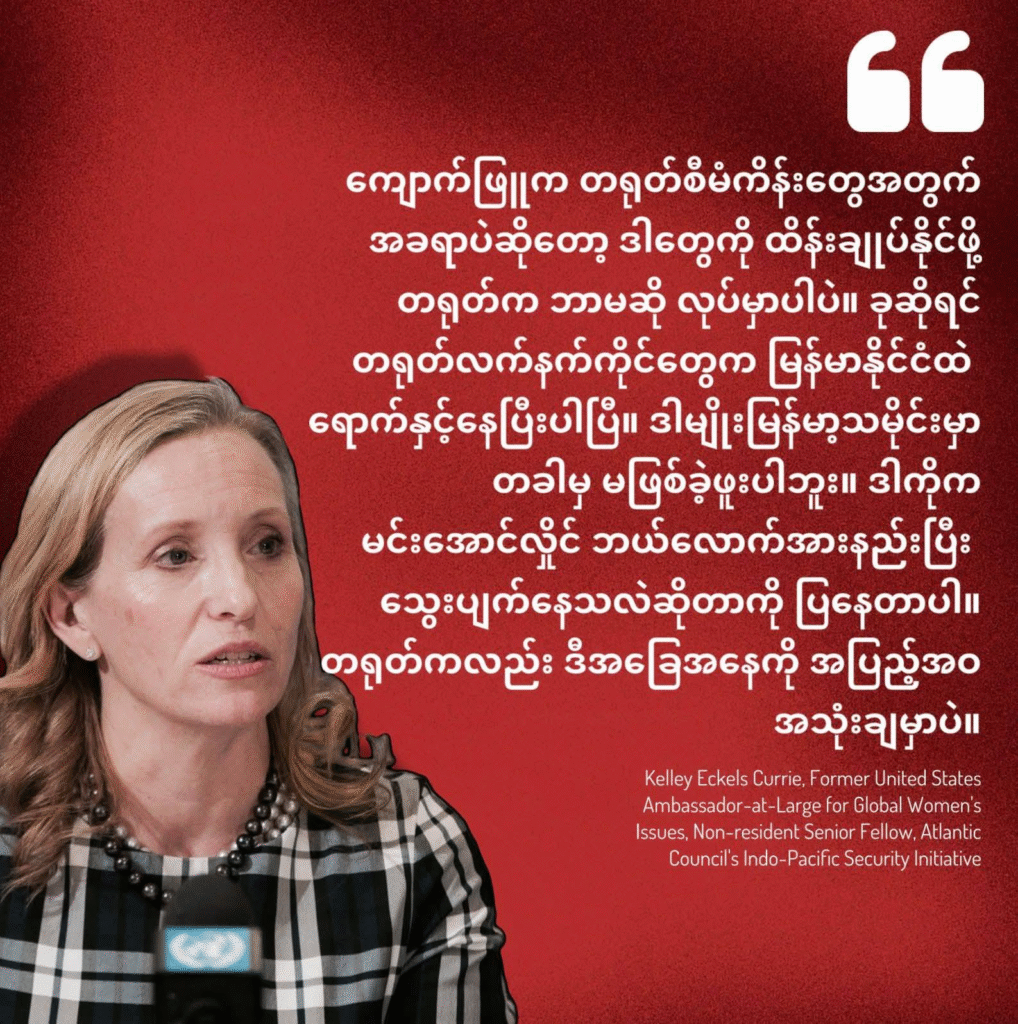
Kelley Eckels Currie
Former U.S. Ambassador-at-Large for Global Women’s Issues; Senior Fellow at Atlantic Council
- The U.S. sanctioned the UWSA for many years. Today they are stronger, richer, and more influential.
- Like in Ukraine, Beijing and the UWSA are powerful actors in the Myanmar conflict.
- UWSA is one of the world’s largest drug cartels. They threaten Asia the way Mexican cartels threaten the West.
- Singapore still accepts UWSA leaders and allows them to purchase property. Thailand continues giving them citizenship. China allows them to base their economic operations there.
- Countries enabling UWSA should face secondary sanctions.
- U.S. narcotics and treasury agencies must track UWSA assets more aggressively.
- Peace in Myanmar depends on the Myanmar people themselves rejecting Chinese interference.
- The people are carrying out a “DIY Revolution”—achieving battlefield successes without outside support.
- The U.S. cannot offer full support, but it can help by restraining the junta’s external backers.
Rep. Jayapal (Democrat, Washington)
Question:
Since China is supporting the junta, why should the U.S. engage more deeply in Myanmar?
Steve Ross, Senior Fellow, Stimson Center
- Since the coup, everyone expected U.S. action.
- Congress passed the BURMA Act, but implementation is still weak.
- China actually dislikes Min Aung Hlaing.
- Beijing supports him only because it expects a post-election government to restore stability.
- Min Aung Hlaing wants to be both President and Commander-in-Chief.
- If that happens, China’s support could significantly shift, depending on its interests.
Rep. Self (Republican, Texas)
Question:
Has Myanmar become a Chinese client state?
Projects such as BRI, Kyaukphyu port, and the China–Myanmar pipelines are strategically vital to Beijing.
Kelley Eckels Currie
- Kyaukphyu is critical to China’s strategic ambitions. Beijing will do anything to secure it.
- Chinese armed personnel are now inside Myanmar—something unprecedented in Myanmar’s history.
- This reflects how weak and desperate Min Aung Hlaing is.
- China will exploit this situation fully.
Rep. Self (Republican)
Question:
Since South Korean and Indian companies are involved in these projects, can U.S. pressure influence them?
Kelley Eckels Currie
- For Korea (POSCO), U.S. private diplomacy reduced post-2021 activities, but key support still continues.
- Regional allies also continue business with the junta.
- India tries to “play both sides” like China, but it does not have the leverage for such a game.
- The U.S. must push India to stop engaging directly with the junta.
FACT CHECK SUMMARY
Accurate / supported claims:
- China maintains relations with the junta but is uneasy with Min Aung Hlaing personally.
- UWSA is heavily involved in narcotics production and has long-standing cross-border ties.
- Singapore has been repeatedly accused of allowing UWSA-linked figures to buy property (widely cited in reports, though Singapore denies knowingly enabling illicit actors).
- Chinese military-linked individuals have been seen inside Myanmar related to BRI security—reported but sensitive.
- India and South Korea maintain limited economic ties with the junta.
Claims needing nuance:
- “Thailand gives citizenship to UWSA leaders” — There are cases of residency and ID cards, but full citizenship is not universally confirmed.
- “Chinese armed personnel inside Myanmar” — This refers to security contractors and intelligence presence, not formal PLA deployment.
Nothing in the content is fabricated; most reflects established expert perspectives.