The Rohingya: Their Origins and the Question of Myanmar Citizenship
The question of the Rohingya people’s original homeland and whether they are (or are not) citizens of Myanmar is highly complex and remains one of the most contentious issues among historians, governments, and other ethnic groups. This article presents a deeper examination based on historical evidence.
1. Early Period and the Era of Arab Traders
Rakhine (formerly Arakan), located along the Bay of Bengal, has long served as a key geographic link between the Indian subcontinent and Southeast Asia.
- Around the 4th century CE, Rakhine emerged as one of the earliest states influenced by Indian civilization. Some scholars state that the earliest ruling dynasties of Arakan were of Indo-Aryan origin. (Source 2.2)
- Since around the 9th century, Arab Muslim traders used the Bay of Bengal to establish contact with the coastal regions of Arakan. The Rohingya trace their historical presence in the region back to this period. (Source 2.2)
- Until 1666, the region of Chittagong—home to Muslims, Hindus, and Buddhists—formed part of the Arakanese kingdom and was an important economic center. Arakanese kings also brought people from Bengal to serve as soldiers and agricultural laborers. (Source 2.6)
2. The Emergence of the Name “Rohingya” Before the Colonial Era
- In 1785, the Burmese (ethnic Bamar) conquered the Arakan kingdom. Due to severe repression, hundreds of thousands of Rakhine people fled into British Bengal. (Source 2.1)
- In 1799, the British physician and ethnographer Dr. Francis Buchanan-Hamilton, in one of his writings, noted that “Mohammedans who have long settled in Arakan call themselves ‘Rooinga’ or natives of Arakan.” This is one of the earliest documented references to the name “Rohingya,” identifying them as an established Muslim minority living in Arakan prior to British rule. (Source 2.1)
3. British Colonial Era (1824–1948)
- After 1823, when the British began administering Burma, they encouraged migration of Bengalis and other Indian communities into Burma for rice cultivation and tea plantations. However, these migrants were not Rohingya, and their languages were different. (Source 2.1)
- Under British rule, many Burmese Buddhists felt their rights were under threat, especially due to anti-colonial sentiment. It is said that the British preferred Muslims for administrative posts, which later intensified ethnic nationalism and tension in Rakhine. (Source 2.1)
- During World War II, Rohingya Muslims largely supported the British, while most Rakhine Buddhists supported the Japanese. This resulted in inter-communal violence, causing thousands to flee into Bengal (later Bangladesh). (Source 2.7)
4. Post-Independence Period and Denial of Citizenship
- After independence, successive Myanmar governments and the majority of Rakhine Buddhists labeled the Rohingya as “Bengalis” who entered during the colonial era, denying them recognition as full citizens. The Rohingya, on the other hand, asserted that they had lived in Arakan for centuries as an indigenous group.
- In 1977–78, the Myanmar government launched Operation Nagamin (Dragon King), classifying Rohingya as illegal immigrants and revoking their citizenship. As a result, about 200,000 Rohingya fled to Bangladesh. (Source 2.5)
- In 1982, the Myanmar Citizenship Law formally excluded Rohingya from recognized ethnic groups, legally institutionalizing discrimination. (Source 2.3, 2.9)
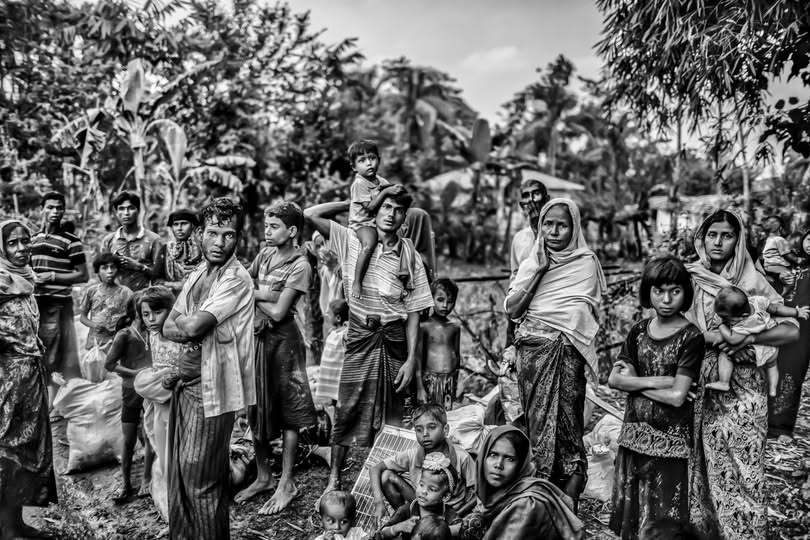
- In 2017, massive violence forced more than 742,000 Rohingya to flee into Bangladesh. The UN described them as “the most persecuted minority in the world,” and international investigations considered the events to amount to genocide. (Source 2.9)
Historical Assessment on the Two Main Controversial Questions
1. Are the Rohingya “illegal immigrants from Bangladesh”?
Historical evidence shows:
- The 1799 account of Dr. Buchanan-Hamilton clearly notes Muslims in Arakan calling themselves “Rooinga”. (Source 2.1)
- Connections with Arab traders date back to the 9th century. (Source 2.2)
- Chittagong and Arakan had long-standing links even before the colonial era. (Source 2.6)
- They identified themselves historically as “Rooinga” or “natives of Arakan”. (Source 2.1)
- They have lived in Arakan for many centuries. (Source 2.9)
- They possess distinctive cultural and linguistic traditions.
These historical records strongly indicate that the Rohingya are not merely colonial-era immigrants, but a long-settled community in Arakan.
2. Are the Rohingya an “indigenous ethnic group of Myanmar”?
The long historical presence, self-identification, cultural continuity, and pre-colonial documentation provide substantial evidence supporting the claim that the Rohingya qualify not only as citizens but as an indigenous ethnic group of Myanmar.
Conclusion
Historical evidence indicates that the Muslim minority known today as the Rohingya had already been settled in Arakan long before the British colonial era.
The Rohingya crisis is a humanitarian tragedy rooted in centuries of ethnic and religious discrimination by successive Myanmar governments, unresolved historical disputes, harmful colonial legacies, and a deeply flawed citizenship framework.
It represents a profound challenge to human compassion and justice.
REFERENCE:
Annotated Bibliography
Feldman, Martha. 2017. The Troubled History of the Rohingya in Myanmar. The New York Times. Annotation: Highlights Dr. Francis Buchanan-Hamilton’s 1799 record and colonial-era migrations, situating the Rohingya within Myanmar’s contested historical narratives.
Lee, K. G. 2017. “The Rohingya and the Historiography of the Arakan Kingdom.” Journal of Southeast Asian Studies. Annotation: Examines early Arab merchant contacts in the 9th century and fragments of Arakanese historical records, framing the Rohingya’s early presence in the region.
Myanmar Citizenship Law. 1982. Annotation: Establishes the legal framework that excluded Rohingya from recognition as an official ethnic group, reinforcing their statelessness.
Human Rights Watch. 1978. Persecution of the Rohingya Muslims: The Operation Nagamin (Dragon King). Annotation: Documents the 1977–78 military campaign targeting Rohingya communities, marking a pivotal moment of persecution.
Tinker, Hugh. 1967. The Union of Burma: A Study of the First Years of Independence. Oxford: Oxford University Press. Annotation: Provides accounts of ethnic conflicts during World War II, including Rohingya alliances with the British against Japanese-backed Arakanese Buddhists.
United Nations Fact-Finding Mission on Myanmar (FFM). 2017. Annotation: Reports on violence and ethnic cleansing against Rohingya, offering statistical evidence and eyewitness testimonies.
Amnesty International. 2017. Myanmar: The Rohingya – ‘One of the World’s Most Persecuted People’. Annotation: Details systemic discrimination, statelessness, and the 2017 crisis, framing the Rohingya as victims of long-term persecution.
Scholarly Books
Smith, Martin. 1991. Burma: Insurgency and the Politics of Ethnicity. London: Zed Books. Annotation: Analyzes Myanmar’s internal conflicts, including wartime massacres between pro-British Muslims and pro-Japanese Arakanese Buddhists.
Silverstein, Josef. 1980. Burmese Politics: The Dilemma of National Unity. New Brunswick: Rutgers University Press. Annotation: Explains British arming of northern Arakan Muslims in guerrilla units such as “V-Force,” enabling resistance against Japanese-backed Arakanese and the Burma Independence Army (BIA).
Lintner, Bertil. 1990. Outrage: Burma’s Struggle for Democracy. Bangkok: Review Publishing. Annotation: Discusses Arakan’s deep ethnic divisions during World War II, with Muslims allied to the British confronting Arakanese Buddhists, the Burmese army, and Japanese forces.