The coup d’état and subsequent massacre at Mandalay Palace was a notorious event within the Konbaung dynasty of Burma (Myanmar) that occurred in February 1879. It was orchestrated to secure the succession of King Thibaw Min, the last Burmese monarch.
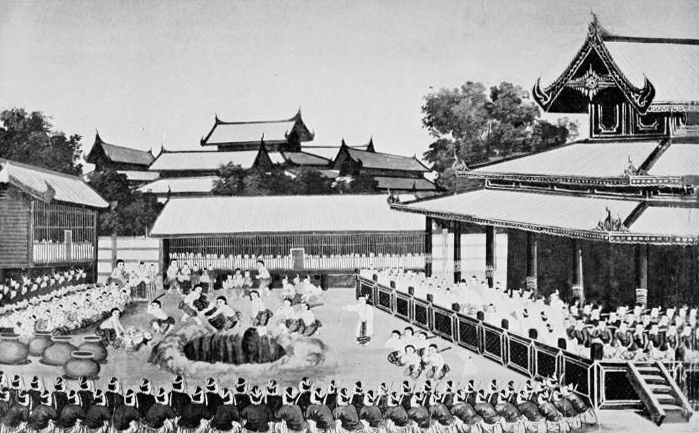
By Saya Chone (1866–1917) – This image has been extracted from another file, Public Domain, https://commons.wikimedia.org/w/index.php?curid=61476774
King Mindon was somewhat like the Sr Gen Than Shwe and Queen Hsinbyumashin wasrepresented by Daw Kyaing Kyaing.
Present Junta, The National Security and Peace Commission members are like Kinwun Mingyi and Taingda Mingyi.
1885 i.e. 6 yrs later became colony of British. At that time Rakhine, Tanintharyi and Lower Burma already under British.
Now 6 yr after 2021, could become China’s colony. Now partly Was, Kokant, EROs and Ethnic rebels, Palaung under China.
Nyaungyan bros escaped with the help of British and now NUG and others are safe in US, Thai etc.
Only about Killed about 40-80 princes and princesses massacred and there was a later follow up massacre few yrs after that about 400 royals.
Since the February 1, 2021 coup led by Senior General Min Aung Hlaing, the Myanmar military has arrested more than 28,051 people and killed at least 6,087 civilians, according to statistics from the Assistance Association for Political Prisoners (AAPP) as of December 31, 2024.
Deaths and Casualties
- Civilians and revolutionaries killed: As of late 2024, the AAPP has verified the killing of at least 6,087 civilians. Other reports have estimated a higher total death toll, including combatants in the civil war, with some sources citing over 50,000 deaths by early 2024.
- Extrajudicial killings and torture: Human rights organizations have documented widespread arbitrary arrests, extrajudicial killings, and torture in detention facilities, including cases where victims were burned alive.
- Executions: In July 2022, the junta carried out its first judicial executions in decades, executing four pro-democracy activists.
These figures primarily represent documented cases, and the actual numbers are believed to be higher due to the difficulty of monitoring the situation amid conflict and information blackouts. For the most up-to-date figures, one can refer to the daily updates provided by the AAPP
2021 Min Aung Hlaing Coup
- Background: Myanmar had been transitioning towards democracy after decades of military rule, with the National League for Democracy (NLD) winning a landslide victory in the 2020 elections. However, the military, led by Min Aung Hlaing, contested the election results, alleging widespread fraud.
- The Coup: On February 1, 2021, the military seized power, detaining key NLD leaders, including Aung San Suu Kyi. The coup was met with immediate backlash from the populace, leading to widespread protests and civil disobedience movements across the country.
- Casualties: The military’s response was brutal, with reports indicating that over 10,000 people were arrested, including political leaders, activists, and journalists. Human Rights groups estimate that thousands of civilians have been killed, with many others facing torture and disappearances.
- Aftermath: The coup has led to an ongoing civil war, with various ethnic armed groups and newly formed resistance forces (such as the People’s Defense Force) fighting against the military regime. The international community has largely condemned the coup, with sanctions imposed on military leaders and calls for restoration of democracy.
Background and Events of coup d’état and subsequent massacre at 1879 Mandalay Palace
The events followed the death of King Mindon Min in 1878. A prior palace coup attempt in 1866, during which the designated crown prince, Prince Kanaung, was murdered, made King Mindon reluctant to name an heir apparent, leading to a succession crisis. Taking advantage of this, Queen Dowager Hsinbyumashin and her co-conspirators maneuvered her son-in-law, Prince Thibaw, onto the throne.
The massacre itself occurred in phases between February 13 and 17, 1879. Over 40 princes, princesses, and other members of the royal family who were potential rivals to the throne were systematically eliminated. The killings were carried out by royal bodyguards and ministers.
The Massacre Details
- Method: To avoid the spilling of royal blood on the ground (a serious violation of royal custom), many victims were killed by having their throats crushed with bamboo poles, while others were killed with swords.
- Burial: The bodies were enclosed in red velvet bags, interred in a large pit, and elephants were used to trample the ground to conceal the burial site.
- Perpetrators: The main perpetrators included Queen Dowager Hsinbyumashin, U Kaung Taingda Mingyi, Hlethin Atwinwun, and Maung Maung Toke.
- King Thibaw’s Role: According to historical accounts, King Thibaw and his principal Queen, Supayalat, were initially unaware of the extent of the killings, reportedly watching a court performance at the time. King Thibaw later expressed deep upset and ordered the executioners punished, but Queen Supayalat and her mother, Laungshe Mibaya, successfully appealed for their lives.
Aftermath
The massacre consolidated King Thibaw’s power and established him and Queen Supayalat as the undisputed rulers. The British government sent a formal letter of protest, warning of consequences if the executions continued, but Burmese officials responded that it was a purely internal affair. The event further damaged the kingdom’s international standing and contributed to the circumstances that would lead to the Third Anglo-Burmese War and the eventual annexation of Burma by the British in 1885, ending the Konbaung dynasty.
Colonial Implications
- 1879 to 1885: The aftermath of the 1879 coup directly led to British colonization, resulting in significant changes to Myanmar’s governance, economy, and social structures. The loss of sovereignty marked a traumatic chapter in the nation’s history.
- 2021 and Beyond: The potential for Myanmar to become a satellite state of China raises concerns about neo-colonialism. Regions like Wa, Kokang, and others are increasingly influenced by Chinese interests, complicating the country’s sovereignty and future political landscape.
Conclusion
The 1879 Mandalay Royal Palace coup and the 2021 Min Aung Hlaing coup, while separated by over a century, share significant similarities in the patterns of violence, power struggles, and the resulting impact on Myanmar’s sovereignty. As Myanmar navigates this turbulent period, the outcomes of these coups will resonate in its ongoing quest for democracy, national identity, and independence from foreign dominance.
Read also:
1879 massacre at Mandalay Palace
မြန်မာပြည်မြောက်ပိုင်းရောက် မင်းသားရဲ့ တော်လှန်ရေး
Khin Khin Lay, Dagon (2003). Introduction and Conclusion of Yadanabon (ရတနာပုံ၏နိဒါန်းနှင့်နိဂုံး).
“Massacre at Mandalay Palace”. Nation Thailand. 5 August 2013.
Htet, Kaung (August 2004). “စုဖုရားလတ်ရှင်းတမ်းနှင့် ပါတော်မူဖြစ်ရပ်များ” [Discourse on Supayalat and the events of the Fall of Mandalay].