Ko Ko Gyi of the People’s Party recently remarked that in Myanmar politics, opposition parties have only ever come to power through elections — apparently referring to the NLD government from 2015 to 2020.
But it seems he has not thought this through carefully.
In the Wa region, the UWSA (United Wa State Army) has exercised absolute control since April 17, 1989 — that’s over 36 years — without holding a single election. They rule as they please, not because of ballots, but because of their military might.
In Laukkai, the MNDAA (Myanmar National Democratic Alliance Army) governs its own territory. In Rakhine, the AA (Arakan Army) now effectively administers much of the state. Their authority also arose from military strength, not from elections.
In times of peace, under an impartial and legitimate government, elections can indeed be a fair means of determining power.
But today’s situation is far from that. When war criminals and coup perpetrators are the ones organizing elections — and no genuine opposition parties are allowed to compete — such elections merely serve to extend the military’s slave system and provide it with a political exit strategy.
In that grand performance, Ko Ko Gyi and his peers are merely playing minor supporting roles — extras, stage fillers, and facilitators.
If anyone claims that “power can only be achieved through elections,” the Wa and other ethnic armed groups would surely laugh.
The Myanmar military never bows to anyone except those who wield real armed strength.
If you wish to see whom the military truly respects among political figures and ethnic armed organization (EAO) leaders, just visit the hospital where Ko Ko Gyi, Zaw Min, Thet Thet Khine, and Pauk Yu Chan of the Wa National Unity Party are admitted together for a day.
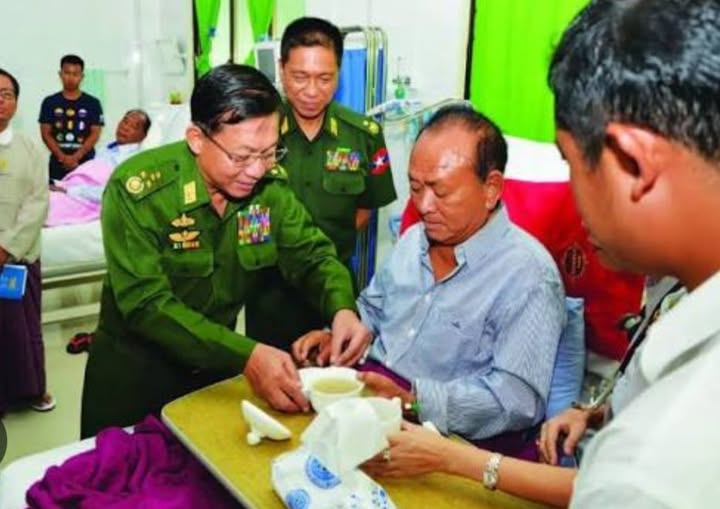
Then observe to whom Min Aung Hlaing sends his bird’s nests, rice porridge, and “get well soon” messages.
That alone answers not only Ko Ko Gyi’s question — “What do you want to become?” — but also a deeper one:
“What have you already become?”
Tharawon (Pyay)
10 November 2025