This is the English translation of FB post U Hla Soewai, who translated into Burmese from Economist’s What a leaked transcript reveals about China’s muscular statecraft”
China has begun to exert its strong political leverage in Myanmar, forcing its own agenda, according to a recent report.
It has been over four years since Myanmar faced a full-blown civil war following the military coup. Since then, hundreds of revolutionary groups have emerged to resist the military junta, sometimes clashing with each other, resulting in a complex and stagnant situation.
The West has largely avoided involvement in the issue. However, China, which shares a nearly 2,000-kilometer border with Myanmar, has taken a different approach. Chinese companies have invested billions of dollars in projects such as extracting rare earth minerals, and constructing pipelines to transport gas and oil from the Bay of Bengal to Yunnan. China aims to ensure the security and stability of these interests.
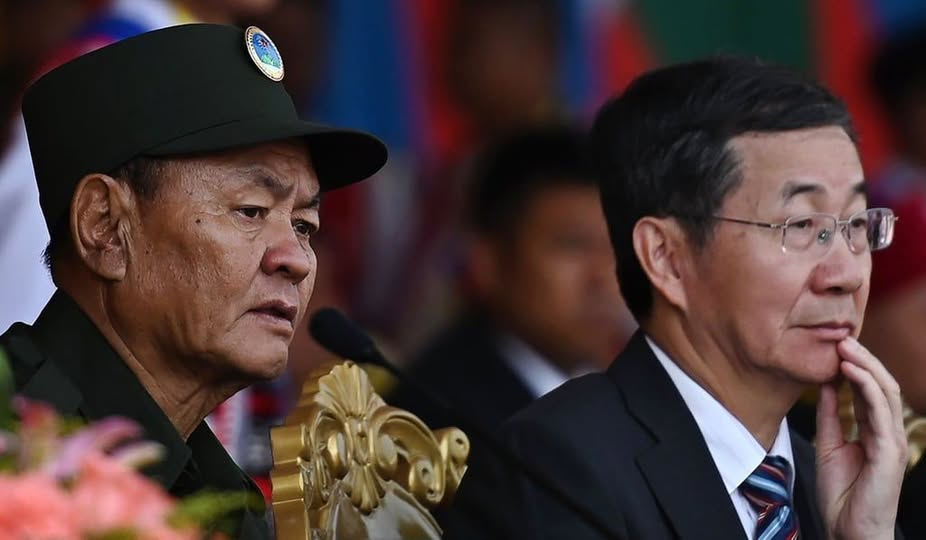
A recent meeting record obtained by The Economist sheds light on China’s efforts to exert influence over Myanmar. The record shows discussions between Chinese diplomats and the Wa State Army (UWSA), a powerful ethnic armed group. The Wa group reportedly shared the record with allied revolutionary forces.
Experts, including Jason Tower, a Myanmar-China expert, consider the record authentic. The Chinese Foreign Ministry and the Wa group have not commented on the matter, but it has been reported in Myanmar media.
The documents reveal China’s tough diplomatic stance. The meeting took place in August 2024, when ethnic revolutionary forces were making gains in northern Shan State under Operation 1027. China was alarmed by the developments and potential losses.
According to the record, Chinese special envoy Tian Rucheng told the Wa group to stop collaborating with the Myanmar National Democratic Alliance Army (MNDAA), calling them “two-faced” for allegedly pretending to cooperate while creating divisions. He warned that China would punish MNDAA for disrupting trade and accused them of working with pro-democracy groups backed by the US and the West to topple the military junta.
Tian Rucheng stated that China had imposed a “five cuts” blockade on MNDAA, restricting access to electricity, water, internet, and trade. He warned Wa leaders that continued support for MNDAA would invite similar consequences.
The record suggests China’s pressure tactics were effective. Shortly after Tian’s warning, MNDAA leader Peng Daring was detained while visiting China. MNDAA later signed a ceasefire with the military junta, and China praised both sides for reaching a positive outcome. MNDAA withdrew from some captured territories, including Laohsai.
Now, MNDAA focuses on developing its territory, offering permanent residency to Chinese investors in Laokai. The Wa group has announced it will no longer support MNDAA, fearing Chinese retaliation.
China’s actions demonstrate its prioritization of border stability and trade over who controls Myanmar’s territory. However, its involvement has altered the conflict’s trajectory without necessarily promoting lasting peace.
China’s demands for project implementation, security, and protection of its citizens have raised concerns about its disregard for Myanmar’s sovereignty. Junta leader Min Aung Hlaing has taken charge of implementing these projects.